00: Environment And Library Tour
Introduces DoubleML, orthogonal-score workflows, synthetic PLR examples, and the package objects used throughout the tutorial series.
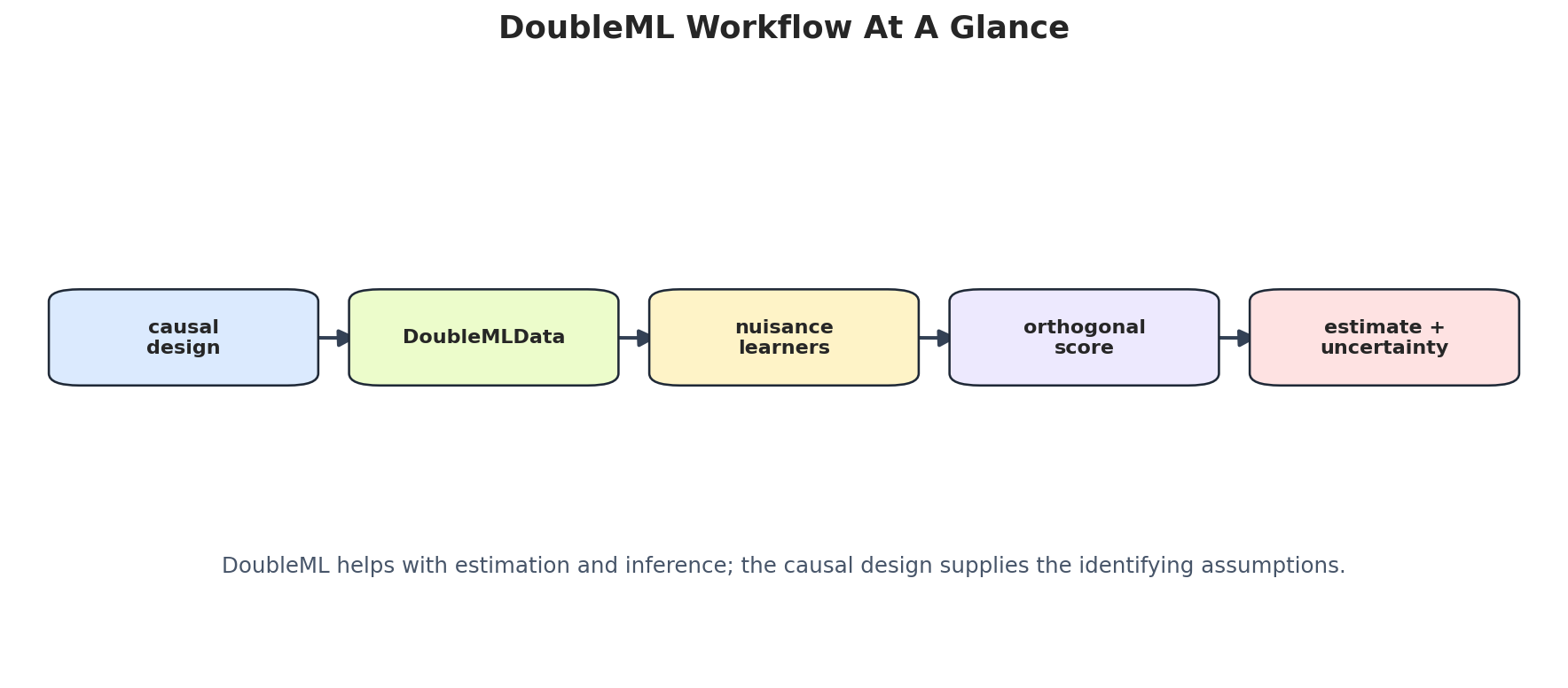
DoubleML is the tutorial track for orthogonal scores, sample splitting, flexible nuisance models, and transparent treatment-effect inference.
00: Environment And Library Tour
Introduces DoubleML, orthogonal-score workflows, synthetic PLR examples, and the package objects used throughout the tutorial series.
01: DML Theory, Orthogonalization, And Cross-Fitting
Builds the mathematical intuition for orthogonal scores and cross-fitting, then shows why nuisance-model errors should have limited first-order impact.
02: Data Backend, DoubleMLData, And Design Setup
Explains how to prepare treatment, outcome, controls, instruments, and sample-selection variables so the statistical design is visible before fitting models.
03: Partially Linear Regression PLR
Covers the PLR model for continuous outcomes and treatments, including residualization, nuisance prediction quality, score behavior, and repeated-split stability.
Adds instrumental variables to the partially linear setup, highlighting first-stage relevance, exclusion-risk stress tests, and residualized IV diagnostics.
05: Interactive Regression Model IRM
Introduces binary-treatment IRM estimation, propensity modeling, outcome nuisance functions, overlap diagnostics, and ATE interpretation.
Uses binary instruments and treatment take-up to estimate local causal effects, with attention to compliance, weak instruments, and exclusion violations.
07: Difference-In-Differences DID
Connects DoubleML to panel-style causal designs by combining DiD logic, nuisance adjustment, parallel-trend diagnostics, and treatment-effect estimation.
Studies missing or selectively observed outcomes, separating selection mechanisms from treatment effects and auditing positivity for observed samples.
09: Regression Discontinuity Design RDD
Frames sharp and fuzzy RDD as local causal designs, with running-score plots, bandwidth sensitivity, first-stage checks, and local effect interpretation.
10: Learners, Hyperparameters, And Tuning
Shows how learner choice and tuning affect nuisance quality, bias, and stability, with emphasis on tuning safely within the DML workflow.
11: Sample Splitting, Cross-Fitting, And Repeated Cross-Fitting
Explores fold construction, group-aware splitting, repeated cross-fitting, and why data reuse can quietly damage causal inference.
12: Inference, Bootstrap, And Confidence Bands
Moves from point estimates to uncertainty, covering confidence intervals, bootstrap distributions, simultaneous bands, multiple testing, and coverage diagnostics.
13: Sensitivity Analysis For Unobserved Confounding
Uses sensitivity bounds and benchmark scenarios to ask how strong unobserved confounding would need to be to change the substantive conclusion.
14: Heterogeneous Treatment Effects, GATE, CATE, And BLP
Introduces heterogeneous-effect summaries in DoubleML, including GATE, CATE, and best linear projection views for segment-level decision support.
15: Policy Learning, Weighted ATEs, Quantiles, And CVaR
Translates treatment-effect estimates into policy comparisons, weighted estimands, distributional targets, and downside-risk measures such as CVaR.
16: Custom Scores And Advanced API
Looks under the hood at custom scores, advanced API patterns, and how to extend DoubleML while preserving the statistical logic of the estimator.
17: Common Pitfalls, Diagnostics, And Reporting
Reviews leakage, weak overlap, poor nuisance fits, invalid splits, fragile inference, and reporting checks that make DML results defensible.
18: End-To-End DoubleML Case Study
Completes the series with a full applied workflow from design setup and nuisance modeling through estimates, diagnostics, sensitivity, and final communication.