About
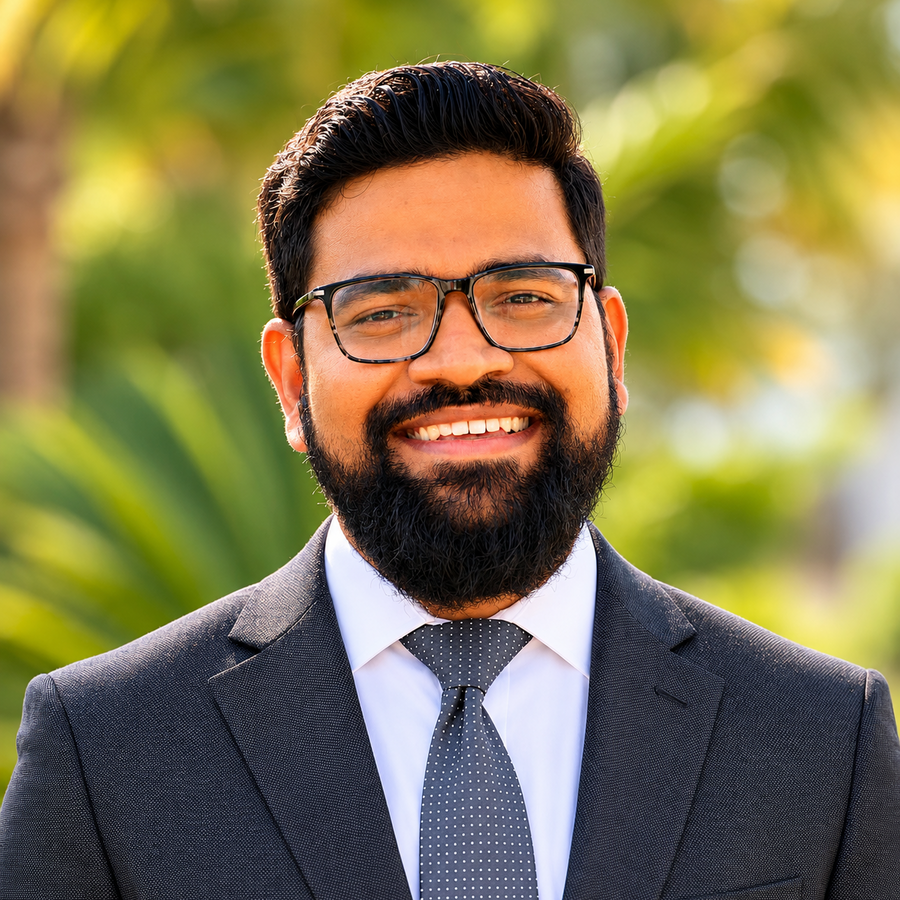
Prashant Shekhar, PhD
Business Data Science | Causal Inference | Experimentation | Statistical Decision Systems
Daytona Beach, FL
Contacts: Email, Google Scholar, GitHub, and LinkedIn
I am a tenure-track Assistant Professor of Data Science and Mathematics at Embry-Riddle Aeronautical University. Here I lead the Probability and Statistical Inference curriculum and research thrust in the MS in Data Science program, aimed at equipping future data scientists with mathematical sophistication and statistical and causal tools for decision-making. Before joining Embry-Riddle, I was a Data Scientist at Tufts University’s Data Intensive Studies Center, where I led and managed university-wide data science collaborations on topics ranging from healthcare to remote sensing.
Across my research, teaching, and other projects, the central theme has been decision quality. I study how scientists can define the right target, evaluate what the data can support, quantify uncertainty, inspect model behavior, and translate results into defensible recommendations. My research has been supported by funding agencies like Department of Transportation, among others.
Education
The State University of New York at Buffalo
PhD in Computational Data Science
MS in Mechanical Engineering
Aug 2014 - Aug 2019
Indian Institute of Technology, Kharagpur
Bachelors in Industrial and Systems Engineering
Sept 2010 - May 2014
Research Interests
My research interests sit at the intersection of causal inference, statistical learning, machine learning, and decision systems. I am especially interested in settings where the available data are useful, incomplete, and consequential, and where the final output has to guide an action with a clear account of uncertainty and risk.
Causal and Statistical Decision Systems
Much of my work starts from practical decisions in advertising, marketplaces, recommendations, ranking, pricing, pacing, and platform experiments. I study how analysts can define the right estimand, use logged or partially observed evidence responsibly, quantify uncertainty, handle interference and support limitations, and decide whether a result is ready for deployment, further validation, or redesign.
Research: support-aware off-policy evaluation, online experiment design, incrementality under signal loss, conformal uncertainty for pacing, interference and spillovers, long-term recommender effects, logged bandit evaluation, discovery quality mediation, ranking lift
Teaching: statistical inference, core causal inference, causal machine learning, industry applications, randomized experiments, quasi-experiments, DoWhy, EconML, DoubleML, causal-learn
Interpretable and Reliable Machine Learning
I am interested in machine-learning models that can be inspected, stress-tested, and explained in settings where decisions carry cost. This includes interpretable modeling, feature attribution, counterfactual explanations, surrogate modeling, multiscale bases, forecasting, uncertainty quantification, validation, reliability checks, and failure-mode analysis. The goal is to make model behavior understandable enough for scientific, engineering, and operational use.
Research: surrogate modeling, multiscale bases, forecasting and splines, aerosol machine learning
Teaching: interpretable ML and XAI, machine learning basics
Anomaly Detection and Handling
I treat anomaly detection as part of operational decision-making. In many settings, the hard part is deciding when a rare event, distribution shift, defect, or new class should trigger action. My work in this area spans biomedical flow-cytometry signals, manufacturing inspection, autonomous-vehicle segmentation, public data streams, and post-deployment handling of failure modes.
Research: biomedical flow-cytometry signals, manufacturing inspection, autonomous-vehicle segmentation
Teaching: anomaly detection for decision systems
Privacy, Security, and Robust AI Systems
Another thread in my work concerns AI systems that must operate under privacy, security, and robustness constraints. I study encrypted and selectively encrypted training, gradient leakage risk, RF fingerprinting, adversarial segmentation attacks, private incrementality measurement, and robust reporting when the available signal is degraded. I am interested in methods that make these systems usable while keeping the risks explicit.
Research: encrypted and selectively encrypted training, RF fingerprinting, adversarial segmentation attacks
Teaching: AI and machine learning