00: Environment And Library Tour
Sets up causal-learn, introduces the discovery workflow, and uses a small teaching DAG to connect graph structure with data and evaluation metrics.
causal-learn is the tutorial track for causal discovery: learning candidate graph structures while staying honest about assumptions, equivalence classes, hidden confounding, and stability.
00: Environment And Library Tour
Sets up causal-learn, introduces the discovery workflow, and uses a small teaching DAG to connect graph structure with data and evaluation metrics.
01: Graphs, DAGs, CPDAGs, PAGs, And Evaluation
Builds graph literacy for discovery work, including DAGs, equivalence classes, PAG edge marks, and metrics for missing, extra, or reversed edges.
02: Synthetic Data For Causal Discovery
Creates controlled simulation settings so discovery algorithms can be studied under known truth, hidden confounding, nonstationarity, and noisy mechanisms.
Explains the conditional-independence tests that drive constraint-based discovery, including Fisher-Z, discrete tests, conditioning sets, and sample-size sensitivity.
04: PC Algorithm For Continuous Data
Applies the PC algorithm to continuous data, showing how alpha choices, sample size, nonlinearity, and evaluation metrics affect the learned graph.
05: PC With Prior Knowledge, Missing Data, And Discrete Data
Shows how background knowledge, missingness strategies, and discrete variables change PC results and how constraints can help or mislead discovery.
06: FCI For Latent Confounders
Introduces FCI for settings with hidden common causes, comparing observed-variable PC results with PAG-style output that represents latent ambiguity.
07: CD-NOD For Nonstationary Data
Uses changing environments and distribution shifts to study CD-NOD, mechanism changes, pooled versus environment-aware discovery, and stability across regimes.
08: Score-Based Discovery With GES
Introduces score-based search with GES, BIC-style penalties, mechanism misspecification, and comparisons against constraint-based graph recovery.
09: Exact Search And Score Functions
Explores exact-search ideas and score functions, emphasizing why exhaustive graph search is informative for small problems but difficult to scale.
10: LiNGAM And Linear Non-Gaussian Models
Studies LiNGAM assumptions, non-Gaussian noise, coefficient recovery, residual independence, bootstrap edge stability, and threshold sensitivity.
11: Functional Causal Models: ANM And PNL
Introduces nonlinear functional causal model ideas through additive-noise and post-nonlinear reasoning, with pairwise direction tests and residual diagnostics.
12: Permutation-Based Methods: GRaSP And BOSS
Covers permutation-based search methods, including GRaSP and BOSS, while tracking runtime, depth choices, sample size, and seed stability.
13: Time-Series Causal Discovery
Moves discovery into temporal data, using lagged relationships, Granger-style structure, autocorrelation, threshold sensitivity, and temporal graph interpretation.
14: Hidden Representation Learning With GIN
Studies latent measurement structure and hidden representations, showing how indicator variables, cross-loadings, and noise affect graph recovery.
15: Benchmarking, Stability, And Sensitivity
Benchmarks multiple discovery methods under assumption stress, tuning changes, sample-size variation, and stability checks so graph claims are not overconfident.
16: End-To-End Causal Discovery Case Study
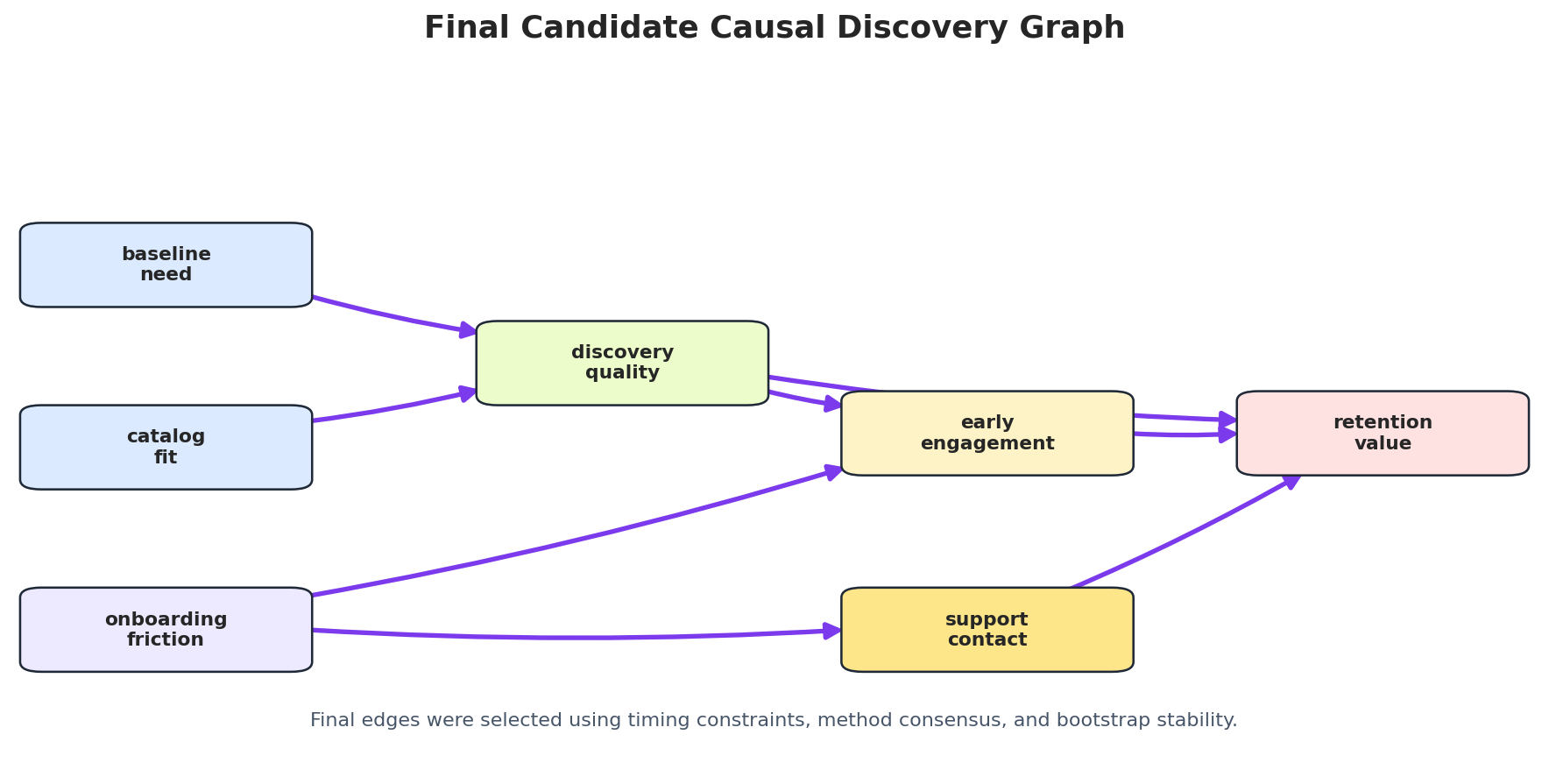
Assembles an applied discovery workflow: exploratory checks, candidate algorithms, constraints, edge stability, final graph selection, and cautious interpretation.
17: Common Pitfalls, Reporting, And Limitations
Closes with recurring failure modes such as equivalence, hidden confounding, selection bias, weak signals, temporal leakage, duplicate measurements, and reporting limitations.