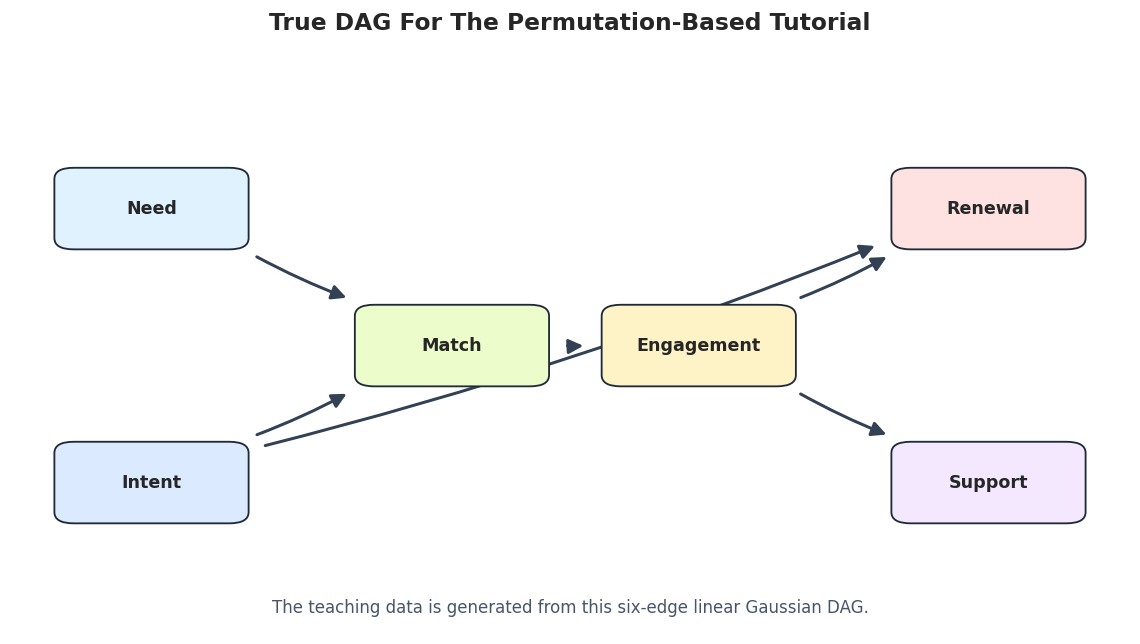
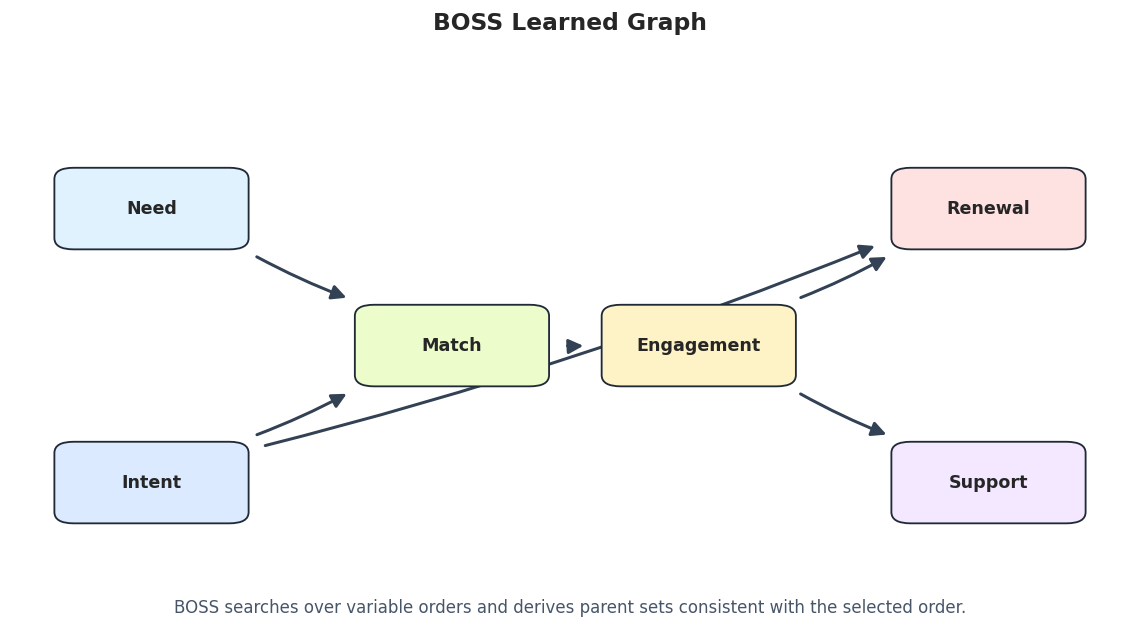
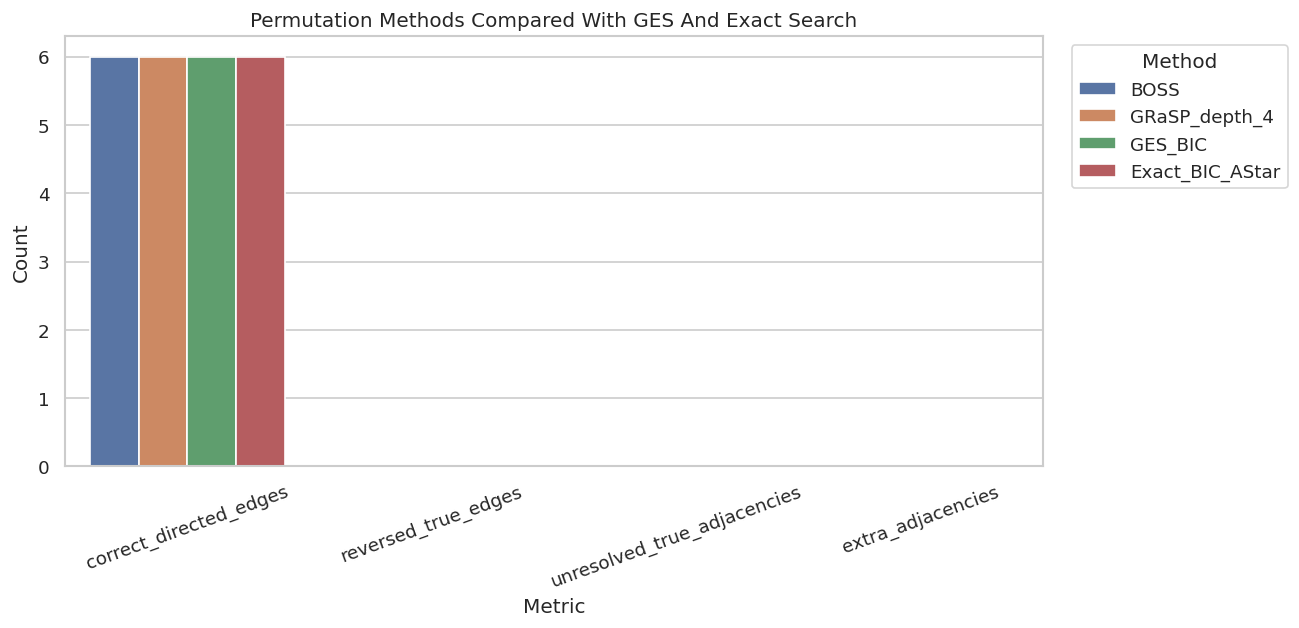
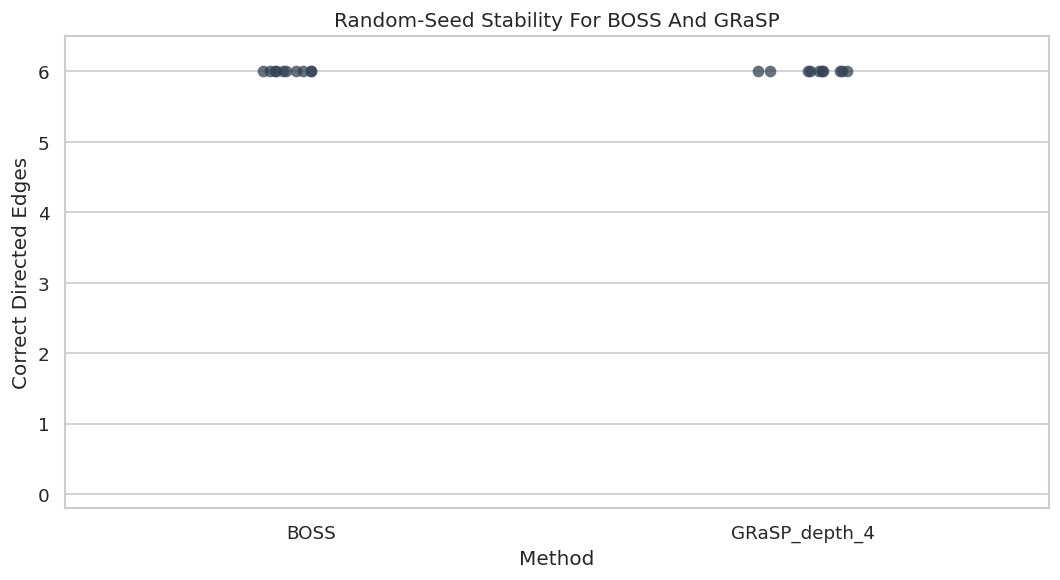
# Define reusable helpers for the Helper Functions section.
def parse_causallearn_edge(edge):
    """
    Convert a causal-learn edge object into source, endpoint pattern, and target strings.

    Parameters
    ----------
    edge : object
        Graph edge object or edge row being parsed, classified, or drawn.

    Returns
    -------
    tuple[str, str, str]
        Source node, endpoint mark, and target node parsed from a causal-learn edge.
    """
    parts = str(edge).strip().split()
    if len(parts) != 3:
        return {"source": str(edge), "edge_type": "unknown", "target": "unknown"}
    return {"source": parts[0], "edge_type": parts[1], "target": parts[2]}
def graph_to_edge_table(graph, label):
    """
    Return a tidy edge table from a causal-learn graph object.

    Parameters
    ----------
    graph : object
        Graph object returned by causal-learn or constructed from the edge table.
    label : str
        Readable label attached to the method, scenario, or output row.

    Returns
    -------
    pd.DataFrame
        Edge table with source, target, edge mark, and method metadata.
    """
    rows = [parse_causallearn_edge(edge) for edge in graph.get_graph_edges()]
    edge_df = pd.DataFrame(rows, columns=["source", "edge_type", "target"])
    if edge_df.empty:
        edge_df = pd.DataFrame(columns=["source", "edge_type", "target"])
    edge_df.insert(0, "run", label)
    return edge_df
def adjacency_to_edge_table(adjacency, variables, label):
    """
    Convert a parent-row, child-column adjacency matrix into a tidy directed edge table.

    Parameters
    ----------
    adjacency : object
        Adjacency matrix encoding candidate parent-child edges.
    variables : list[str]
        Variables included in the graph, lag frame, or diagnostic.
    label : str
        Readable label attached to the method, scenario, or output row.

    Returns
    -------
    pd.DataFrame
        Graph edge table for adjacency to edge table, including node names and edge-orientation information where available.
    """
    rows = []
    for parent_idx, child_idx in zip(*np.where(adjacency > 0)):
        rows.append(
            {
                "run": label,
                "source": variables[int(parent_idx)],
                "edge_type": "-->",
                "target": variables[int(child_idx)],
            }
        )
    return pd.DataFrame(rows, columns=["run", "source", "edge_type", "target"])
def directed_pairs(edge_df):
    """
    Extract definite directed pairs from an edge table.

    Parameters
    ----------
    edge_df : pd.DataFrame
        Learned or oracle edge table being summarized or drawn.

    Returns
    -------
    set[tuple[str, str]]
        Ordered source-target pairs representing directed learned edges.
    """
    pairs = set()
    for row in edge_df.itertuples(index=False):
        if row.edge_type == "-->":
            pairs.add((row.source, row.target))
        elif row.edge_type == "<--":
            pairs.add((row.target, row.source))
    return pairs
def skeleton_pairs(edge_df):
    """
    Extract adjacencies while ignoring direction.

    Parameters
    ----------
    edge_df : pd.DataFrame
        Learned or oracle edge table being summarized or drawn.

    Returns
    -------
    set[tuple[str, str]]
        Unordered node pairs representing the learned graph skeleton.
    """
    pairs = set()
    for row in edge_df.itertuples(index=False):
        if row.target != "unknown":
            pairs.add(frozenset([row.source, row.target]))
    return pairs
def summarize_against_truth(edge_df, truth_df, label):
    """
    Compute graph-recovery metrics against a directed truth table.

    Parameters
    ----------
    edge_df : pd.DataFrame
        Learned or oracle edge table being summarized or drawn.
    truth_df : pd.DataFrame
        Oracle edge table used as the synthetic ground-truth benchmark.
    label : str
        Readable label attached to the method, scenario, or output row.

    Returns
    -------
    pd.DataFrame
        Graph-recovery summary table with edge counts, precision, recall, missing edges, and extra edges.
    """
    true_directed = set(zip(truth_df["source"], truth_df["target"]))
    true_skeleton = {frozenset(edge) for edge in true_directed}
    learned_directed = directed_pairs(edge_df)
    learned_skeleton = skeleton_pairs(edge_df)
    correct_directed = learned_directed & true_directed
    reversed_true = {(src, dst) for src, dst in true_directed if (dst, src) in learned_directed}
    missing_skeleton = true_skeleton - learned_skeleton
    extra_skeleton = learned_skeleton - true_skeleton
    unresolved_true = 0
    for src, dst in true_directed:
        pair = frozenset([src, dst])
        if pair in learned_skeleton and (src, dst) not in learned_directed and (dst, src) not in learned_directed:
            unresolved_true += 1
    directed_count = len(learned_directed)
    return pd.DataFrame(
        [
            {
                "run": label,
                "learned_edges_total": len(edge_df),
                "definite_directed_edges": directed_count,
                "true_edges": len(true_directed),
                "correct_directed_edges": len(correct_directed),
                "directed_precision": len(correct_directed) / directed_count if directed_count else np.nan,
                "directed_recall": len(correct_directed) / len(true_directed) if true_directed else np.nan,
                "reversed_true_edges": len(reversed_true),
                "unresolved_true_adjacencies": unresolved_true,
                "missing_true_adjacencies": len(missing_skeleton),
                "extra_adjacencies": len(extra_skeleton),
            }
        ]
    )
def run_boss(data_df, label, seed=1, lambda_value=0.5):
    """
    Run BOSS with a controlled random seed.

    Parameters
    ----------
    data_df : pd.DataFrame
        Dataset for the current simulated or observed experiment.
    label : str
        Readable label attached to the method, scenario, or output row.
    seed : int
        Random seed for reproducible simulation or resampling.
    lambda_value : float
        Numeric value for `lambda`.

    Returns
    -------
    tuple
        Tuple containing graph, edge_table, elapsed.
    """
    random.seed(seed)
    np.random.seed(seed)
    start = time.perf_counter()
    buffer = io.StringIO()
    with contextlib.redirect_stdout(buffer):
        graph = boss(
            data_df.to_numpy(),
            score_func="local_score_BIC_from_cov",
            parameters={"lambda_value": lambda_value},
            verbose=False,
            node_names=list(data_df.columns),
        )
    elapsed = time.perf_counter() - start
    edge_table = graph_to_edge_table(graph, label=label)
    return graph, edge_table, elapsed
def run_grasp(data_df, label, seed=1, depth=4, lambda_value=0.5):
    """
    Run GRaSP with a controlled random seed and chosen depth.

    Parameters
    ----------
    data_df : pd.DataFrame
        Dataset for the current simulated or observed experiment.
    label : str
        Readable label attached to the method, scenario, or output row.
    seed : int
        Random seed for reproducible simulation or resampling.
    depth : int
        Maximum conditioning-set depth used by the discovery algorithm.
    lambda_value : float
        Numeric value for `lambda`.

    Returns
    -------
    tuple
        Tuple containing graph, edge_table, elapsed.
    """
    random.seed(seed)
    np.random.seed(seed)
    start = time.perf_counter()
    buffer = io.StringIO()
    with contextlib.redirect_stdout(buffer):
        graph = grasp(
            data_df.to_numpy(),
            score_func="local_score_BIC_from_cov",
            depth=depth,
            parameters={"lambda_value": lambda_value},
            verbose=False,
            node_names=list(data_df.columns),
        )
    elapsed = time.perf_counter() - start
    edge_table = graph_to_edge_table(graph, label=label)
    return graph, edge_table, elapsed
def run_ges_bic(data_df, label, lambda_value=0.5):
    """
    Run BIC-GES quietly for comparison.

    Parameters
    ----------
    data_df : pd.DataFrame
        Dataset for the current simulated or observed experiment.
    label : str
        Readable label attached to the method, scenario, or output row.
    lambda_value : float
        Numeric value for `lambda`.

    Returns
    -------
    tuple
        Tuple containing record, edge_table, elapsed.
    """
    start = time.perf_counter()
    buffer = io.StringIO()
    with contextlib.redirect_stdout(buffer):
        record = ges(
            data_df.to_numpy(),
            score_func="local_score_BIC",
            node_names=list(data_df.columns),
            lambda_value=lambda_value,
        )
    elapsed = time.perf_counter() - start
    edge_table = graph_to_edge_table(record["G"], label=label)
    return record, edge_table, elapsed
def run_exact_bic(data_df, label):
    """
    Run exact BIC search with A* for the small example graph.

    Parameters
    ----------
    data_df : pd.DataFrame
        Dataset for the current simulated or observed experiment.
    label : str
        Readable label attached to the method, scenario, or output row.

    Returns
    -------
    tuple
        Tuple containing adjacency, stats, edge_table, elapsed.
    """
    start = time.perf_counter()
    adjacency, stats = bic_exact_search(data_df.to_numpy(), search_method="astar", verbose=False)
    elapsed = time.perf_counter() - start
    edge_table = adjacency_to_edge_table(adjacency, list(data_df.columns), label=label)
    return adjacency, stats, edge_table, elapsed
def best_parent_sets_for_order(data_df, order, lambda_value=0.5, max_parents=None):
    """
    Exhaustively choose the best parent set for each node given a fixed order.

    Parameters
    ----------
    data_df : pd.DataFrame
        Dataset for the current simulated or observed experiment.
    order : object
        Variable ordering proposed by an order-based graph-search method.
    lambda_value : float
        Numeric value for `lambda`.
    max_parents : object
        Maximum number of candidate parents allowed in the graph search.

    Returns
    -------
    tuple
        Tuple containing parent_table, edge_table, total_score.
    """
    data = data_df.to_numpy()
    cov = np.cov(data.T, ddof=0)
    n = data.shape[0]
    index = {name: i for i, name in enumerate(data_df.columns)}
    rows = []
    edge_rows = []
    total_score = 0.0
    for position, child in enumerate(order):
        child_idx = index[child]
        candidate_parents = list(order[:position])
        parent_limit = len(candidate_parents) if max_parents is None else min(max_parents, len(candidate_parents))
        best_score = -np.inf
        best_parents = []
        for size in range(parent_limit + 1):
            for parent_names in itertools.combinations(candidate_parents, size):
                parent_indices = [index[name] for name in parent_names]
                score = local_score_BIC_from_cov((cov, n), child_idx, parent_indices, {"lambda_value": lambda_value})
                if score > best_score:
                    best_score = score
                    best_parents = list(parent_names)
        total_score += best_score
        rows.append(
            {
                "order_label": " -> ".join(order),
                "child": child,
                "position": position + 1,
                "allowed_parent_count": len(candidate_parents),
                "selected_parents": ", ".join(best_parents) if best_parents else "none",
                "local_score": best_score,
            }
        )
        for parent in best_parents:
            edge_rows.append({"run": "fixed_order", "source": parent, "edge_type": "-->", "target": child})
    parent_table = pd.DataFrame(rows)
    edge_table = pd.DataFrame(edge_rows, columns=["run", "source", "edge_type", "target"])
    return parent_table, edge_table, total_score
GRAPH_POSITIONS = {
    "need": (0.11, 0.72),
    "intent": (0.11, 0.28),
    "match": (0.39, 0.50),
    "engagement": (0.62, 0.50),
    "renewal": (0.89, 0.72),
    "support": (0.89, 0.28),
}
NODE_LABELS = {name: name.title() for name in GRAPH_POSITIONS}
NODE_COLORS = {
    "need": "#e0f2fe",
    "intent": "#dbeafe",
    "match": "#ecfccb",
    "engagement": "#fef3c7",
    "renewal": "#fee2e2",
    "support": "#f3e8ff",
}
def trim_edge_to_box(start, end, box_w=0.145, box_h=0.095, gap=0.012):
    """
    Return edge endpoints that stop just outside source and target boxes.

    Parameters
    ----------
    start : tuple[float, float]
        Starting coordinate of the arrow or edge segment.
    end : tuple[float, float]
        Ending coordinate of the arrow or edge segment.
    box_w : float
        Width of the node box used to trim edge endpoints.
    box_h : float
        Height of the node box used to trim edge endpoints.
    gap : float
        Extra spacing between an edge endpoint and a node boundary.

    Returns
    -------
    tuple[tuple[float, float], tuple[float, float]]
        Start and end coordinates trimmed so the edge stops at box boundaries.
    """
    x0, y0 = start
    x1, y1 = end
    dx = x1 - x0
    dy = y1 - y0
    length = float(np.hypot(dx, dy))
    if length == 0:
        return start, end
    effective_w = box_w + 0.04
    effective_h = box_h + 0.04
    x_limit = (effective_w / 2) / abs(dx) if dx else np.inf
    y_limit = (effective_h / 2) / abs(dy) if dy else np.inf
    t = min(x_limit, y_limit) + gap / length
    return (x0 + dx * t, y0 + dy * t), (x1 - dx * t, y1 - dy * t)
def draw_box_graph(edge_df, title, path, note=None):
    """
    Draw a DAG-style graph with rounded boxes and visible arrowheads.

    Parameters
    ----------
    edge_df : pd.DataFrame
        Learned or oracle edge table being summarized or drawn.
    title : str
        Title shown above the plot.
    path : str or pathlib.Path
        Optional output path for the figure.
    note : str or None
        Optional explanatory note shown in the plot.

    Returns
    -------
    None
        Draws the graph diagram directly on the Matplotlib axes and saves it when requested.
    """
    fig, ax = plt.subplots(figsize=(12, 6.2))
    ax.set_axis_off()
    ax.set_xlim(-0.02, 1.02)
    ax.set_ylim(0.04, 0.96)
    box_w, box_h = 0.145, 0.095
    for row in edge_df.itertuples(index=False):
        if row.source not in GRAPH_POSITIONS or row.target not in GRAPH_POSITIONS:
            continue
        raw_start = GRAPH_POSITIONS[row.source]
        raw_end = GRAPH_POSITIONS[row.target]
        if row.edge_type == "<--":
            raw_start, raw_end = raw_end, raw_start
        start, end = trim_edge_to_box(raw_start, raw_end, box_w=box_w, box_h=box_h)
        if row.edge_type in {"-->", "<--"}:
            arrowstyle = "-|>"
            mutation_scale = 18
            linewidth = 1.8
            color = "#334155"
        else:
            arrowstyle = "-"
            mutation_scale = 1
            linewidth = 1.5
            color = "#64748b"
        arrow = FancyArrowPatch(
            start,
            end,
            arrowstyle=arrowstyle,
            mutation_scale=mutation_scale,
            linewidth=linewidth,
            color=color,
            connectionstyle="arc3,rad=0.035",
            zorder=2,
        )
        ax.add_patch(arrow)
    for node, (x, y) in GRAPH_POSITIONS.items():
        rect = FancyBboxPatch(
            (x - box_w / 2, y - box_h / 2),
            box_w,
            box_h,
            boxstyle="round,pad=0.018",
            facecolor=NODE_COLORS[node],
            edgecolor="#1f2937",
            linewidth=1.1,
            zorder=5,
        )
        ax.add_patch(rect)
        ax.text(x, y, NODE_LABELS[node], ha="center", va="center", fontsize=10.5, fontweight="bold", zorder=6)
    if note:
        ax.text(0.50, 0.08, note, ha="center", va="center", fontsize=10, color="#475569")
    ax.set_title(title, pad=18, fontsize=14, fontweight="bold")
    fig.savefig(path, dpi=160, bbox_inches="tight")
    plt.show()
def truth_as_edge_table(truth_df, label="truth"):
    """
    Convert a truth table into a plotting-ready edge table.

    Parameters
    ----------
    truth_df : pd.DataFrame
        Oracle edge table used as the synthetic ground-truth benchmark.
    label : str
        Readable label attached to the method, scenario, or output row.

    Returns
    -------
    pd.DataFrame
        Oracle graph edge table with run label and directed-edge marks.
    """
    return truth_df.assign(run=label, edge_type="-->")[["run", "source", "edge_type", "target"]]