01. Heterogeneous Treatment Effects
This lecture connects Heterogeneous Treatment Effects to nuisance modeling, treatment targeting, policy value, and validation.
This course focuses on causal questions where modern machine learning is useful after the estimand is clear. Flexible models enter the workflow when they solve real causal problems such as modeling nuisance functions, estimating heterogeneous effects, learning treatment policies, evaluating logged decisions, and validating decision rules.
The objective is to connect machine learning power to causal discipline. By the end of the course, a reader should be able to explain what CATE and uplift models estimate, compare meta-learners and causal forests, understand Double ML as an orthogonalization strategy, design policy-learning workflows, and recognize why validation for causal ML is different from ordinary prediction validation.
01. Heterogeneous Treatment Effects
This lecture connects Heterogeneous Treatment Effects to nuisance modeling, treatment targeting, policy value, and validation.
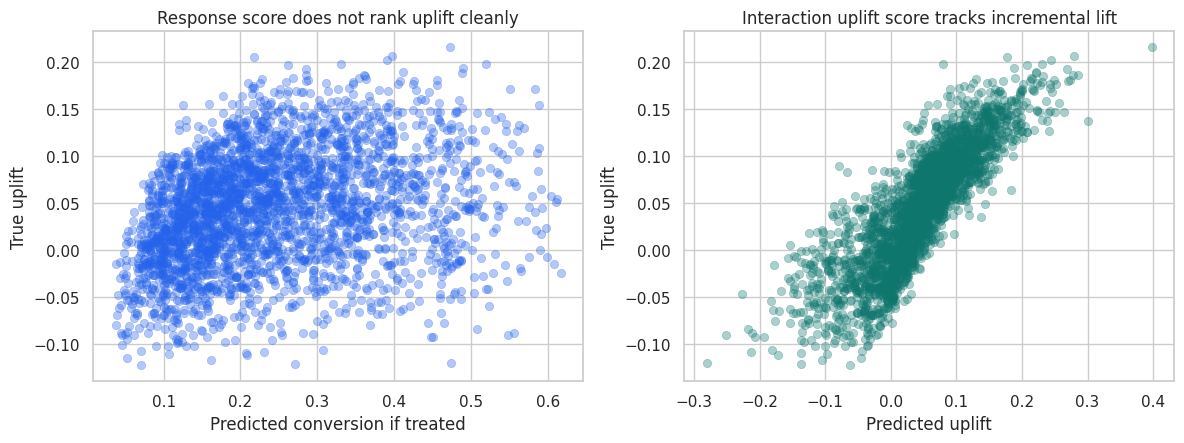
This lecture develops CATE and Uplift Modeling with examples that make assumptions, diagnostics, and interpretation visible.
03. Meta-Learners: S, T, X, R, and DR
This lecture uses Meta-Learners: S, T, X, R, and DR to clarify the analyst’s question, evidence, assumptions, and decision implications.
This lecture studies causal forests through heterogeneity, honest splitting, uncertainty, and treatment-targeting diagnostics.
05. Double/Debiased Machine Learning
This lecture frames Double/Debiased Machine Learning as a decision problem and asks what evidence can be trusted, challenged, and communicated.
06. Policy Learning and Treatment Targeting
This lecture builds intuition for Policy Learning and Treatment Targeting and ties the result to model choice, uncertainty, and action.
This lecture applies Off-Policy Evaluation with emphasis on diagnostics, tradeoffs, and evidence limits.
08. Causal ML Model Validation
This lecture develops Causal ML Model Validation as a practical pattern for analysis, diagnostics, and decision support.