00: Environment And Library Tour
Introduces the EconML ecosystem, the CATE-focused workflow, and the core objects used to connect causal estimands with machine-learning estimators.
EconML is the tutorial track for CATE estimation and treatment targeting once the causal question and adjustment strategy are clear.
00: Environment And Library Tour
Introduces the EconML ecosystem, the CATE-focused workflow, and the core objects used to connect causal estimands with machine-learning estimators.
01: CATE Foundations And Potential Outcomes
Builds the potential-outcomes foundation for heterogeneous treatment effects, showing why CATE estimation is a causal problem before it is a modeling problem.
02: Double Machine Learning Basics
Explains residualization, nuisance models, cross-fitting, and orthogonalization as the statistical machinery behind many EconML estimators.
03: LinearDML And SparseLinearDML
Uses linear and sparse DML estimators to recover interpretable treatment-effect structure while keeping nuisance modeling flexible.
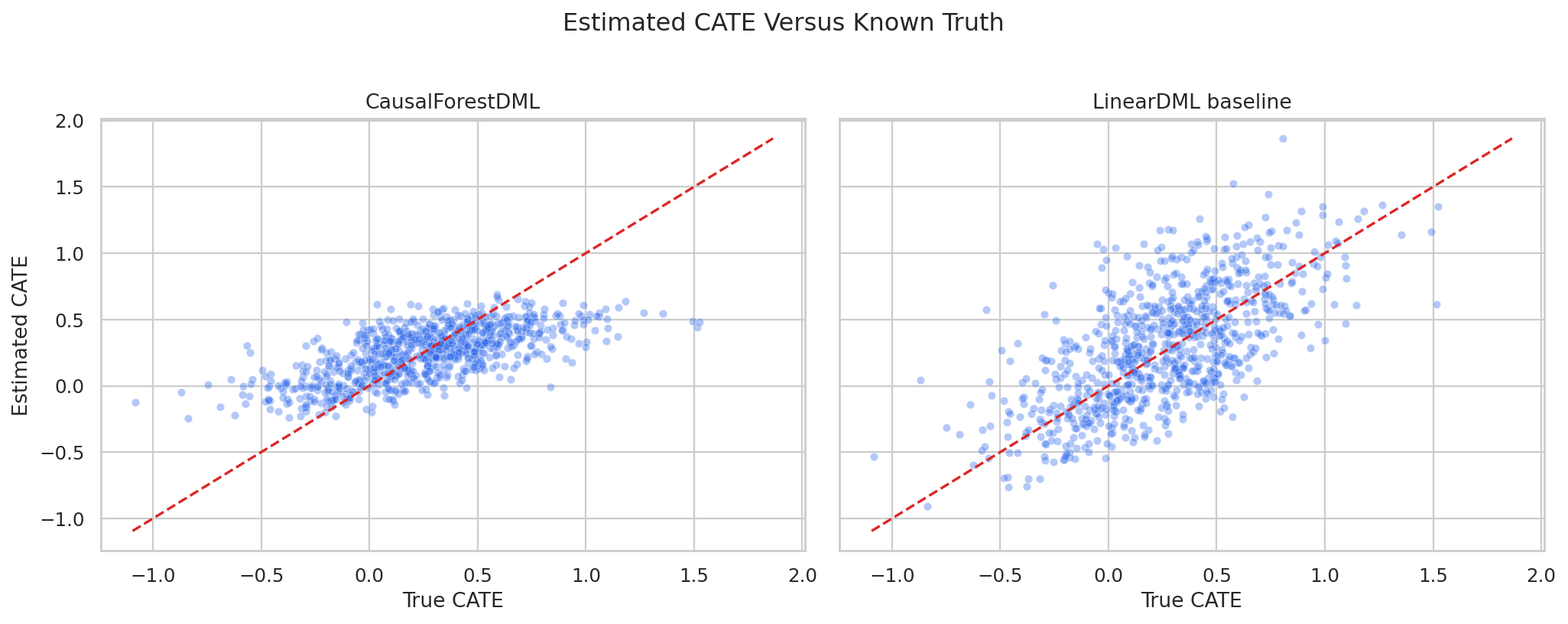
Develops causal forests as a nonparametric CATE tool, emphasizing effect recovery, segment diagnostics, overlap, and uncertainty in heterogeneous treatment targeting.
05: DRLearner And Doubly Robust Estimation
Shows how DRLearner combines outcome and propensity models so effect estimation can remain stable when one nuisance component is imperfect.
06: Meta-Learners: S, T, And X Learners
Compares S-, T-, and X-learners to show how different modeling decompositions handle treatment imbalance, heterogeneity, and targeting quality.
07: Policy Learning And Treatment Targeting
Turns CATE estimates into treatment rules, budget curves, policy trees, and decision comparisons that can be audited before deployment.
08: Interpretability, SHAP, And Segments
Explains heterogeneous-effect models with feature importance, SHAP-style summaries, local examples, and segment-level diagnostics.
09: Inference, Intervals, And Uncertainty
Adds uncertainty quantification to CATE workflows, including interval width, policy confidence, bootstrap thinking, and support-aware interpretation.
10: Multiple Treatments And Continuous Treatments
Extends the workflow beyond binary treatments by covering multi-arm treatment comparisons, continuous doses, marginal effects, and policy tradeoffs.
11: Instrumental Variables With DMLIV, OrthoIV, And DeepIV Concepts
Introduces IV-style causal ML, first-stage strength, exclusion concerns, and heterogeneous-effect recovery when treatment assignment is endogenous.
12: Panel And Longitudinal Extensions
Frames panel and longitudinal settings as dynamic effect problems, with period-specific treatments, cumulative effects, and policy ranking over time.
13: Estimator Comparison Benchmark
Benchmarks estimators on accuracy, calibration, runtime, segment bias, and targeting performance so method choice becomes empirical rather than cosmetic.
Assembles an applied CATE project from design setup through modeling, validation, targeting, and a decision-ready report.
15: Common Pitfalls, Debugging, And Reporting
Reviews leakage, post-treatment controls, poor nuisance models, weak overlap, unstable targeting, and reporting checks that protect CATE work from overclaiming.