# Build and label the diagnostic visualization for the Setup section.
from pathlib import Path
import os
import warnings
import importlib.metadata as importlib_metadata
# Keep Matplotlib cache files in a writable location during notebook execution.
os.environ.setdefault("MPLCONFIGDIR", "/tmp/matplotlib-ranking-sys")
warnings.filterwarnings("default")
warnings.filterwarnings("ignore", category=DeprecationWarning)
warnings.filterwarnings("ignore", category=PendingDeprecationWarning)
warnings.filterwarnings("ignore", category=FutureWarning)
warnings.filterwarnings("ignore", message=".*IProgress not found.*")
warnings.filterwarnings("ignore", message=".*X does not have valid feature names.*")
warnings.filterwarnings("ignore", message=".*The final model has a nonzero intercept.*")
warnings.filterwarnings("ignore", message=".*Co-variance matrix is underdetermined.*")
warnings.filterwarnings("ignore", module="sklearn.linear_model._logistic")
import numpy as np
# Compatibility shim for older SHAP/EconML imports under NumPy 2.x.
if not hasattr(np, "bool8"):
    np.bool8 = np.bool_
if not hasattr(np, "obj2sctype"):
    def _numpy_obj2sctype_compat(rep, default=None):
        try:
            return np.dtype(rep).type
        except TypeError:
            return default
    np.obj2sctype = _numpy_obj2sctype_compat
import pandas as pd
pd.set_option("display.max_colwidth", None)
pd.set_option("display.max_columns", None)
pd.set_option("display.width", 0)
import matplotlib.pyplot as plt
import seaborn as sns
from sklearn.tree import plot_tree
from IPython.display import display
from sklearn.ensemble import RandomForestClassifier, RandomForestRegressor
from sklearn.linear_model import LinearRegression
from sklearn.metrics import brier_score_loss, log_loss, mean_squared_error, roc_auc_score
from sklearn.model_selection import KFold, StratifiedKFold, cross_val_predict, train_test_split
try:
    import econml
    from econml.dml import CausalForestDML, LinearDML
    from econml.dr import DRLearner
    from econml.policy import DRPolicyTree, DRPolicyForest
    ECONML_AVAILABLE = True
    ECONML_VERSION = getattr(econml, "__version__", "unknown")
except Exception as exc:
    ECONML_AVAILABLE = False
    ECONML_VERSION = f"import failed: {type(exc).__name__}: {exc}"
RANDOM_SEED = 2026
rng = np.random.default_rng(RANDOM_SEED)
OUTPUT_DIR = Path("outputs")
FIGURE_DIR = OUTPUT_DIR / "figures"
TABLE_DIR = OUTPUT_DIR / "tables"
FIGURE_DIR.mkdir(parents=True, exist_ok=True)
TABLE_DIR.mkdir(parents=True, exist_ok=True)
sns.set_theme(style="whitegrid", context="notebook")
pd.set_option("display.max_columns", 140)
pd.set_option("display.float_format", lambda value: f"{value:,.4f}")
print(f"EconML available: {ECONML_AVAILABLE}")
print(f"EconML version: {ECONML_VERSION}")07: Policy Learning and Treatment Targeting
This lesson moves from estimating treatment effects to using them for decisions.
A CATE model answers:
How much benefit do we expect from treatment for this unit?
A policy answers:
Which units should we actually treat?
Those are related but not identical. A policy may have a limited budget, a treatment cost, fairness or support constraints, and uncertainty concerns. We work through how to turn CATE estimates into treatment rules, compare policies, and use EconML’s policy learners as another way to learn decision rules directly.
The lesson uses a synthetic truth-known setting so we can evaluate policy value exactly. In real work, policy value usually needs an experiment, randomized holdout, or careful off-policy evaluation.
Learning Goals
By the end, you should be able to:
- distinguish CATE estimation from treatment policy selection;
- define net benefit after treatment cost;
- turn CATE estimates into threshold and budgeted targeting rules;
- compute true policy value in a simulation;
- compare random, treat-all, threshold, top-k, and oracle policies;
- fit EconML
DRPolicyTreeandDRPolicyForest; - compare direct policy learners with CATE-ranking policies;
- inspect treatment rates, segment targeting, regret, and support risks;
- explain why offline policy decisions need uncertainty and overlap checks.
Dataset and Experiment Setup
We use synthetic or semi-synthetic treatment-effect datasets with observable oracle effects to study Policy Learning And Treatment Targeting. Known treatment-effect surfaces let us check whether CATE, policy, interval, and interpretability tools recover the right heterogeneity pattern.
Read each row as a customer, user, patient, seller, or operational unit with covariates measured before treatment. Effect modifiers drive heterogeneity, while controls and propensities create the observational difficulty. The experiment turns estimates into action rules. The important outcome is estimation accuracy and whether the learned rule improves a decision under constraints.
The oracle columns are teaching instruments. In a real deployment, those columns would not exist, so diagnostics, overlap checks, uncertainty, and sensitivity analysis become essential.
Mathematical Foundation
Policy learning turns estimated treatment effects into actions. If \(\pi(X)\) is a treatment rule, its value is
\[ V(\pi)=\mathbb{E}\{Y(\pi(X))\}. \]
With a cost threshold \(c(X)\), a simple rule treats when
\[ \widehat\tau(X)-c(X)>0. \]
The decision should also account for uncertainty, budget, support, and fairness constraints.
Tutorial Workflow
CATE versus Policy
A treatment-effect estimate is a score. A policy is an action rule.
For binary treatment, a simple policy can be written as:
policy(X) = 1 if estimated_net_CATE(X) > threshold else 0
where:
estimated_net_CATE = estimated_outcome_CATE - treatment_cost
If there is no budget constraint, a simple rule treats units with positive estimated net benefit. If there is a budget constraint, the rule may treat only the top k% of units ranked by estimated net benefit.
The key evaluation quantity in this lesson is policy gain relative to treating nobody:
policy_gain = mean(policy(X) * true_net_CATE(X))
A good policy has high positive gain, treats a defensible share of the population, and avoids overreliance on noisy or unsupported regions.
The lesson follows this path:
- Create a confounded dataset with true potential outcomes and treatment cost.
- Define true net CATE and oracle policy value.
- Fit CATE models that estimate net treatment benefit.
- Convert CATE scores into threshold and budgeted policies.
- Fit direct EconML policy learners.
- Compare policy gain, regret, treatment rate, and segment targeting.
- Inspect policy trees and feature importances.
- Evaluate support and uncertainty risks.
- Close with a practical policy-learning checklist.
Setup
The code below imports packages, creates output folders, fixes a random seed, and checks whether the EconML estimators needed for the lesson are available.
The lesson is ready if EconML imports successfully. The output files use the 07_ prefix so they are easy to separate from earlier tutorial outputs.
Policy Objects in This Lesson
The next table names the policy strategies we will compare. Some are simple score-based rules; others are learned directly by EconML policy estimators.
| policy family | how it works | why include it |
|---|---|---|
| Treat nobody | Set treatment to 0 for every unit | Baseline value for policy gain |
| Treat everybody | Set treatment to 1 for every unit | Shows whether treatment is beneficial on average after cost |
| CATE threshold | Treat when estimated net CATE is above zero | Natural rule without a fixed budget |
| Budgeted top-k | Treat the top share of units ranked by estimated net CATE | Matches constrained treatment capacity |
| DRPolicyTree / DRPolicyForest | Learn a decision rule directly from observed outcomes, treatment, X, and W | Uses EconML’s direct policy-learning tools |
| Oracle | Treat using true net CATE | Upper benchmark available only in simulation |
A policy comparison should include simple baselines. A complicated learner is only useful if it improves over clear rules like treat nobody, treat everybody, and top-k targeting.
Synthetic Example Data
The dataset below has a binary treatment, observed confounding, heterogeneous treatment effects, and an explicit treatment cost.
The observed outcome is a gross benefit. We create a net outcome by subtracting treatment cost from treated rows:
observed_net_outcome = observed_outcome - treatment_cost * treatment
The policy problem is to maximize expected net outcome, more than gross outcome. That distinction matters because some units may have positive gross treatment effects but negative net effects after cost.
# Prepare intermediate objects for the Synthetic Example Data section.
n = 3_000
TREATMENT_COST = 0.28
baseline_need = rng.normal(0, 1, size=n)
prior_engagement = rng.normal(0, 1, size=n)
friction_score = 0.50 * baseline_need - 0.25 * prior_engagement + rng.normal(0, 0.85, size=n)
content_affinity = 0.38 * prior_engagement + rng.normal(0, 0.95, size=n)
price_sensitivity = rng.normal(0, 1, size=n)
trust_score = rng.normal(0, 1, size=n)
recency_gap = rng.normal(0, 1, size=n)
region_risk = rng.binomial(1, 0.35, size=n)
high_need_segment = (baseline_need > 0.55).astype(int)
account_tenure = rng.normal(0, 1, size=n)
seasonality_index = rng.normal(0, 1, size=n)
device_stability = rng.normal(0, 1, size=n)
traffic_intensity = rng.normal(0, 1, size=n)
propensity_logit = (
    -0.35
    + 0.78 * baseline_need
    + 0.44 * prior_engagement
    + 0.40 * friction_score
    + 0.32 * content_affinity
    - 0.20 * trust_score
    + 0.26 * region_risk
    + 0.24 * high_need_segment
    - 0.28 * account_tenure
    + 0.22 * seasonality_index
    + 0.15 * traffic_intensity
)
propensity = 1 / (1 + np.exp(-propensity_logit))
propensity = np.clip(propensity, 0.035, 0.965)
treatment = rng.binomial(1, propensity, size=n)
gross_cate = (
    0.42
    + 0.34 * high_need_segment
    + 0.24 * np.tanh(prior_engagement)
    - 0.24 * np.maximum(friction_score, 0)
    + 0.18 * content_affinity
    - 0.16 * region_risk
    - 0.14 * (price_sensitivity > 0.75).astype(float)
    + 0.10 * np.sin(content_affinity + baseline_need)
)
true_net_cate = gross_cate - TREATMENT_COST
mu0 = (
    2.10
    + 0.78 * baseline_need
    + 0.58 * prior_engagement
    - 0.48 * friction_score
    + 0.28 * content_affinity
    + 0.22 * trust_score
    + 0.34 * account_tenure
    + 0.22 * seasonality_index
    + 0.18 * device_stability
    + 0.16 * traffic_intensity
    + 0.16 * region_risk
    + 0.12 * baseline_need * friction_score
)
mu1 = mu0 + gross_cate
noise = rng.normal(0, 0.90, size=n)
outcome = np.where(treatment == 1, mu1, mu0) + noise
net_outcome = outcome - TREATMENT_COST * treatment
teaching_df = pd.DataFrame(
    {
        "user_id": np.arange(n),
        "baseline_need": baseline_need,
        "prior_engagement": prior_engagement,
        "friction_score": friction_score,
        "content_affinity": content_affinity,
        "price_sensitivity": price_sensitivity,
        "trust_score": trust_score,
        "recency_gap": recency_gap,
        "region_risk": region_risk,
        "high_need_segment": high_need_segment,
        "account_tenure": account_tenure,
        "seasonality_index": seasonality_index,
        "device_stability": device_stability,
        "traffic_intensity": traffic_intensity,
        "propensity": propensity,
        "treatment": treatment,
        "outcome": outcome,
        "net_outcome": net_outcome,
        "mu0": mu0,
        "mu1": mu1,
        "gross_cate": gross_cate,
        "true_net_cate": true_net_cate,
    }
)
teaching_df.head()| user_id | baseline_need | prior_engagement | friction_score | content_affinity | price_sensitivity | trust_score | recency_gap | region_risk | high_need_segment | account_tenure | seasonality_index | device_stability | traffic_intensity | propensity | treatment | outcome | net_outcome | mu0 | mu1 | gross_cate | true_net_cate | |
|---|---|---|---|---|---|---|---|---|---|---|---|---|---|---|---|---|---|---|---|---|---|---|
| 0 | 0 | -0.7931 | -0.4520 | 0.0233 | 1.2695 | 1.4847 | 0.5943 | 1.6834 | 0 | 0 | -0.3757 | -1.0499 | -0.0713 | 1.7041 | 0.3228 | 0 | 1.6283 | 1.6283 | 1.5931 | 2.0403 | 0.4471 | 0.1671 |
| 1 | 1 | 0.2406 | -0.3531 | -0.7239 | -0.7717 | -1.7368 | 1.3611 | -1.4981 | 1 | 0 | 0.0106 | -1.5990 | -0.4807 | 2.2731 | 0.2931 | 0 | 3.6170 | 3.6170 | 2.5818 | 2.5708 | -0.0109 | -0.2909 |
| 2 | 2 | -1.8963 | -0.9423 | -1.1321 | 0.5177 | 0.9344 | 1.2671 | 2.8652 | 1 | 0 | 1.6226 | 0.3719 | -1.0464 | -1.3406 | 0.0432 | 0 | 2.3763 | 2.3763 | 1.6897 | 1.6280 | -0.0617 | -0.3417 |
| 3 | 3 | 1.3958 | 0.0110 | 1.1108 | 0.1338 | 0.2148 | 0.6624 | -0.2507 | 1 | 1 | -1.5408 | -1.8431 | 0.3545 | 0.7243 | 0.8498 | 1 | 5.4312 | 5.1512 | 2.4415 | 2.9016 | 0.4601 | 0.1801 |
| 4 | 4 | 0.6383 | 1.1904 | -0.4781 | 1.9206 | -0.3884 | 0.0489 | -1.8590 | 1 | 1 | -0.5915 | -0.6628 | 0.1159 | -0.8280 | 0.8147 | 1 | 3.6548 | 3.3748 | 3.7312 | 4.9313 | 1.2001 | 0.9201 |
Policy learning is being framed as net value maximization. The gross CATE can be positive while the net CATE is negative if the treatment cost is larger than expected benefit.
Field Dictionary
This table clarifies which fields are observed in a real analysis and which are oracle fields available only because we simulated the data.
effect_modifier_cols = [
    "baseline_need",
    "prior_engagement",
    "friction_score",
    "content_affinity",
    "price_sensitivity",
    "region_risk",
    "high_need_segment",
]
control_cols = ["trust_score", "recency_gap", "account_tenure", "seasonality_index", "device_stability", "traffic_intensity"]
all_observed_covariates = effect_modifier_cols + control_cols
true_driver_cols = effect_modifier_cols.copy()
field_rows = []
for col in effect_modifier_cols:
    field_rows.append(
        {
            "column": col,
            "role": "X policy/CATE feature",
            "observed_in_real_analysis": "yes",
            "description": "Pre-treatment feature used for treatment-effect ranking and policy decisions.",
            "true_net_cate_driver": "yes" if col in true_driver_cols else "no",
        }
    )
for col in control_cols:
    field_rows.append(
        {
            "column": col,
            "role": "W/control or support feature",
            "observed_in_real_analysis": "yes",
            "description": "Pre-treatment feature used for nuisance adjustment and support diagnostics.",
            "true_net_cate_driver": "no",
        }
    )
for col, role, description in [
    ("treatment", "treatment", "Binary intervention indicator."),
    ("outcome", "observed outcome", "Observed gross post-treatment outcome."),
    ("net_outcome", "observed net outcome", "Observed outcome after subtracting treatment cost for treated rows."),
    ("propensity", "oracle", "True treatment probability from the simulated assignment process."),
    ("mu0", "oracle", "True conditional mean outcome under control."),
    ("mu1", "oracle", "True conditional mean gross outcome under treatment."),
    ("gross_cate", "oracle", "Known gross individual treatment effect."),
    ("true_net_cate", "oracle", "Known treatment effect after subtracting treatment cost."),
]:
    field_rows.append(
        {
            "column": col,
            "role": role,
            "observed_in_real_analysis": "yes" if role in ["treatment", "observed outcome", "observed net outcome"] else "no",
            "description": description,
            "true_net_cate_driver": "not applicable",
        }
    )
field_dictionary = pd.DataFrame(field_rows)
field_dictionary.to_csv(TABLE_DIR / "07_field_dictionary.csv", index=False)
display(field_dictionary)| column | role | observed_in_real_analysis | description | true_net_cate_driver | |
|---|---|---|---|---|---|
| 0 | baseline_need | X policy/CATE feature | yes | Pre-treatment feature used for treatment-effect ranking and policy decisions. | yes |
| 1 | prior_engagement | X policy/CATE feature | yes | Pre-treatment feature used for treatment-effect ranking and policy decisions. | yes |
| 2 | friction_score | X policy/CATE feature | yes | Pre-treatment feature used for treatment-effect ranking and policy decisions. | yes |
| 3 | content_affinity | X policy/CATE feature | yes | Pre-treatment feature used for treatment-effect ranking and policy decisions. | yes |
| 4 | price_sensitivity | X policy/CATE feature | yes | Pre-treatment feature used for treatment-effect ranking and policy decisions. | yes |
| 5 | region_risk | X policy/CATE feature | yes | Pre-treatment feature used for treatment-effect ranking and policy decisions. | yes |
| 6 | high_need_segment | X policy/CATE feature | yes | Pre-treatment feature used for treatment-effect ranking and policy decisions. | yes |
| 7 | trust_score | W/control or support feature | yes | Pre-treatment feature used for nuisance adjustment and support diagnostics. | no |
| 8 | recency_gap | W/control or support feature | yes | Pre-treatment feature used for nuisance adjustment and support diagnostics. | no |
| 9 | account_tenure | W/control or support feature | yes | Pre-treatment feature used for nuisance adjustment and support diagnostics. | no |
| 10 | seasonality_index | W/control or support feature | yes | Pre-treatment feature used for nuisance adjustment and support diagnostics. | no |
| 11 | device_stability | W/control or support feature | yes | Pre-treatment feature used for nuisance adjustment and support diagnostics. | no |
| 12 | traffic_intensity | W/control or support feature | yes | Pre-treatment feature used for nuisance adjustment and support diagnostics. | no |
| 13 | treatment | treatment | yes | Binary intervention indicator. | not applicable |
| 14 | outcome | observed outcome | yes | Observed gross post-treatment outcome. | not applicable |
| 15 | net_outcome | observed net outcome | yes | Observed outcome after subtracting treatment cost for treated rows. | not applicable |
| 16 | propensity | oracle | no | True treatment probability from the simulated assignment process. | not applicable |
| 17 | mu0 | oracle | no | True conditional mean outcome under control. | not applicable |
| 18 | mu1 | oracle | no | True conditional mean gross outcome under treatment. | not applicable |
| 19 | gross_cate | oracle | no | Known gross individual treatment effect. | not applicable |
| 20 | true_net_cate | oracle | no | Known treatment effect after subtracting treatment cost. | not applicable |
The fitted models should use only observed pre-treatment features, treatment, and net outcome. Oracle fields are reserved for policy evaluation in the tutorial.
Basic Shape and Net Effect Scale
Before fitting any model, we summarize treatment rate, gross treatment effects, and net treatment effects.
basic_summary = pd.DataFrame(
    [
        {"metric": "rows", "value": len(teaching_df)},
        {"metric": "columns", "value": teaching_df.shape[1]},
        {"metric": "treatment_cost", "value": TREATMENT_COST},
        {"metric": "treatment_rate", "value": teaching_df["treatment"].mean()},
        {"metric": "gross_ate", "value": teaching_df["gross_cate"].mean()},
        {"metric": "true_net_ate", "value": teaching_df["true_net_cate"].mean()},
        {"metric": "share_positive_gross_cate", "value": (teaching_df["gross_cate"] > 0).mean()},
        {"metric": "share_positive_net_cate", "value": (teaching_df["true_net_cate"] > 0).mean()},
        {"metric": "true_net_cate_std", "value": teaching_df["true_net_cate"].std()},
        {"metric": "true_net_cate_min", "value": teaching_df["true_net_cate"].min()},
        {"metric": "true_net_cate_max", "value": teaching_df["true_net_cate"].max()},
    ]
)
basic_summary.to_csv(TABLE_DIR / "07_basic_summary.csv", index=False)
display(basic_summary)| metric | value | |
|---|---|---|
| 0 | rows | 3,000.0000 |
| 1 | columns | 22.0000 |
| 2 | treatment_cost | 0.2800 |
| 3 | treatment_rate | 0.4567 |
| 4 | gross_ate | 0.3413 |
| 5 | true_net_ate | 0.0613 |
| 6 | share_positive_gross_cate | 0.8033 |
| 7 | share_positive_net_cate | 0.5500 |
| 8 | true_net_cate_std | 0.3923 |
| 9 | true_net_cate_min | -1.2210 |
| 10 | true_net_cate_max | 1.1098 |
Treatment value can vary enough that a selective policy may be better than treating everyone. The share of positive net CATE defines the approximate size of the unconstrained oracle policy.
Diagnostics and Interpretation
Net CATE Distribution
This plot shows who has positive or negative true net benefit. The vertical zero line is the natural threshold for an unconstrained policy.
fig, ax = plt.subplots(figsize=(10, 5))
sns.histplot(teaching_df["true_net_cate"], bins=45, kde=True, color="#2563eb", ax=ax)
ax.axvline(0, color="#111827", linewidth=1.5, linestyle="--", label="break-even")
ax.axvline(teaching_df["true_net_cate"].mean(), color="#dc2626", linewidth=2, label="mean net CATE")
ax.set_title("True Net CATE Distribution")
ax.set_xlabel("True Net CATE")
ax.set_ylabel("Rows")
ax.legend()
plt.tight_layout()
fig.savefig(FIGURE_DIR / "07_true_net_cate_distribution.png", dpi=160, bbox_inches="tight")
plt.show()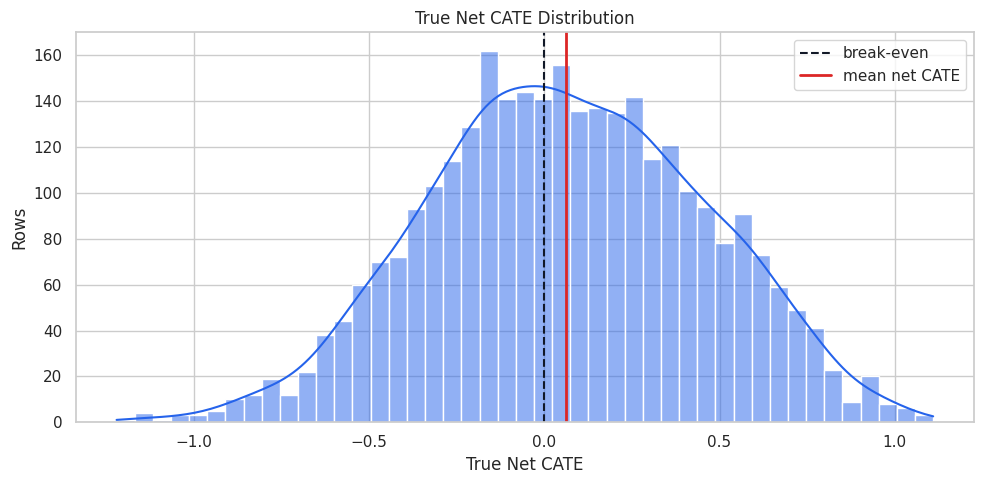
Some units are below the break-even line. Good targeting should avoid treating them when possible, especially under a limited budget.
The decision implication is that estimated gains need to be filtered through uncertainty, cost, support, and operational constraints before becoming actions.
Raw Treated-versus-Control Net Difference
A raw net-outcome difference is not a policy estimate. It mixes treatment effect, treatment cost, and selection into treatment.
raw_group_summary = (
    teaching_df.groupby("treatment")
    .agg(
        rows=("net_outcome", "size"),
        observed_net_outcome_mean=("net_outcome", "mean"),
        true_net_cate_mean=("true_net_cate", "mean"),
        propensity_mean=("propensity", "mean"),
        baseline_need_mean=("baseline_need", "mean"),
        friction_score_mean=("friction_score", "mean"),
        content_affinity_mean=("content_affinity", "mean"),
    )
    .reset_index()
)
raw_net_difference = (
    raw_group_summary.loc[raw_group_summary["treatment"].eq(1), "observed_net_outcome_mean"].iloc[0]
    - raw_group_summary.loc[raw_group_summary["treatment"].eq(0), "observed_net_outcome_mean"].iloc[0]
)
true_net_ate = teaching_df["true_net_cate"].mean()
raw_difference_summary = pd.DataFrame(
    [
        {"quantity": "raw treated minus untreated net outcome mean", "value": raw_net_difference},
        {"quantity": "true net ATE", "value": true_net_ate},
        {"quantity": "raw difference minus true net ATE", "value": raw_net_difference - true_net_ate},
    ]
)
raw_group_summary.to_csv(TABLE_DIR / "07_raw_group_summary.csv", index=False)
raw_difference_summary.to_csv(TABLE_DIR / "07_raw_difference_vs_truth.csv", index=False)
display(raw_group_summary)
display(raw_difference_summary)| treatment | rows | observed_net_outcome_mean | true_net_cate_mean | propensity_mean | baseline_need_mean | friction_score_mean | content_affinity_mean | |
|---|---|---|---|---|---|---|---|---|
| 0 | 0 | 1630 | 1.9006 | -0.0308 | 0.3364 | -0.4163 | -0.2669 | -0.1459 |
| 1 | 1 | 1370 | 2.7439 | 0.1710 | 0.6010 | 0.4301 | 0.2637 | 0.1808 |
| quantity | value | |
|---|---|---|
| 0 | raw treated minus untreated net outcome mean | 0.8433 |
| 1 | true net ATE | 0.0613 |
| 2 | raw difference minus true net ATE | 0.7820 |
Treated and untreated rows differ in baseline features and true net benefit. Policy learning needs adjustment, not raw group comparisons.
That makes the comparison interpretable because differences across methods can be tied to estimator behavior while preprocessing and evaluation stay fixed.
Covariate Balance Check
Standardized mean differences show how different treated and untreated groups are before modeling.
balance_rows = []
for col in all_observed_covariates:
    treated_values = teaching_df.loc[teaching_df["treatment"].eq(1), col]
    control_values = teaching_df.loc[teaching_df["treatment"].eq(0), col]
    pooled_sd = np.sqrt((treated_values.var(ddof=1) + control_values.var(ddof=1)) / 2)
    balance_rows.append(
        {
            "covariate": col,
            "treated_mean": treated_values.mean(),
            "control_mean": control_values.mean(),
            "standardized_difference": (treated_values.mean() - control_values.mean()) / pooled_sd,
        }
    )
balance_table = pd.DataFrame(balance_rows).sort_values("standardized_difference", key=lambda s: s.abs(), ascending=False)
balance_table.to_csv(TABLE_DIR / "07_covariate_balance.csv", index=False)
display(balance_table)| covariate | treated_mean | control_mean | standardized_difference | |
|---|---|---|---|---|
| 0 | baseline_need | 0.4301 | -0.4163 | 0.9205 |
| 6 | high_need_segment | 0.4650 | 0.1399 | 0.7565 |
| 2 | friction_score | 0.2637 | -0.2669 | 0.5384 |
| 1 | prior_engagement | 0.2295 | -0.1412 | 0.3768 |
| 3 | content_affinity | 0.1808 | -0.1459 | 0.3221 |
| 12 | traffic_intensity | 0.1186 | -0.0799 | 0.2011 |
| 9 | account_tenure | -0.0954 | 0.0990 | -0.1909 |
| 7 | trust_score | -0.0846 | 0.0977 | -0.1830 |
| 5 | region_risk | 0.3591 | 0.3196 | 0.0834 |
| 10 | seasonality_index | 0.0082 | -0.0576 | 0.0674 |
| 4 | price_sensitivity | 0.0219 | -0.0446 | 0.0672 |
| 8 | recency_gap | 0.0521 | -0.0129 | 0.0642 |
| 11 | device_stability | 0.0029 | 0.0163 | -0.0134 |
Treatment is observably confounded. The same support and adjustment concerns from CATE estimation carry into policy learning.
The later estimates should be read in light of this sample construction, since data quality and composition set the boundary for any causal claim.
Covariate Balance Plot
The plot highlights the most imbalanced pre-treatment features.
fig, ax = plt.subplots(figsize=(10, 6))
sns.barplot(
    data=balance_table.head(13),
    x="standardized_difference",
    y="covariate",
    color="#60a5fa",
    ax=ax,
)
ax.axvline(0, color="#111827", linewidth=1)
ax.axvline(0.10, color="#9ca3af", linewidth=1, linestyle="--")
ax.axvline(-0.10, color="#9ca3af", linewidth=1, linestyle="--")
ax.set_title("Most Imbalanced Pre-Treatment Features")
ax.set_xlabel("Standardized Difference")
ax.set_ylabel("Feature")
plt.tight_layout()
fig.savefig(FIGURE_DIR / "07_covariate_balance.png", dpi=160, bbox_inches="tight")
plt.show()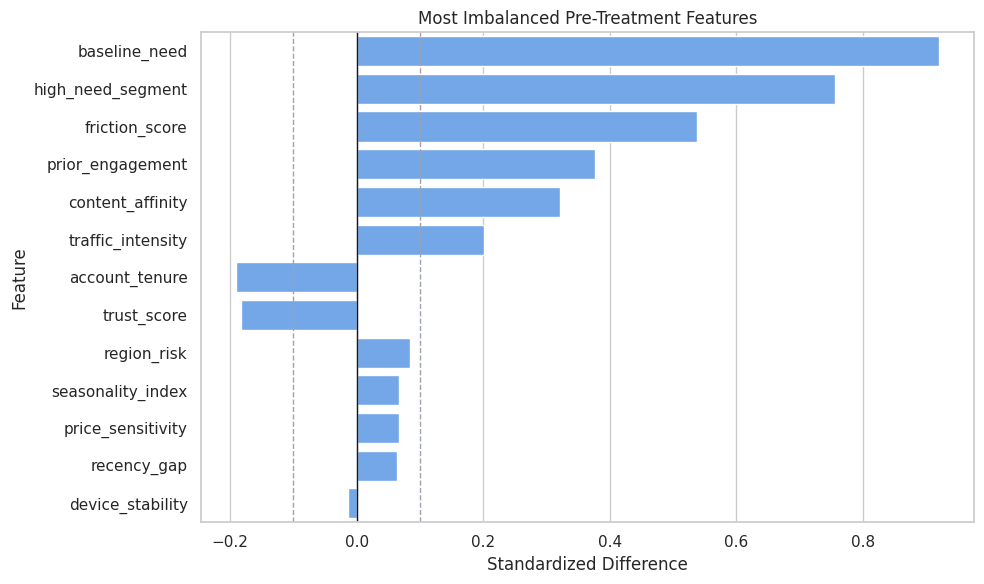
The policy problem is observational, so learned policies should be treated as candidates for evaluation before deployment.
The later estimates should be read in light of this sample construction, since data quality and composition set the boundary for any causal claim.
Propensity Overlap
Policy learning can fail in regions where one action is rarely observed. The next table summarizes treatment rates and net effects by true propensity bucket.
propensity_summary = (
    teaching_df.assign(propensity_bucket=pd.cut(teaching_df["propensity"], bins=np.linspace(0, 1, 11), include_lowest=True))
    .groupby("propensity_bucket", observed=True)
    .agg(
        rows=("propensity", "size"),
        treatment_rate=("treatment", "mean"),
        true_net_cate_mean=("true_net_cate", "mean"),
        baseline_need_mean=("baseline_need", "mean"),
    )
    .reset_index()
)
propensity_summary["propensity_bucket"] = propensity_summary["propensity_bucket"].astype(str)
propensity_summary.to_csv(TABLE_DIR / "07_propensity_bucket_summary.csv", index=False)
display(propensity_summary)| propensity_bucket | rows | treatment_rate | true_net_cate_mean | baseline_need_mean | |
|---|---|---|---|---|---|
| 0 | (-0.001, 0.1] | 196 | 0.0765 | -0.2308 | -1.4609 |
| 1 | (0.1, 0.2] | 394 | 0.1396 | -0.1902 | -0.9668 |
| 2 | (0.2, 0.3] | 374 | 0.2273 | -0.0913 | -0.5870 |
| 3 | (0.3, 0.4] | 387 | 0.3488 | -0.0149 | -0.3482 |
| 4 | (0.4, 0.5] | 391 | 0.4399 | 0.0504 | -0.0150 |
| 5 | (0.5, 0.6] | 316 | 0.5538 | 0.1426 | 0.2446 |
| 6 | (0.6, 0.7] | 276 | 0.6486 | 0.2338 | 0.4927 |
| 7 | (0.7, 0.8] | 308 | 0.7792 | 0.2953 | 0.8007 |
| 8 | (0.8, 0.9] | 262 | 0.8588 | 0.3195 | 1.1600 |
| 9 | (0.9, 1.0] | 96 | 0.9271 | 0.4184 | 1.8146 |
Policy value is easiest to trust in propensity regions where both actions have support. Extreme buckets require more caution.
For causal interpretation, this support check shows when weak overlap may force an estimator to extrapolate beyond comparable treated and control units.
Propensity Overlap Plot
The histogram shows the true propensity distribution by observed treatment group. In real data, this would use an estimated propensity model.
fig, ax = plt.subplots(figsize=(10, 5))
sns.histplot(
    data=teaching_df,
    x="propensity",
    hue="treatment",
    bins=40,
    stat="density",
    common_norm=False,
    alpha=0.45,
    ax=ax,
)
ax.set_title("True Propensity Overlap")
ax.set_xlabel("True Treatment Probability")
ax.set_ylabel("Density")
plt.tight_layout()
fig.savefig(FIGURE_DIR / "07_propensity_overlap.png", dpi=160, bbox_inches="tight")
plt.show()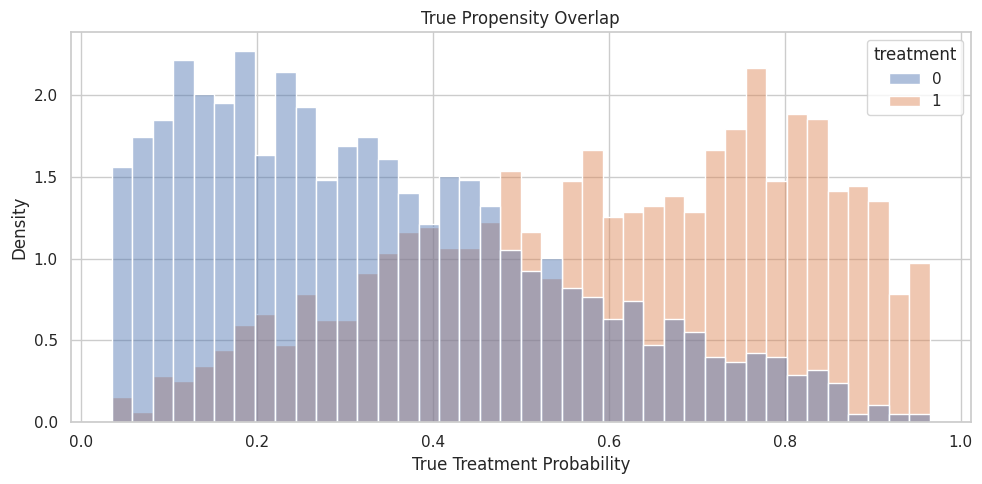
The groups overlap but are shifted. This is a reasonable worked case for policy learning, but not a randomized experiment.
For causal interpretation, this support check shows when weak overlap may force an estimator to extrapolate beyond comparable treated and control units.
Train and Test Split
The train set fits CATE and policy learners. The test set evaluates policy value using known true net CATE.
train_idx, test_idx = train_test_split(
    teaching_df.index,
    test_size=0.35,
    random_state=RANDOM_SEED,
    stratify=teaching_df["treatment"],
)
train_df = teaching_df.loc[train_idx].reset_index(drop=True)
test_df = teaching_df.loc[test_idx].reset_index(drop=True)
split_summary = pd.DataFrame(
    [
        {"split": "train", "rows": len(train_df), "treatment_rate": train_df["treatment"].mean(), "true_net_ate": train_df["true_net_cate"].mean()},
        {"split": "test", "rows": len(test_df), "treatment_rate": test_df["treatment"].mean(), "true_net_ate": test_df["true_net_cate"].mean()},
    ]
)
split_summary.to_csv(TABLE_DIR / "07_train_test_split_summary.csv", index=False)
display(split_summary)| split | rows | treatment_rate | true_net_ate | |
|---|---|---|---|---|
| 0 | train | 1950 | 0.4564 | 0.0586 |
| 1 | test | 1050 | 0.4571 | 0.0665 |
The test set is similar to the train set in treatment rate and true net ATE. That makes policy comparisons easier to read.
Modeling Matrices
The code below creates the arrays passed to EconML estimators. We estimate effects on net outcome, because policy value should account for treatment cost.
Y_net_train = train_df["net_outcome"].to_numpy()
T_train = train_df["treatment"].to_numpy()
Y_net_test = test_df["net_outcome"].to_numpy()
T_test = test_df["treatment"].to_numpy()
X_train = train_df[effect_modifier_cols]
X_test = test_df[effect_modifier_cols]
W_train = train_df[control_cols]
W_test = test_df[control_cols]
all_features_train = train_df[all_observed_covariates]
all_features_test = test_df[all_observed_covariates]
true_net_cate_test = test_df["true_net_cate"].to_numpy()
matrix_summary = pd.DataFrame(
    [
        {"object": "Y_net_train", "rows": Y_net_train.shape[0], "columns": 1, "meaning": "Observed net outcome used for policy-value learning."},
        {"object": "T_train", "rows": T_train.shape[0], "columns": 1, "meaning": "Observed binary treatment."},
        {"object": "X_train", "rows": X_train.shape[0], "columns": X_train.shape[1], "meaning": "Effect modifiers and policy features."},
        {"object": "W_train", "rows": W_train.shape[0], "columns": W_train.shape[1], "meaning": "Additional controls for nuisance adjustment."},
        {"object": "true_net_cate_test", "rows": true_net_cate_test.shape[0], "columns": 1, "meaning": "Oracle net effect used only for policy evaluation."},
    ]
)
matrix_summary.to_csv(TABLE_DIR / "07_model_matrix_summary.csv", index=False)
display(matrix_summary)| object | rows | columns | meaning | |
|---|---|---|---|---|
| 0 | Y_net_train | 1950 | 1 | Observed net outcome used for policy-value learning. |
| 1 | T_train | 1950 | 1 | Observed binary treatment. |
| 2 | X_train | 1950 | 7 | Effect modifiers and policy features. |
| 3 | W_train | 1950 | 6 | Additional controls for nuisance adjustment. |
| 4 | true_net_cate_test | 1050 | 1 | Oracle net effect used only for policy evaluation. |
Once treatment cost is folded into the outcome, the CATE from these estimators is a net benefit estimate. That makes policy thresholding straightforward.
Nuisance Diagnostics
Before fitting policy models, we check whether treatment and net outcome are predictable from observed pre-treatment features.
outcome_probe = RandomForestRegressor(n_estimators=140, min_samples_leaf=20, random_state=RANDOM_SEED, n_jobs=-1)
treatment_probe = RandomForestClassifier(n_estimators=140, min_samples_leaf=20, random_state=RANDOM_SEED, n_jobs=-1)
outcome_cv = KFold(n_splits=5, shuffle=True, random_state=RANDOM_SEED)
treatment_cv = StratifiedKFold(n_splits=5, shuffle=True, random_state=RANDOM_SEED)
net_y_oof = cross_val_predict(outcome_probe, all_features_train, Y_net_train, cv=outcome_cv, method="predict")
t_oof = cross_val_predict(treatment_probe, all_features_train, T_train, cv=treatment_cv, method="predict_proba")[:, 1]
nuisance_diagnostics = pd.DataFrame(
    [
        {"nuisance_model": "net outcome E[Y_net | X, W]", "metric": "out_of_fold_rmse", "value": np.sqrt(mean_squared_error(Y_net_train, net_y_oof))},
        {"nuisance_model": "treatment E[T | X, W]", "metric": "out_of_fold_auc", "value": roc_auc_score(T_train, t_oof)},
        {"nuisance_model": "treatment E[T | X, W]", "metric": "out_of_fold_brier_score", "value": brier_score_loss(T_train, t_oof)},
        {"nuisance_model": "treatment E[T | X, W]", "metric": "out_of_fold_log_loss", "value": log_loss(T_train, t_oof)},
    ]
)
nuisance_diagnostics.to_csv(TABLE_DIR / "07_nuisance_diagnostics.csv", index=False)
display(nuisance_diagnostics)| nuisance_model | metric | value | |
|---|---|---|---|
| 0 | net outcome E[Y_net | X, W] | out_of_fold_rmse | 1.1208 |
| 1 | treatment E[T | X, W] | out_of_fold_auc | 0.7763 |
| 2 | treatment E[T | X, W] | out_of_fold_brier_score | 0.1927 |
| 3 | treatment E[T | X, W] | out_of_fold_log_loss | 0.5690 |
Assignment is predictable, so this is an observational policy problem. The policy learners need nuisance adjustment rather than simple outcome comparisons.
Fit Net CATE Models
We fit three CATE models on net outcome:
LinearDMLas a readable baseline;CausalForestDMLas a flexible CATE model with intervals;DRLearnerwith a forest final model as a doubly robust pseudo-outcome approach.
Each model estimates net benefit from treatment, because the outcome already subtracts treatment cost.
# Fit or evaluate the model objects used in the Fit Net CATE Models section.
if not ECONML_AVAILABLE:
    raise ImportError(f"EconML is not available in this environment: {ECONML_VERSION}")
linear_dml = LinearDML(
    model_y=RandomForestRegressor(n_estimators=120, min_samples_leaf=20, random_state=RANDOM_SEED + 1, n_jobs=-1),
    model_t=RandomForestClassifier(n_estimators=120, min_samples_leaf=20, random_state=RANDOM_SEED + 1, n_jobs=-1),
    discrete_treatment=True,
    fit_cate_intercept=True,
    cv=5,
    random_state=RANDOM_SEED,
)
linear_dml.fit(Y_net_train, T_train, X=X_train, W=W_train, inference=None)
linear_net_cate_test = np.ravel(linear_dml.effect(X_test))
causal_forest = CausalForestDML(
    model_y=RandomForestRegressor(n_estimators=130, min_samples_leaf=20, random_state=RANDOM_SEED + 2, n_jobs=-1),
    model_t=RandomForestClassifier(n_estimators=130, min_samples_leaf=20, random_state=RANDOM_SEED + 2, n_jobs=-1),
    discrete_treatment=True,
    cv=5,
    n_estimators=180,
    min_samples_leaf=18,
    max_samples=0.45,
    honest=True,
    inference=True,
    random_state=RANDOM_SEED,
    n_jobs=-1,
)
causal_forest.fit(Y_net_train, T_train, X=X_train, W=W_train)
forest_net_cate_test = np.ravel(causal_forest.effect(X_test))
forest_lower_test, forest_upper_test = causal_forest.effect_interval(X_test, alpha=0.05)
forest_lower_test = np.ravel(forest_lower_test)
forest_upper_test = np.ravel(forest_upper_test)
dr_learner = DRLearner(
    model_regression=RandomForestRegressor(n_estimators=150, min_samples_leaf=20, random_state=RANDOM_SEED + 3, n_jobs=-1),
    model_propensity=RandomForestClassifier(n_estimators=150, min_samples_leaf=20, random_state=RANDOM_SEED + 3, n_jobs=-1),
    model_final=RandomForestRegressor(n_estimators=180, min_samples_leaf=20, random_state=RANDOM_SEED + 4, n_jobs=-1),
    cv=5,
    min_propensity=0.035,
    random_state=RANDOM_SEED,
)
dr_learner.fit(Y_net_train, T_train, X=X_train, W=W_train, inference=None)
dr_net_cate_test = np.ravel(dr_learner.effect(X_test))
cate_model_summary = pd.DataFrame(
    [
        {"model": "LinearDML", "estimated_net_ate": linear_net_cate_test.mean(), "true_net_ate": true_net_cate_test.mean(), "net_ate_error": linear_net_cate_test.mean() - true_net_cate_test.mean(), "cate_rmse": np.sqrt(mean_squared_error(true_net_cate_test, linear_net_cate_test)), "cate_spearman": pd.Series(linear_net_cate_test).corr(pd.Series(true_net_cate_test), method="spearman")},
        {"model": "CausalForestDML", "estimated_net_ate": forest_net_cate_test.mean(), "true_net_ate": true_net_cate_test.mean(), "net_ate_error": forest_net_cate_test.mean() - true_net_cate_test.mean(), "cate_rmse": np.sqrt(mean_squared_error(true_net_cate_test, forest_net_cate_test)), "cate_spearman": pd.Series(forest_net_cate_test).corr(pd.Series(true_net_cate_test), method="spearman")},
        {"model": "DRLearner forest", "estimated_net_ate": dr_net_cate_test.mean(), "true_net_ate": true_net_cate_test.mean(), "net_ate_error": dr_net_cate_test.mean() - true_net_cate_test.mean(), "cate_rmse": np.sqrt(mean_squared_error(true_net_cate_test, dr_net_cate_test)), "cate_spearman": pd.Series(dr_net_cate_test).corr(pd.Series(true_net_cate_test), method="spearman")},
    ]
)
cate_model_summary.to_csv(TABLE_DIR / "07_net_cate_model_summary.csv", index=False)
display(cate_model_summary)| model | estimated_net_ate | true_net_ate | net_ate_error | cate_rmse | cate_spearman | |
|---|---|---|---|---|---|---|
| 0 | LinearDML | 0.0946 | 0.0665 | 0.0281 | 0.2617 | 0.7263 |
| 1 | CausalForestDML | 0.1105 | 0.0665 | 0.0440 | 0.3285 | 0.5857 |
| 2 | DRLearner forest | 0.0821 | 0.0665 | 0.0156 | 0.4555 | 0.4343 |
Policy learning begins with score quality. A strong targeting model needs useful ranking quality as well as a reasonable average-effect estimate.
CATE Recovery Plot
The scatter plot compares estimated net CATE with true net CATE for the three CATE models.
# Build and label the diagnostic visualization for the CATE Recovery Plot section.
cate_plot_df = pd.concat(
    [
        pd.DataFrame({"true_net_cate": true_net_cate_test, "estimated_net_cate": linear_net_cate_test, "model": "LinearDML"}),
        pd.DataFrame({"true_net_cate": true_net_cate_test, "estimated_net_cate": forest_net_cate_test, "model": "CausalForestDML"}),
        pd.DataFrame({"true_net_cate": true_net_cate_test, "estimated_net_cate": dr_net_cate_test, "model": "DRLearner forest"}),
    ],
    ignore_index=True,
)
limits = [
    min(cate_plot_df["true_net_cate"].min(), cate_plot_df["estimated_net_cate"].min()),
    max(cate_plot_df["true_net_cate"].max(), cate_plot_df["estimated_net_cate"].max()),
]
fig, axes = plt.subplots(1, 3, figsize=(16, 5), sharex=True, sharey=True)
for ax, (model_name, model_df) in zip(axes, cate_plot_df.groupby("model")):
    sample_df = model_df.sample(n=min(650, len(model_df)), random_state=RANDOM_SEED)
    sns.scatterplot(data=sample_df, x="true_net_cate", y="estimated_net_cate", alpha=0.35, s=20, color="#2563eb", ax=ax)
    ax.plot(limits, limits, color="#dc2626", linestyle="--", linewidth=1.5)
    ax.axhline(0, color="#9ca3af", linewidth=1, linestyle=":")
    ax.axvline(0, color="#9ca3af", linewidth=1, linestyle=":")
    ax.set_title(model_name)
    ax.set_xlabel("True Net CATE")
    ax.set_ylabel("Estimated Net CATE")
plt.suptitle("Estimated Net CATE Versus Known Truth", y=1.03)
plt.tight_layout()
fig.savefig(FIGURE_DIR / "07_net_cate_recovery_scatter.png", dpi=160, bbox_inches="tight")
plt.show()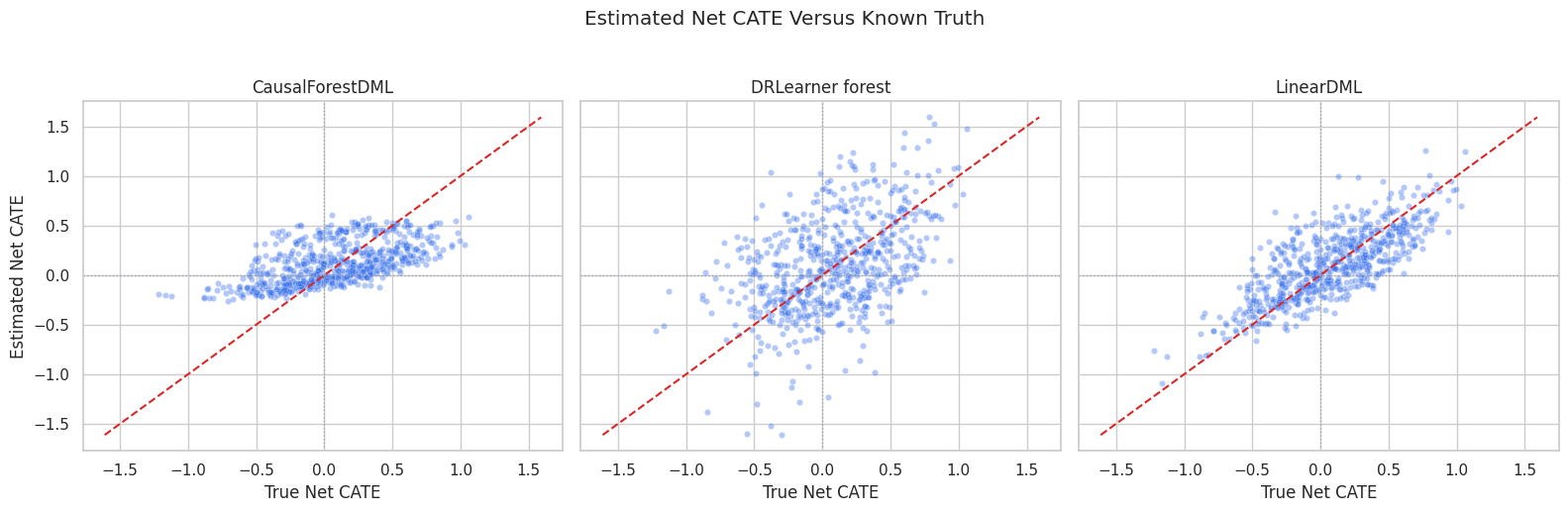
The zero lines matter for policy. Points in the wrong quadrant represent units where the model would make the wrong treat-or-do-not-treat decision under a threshold rule.
Build Score-Based Policies
The code below turns estimated net CATE scores into policy actions:
- threshold policy: treat if estimated net CATE is above zero;
- conservative policy: treat if the causal forest lower interval is above zero;
- top-k policies: treat the highest-scoring 20 percent under each model;
- oracle policies: use true net CATE, available only in simulation.
# Define reusable helpers for the Build Score-Based Policies section.
def top_k_policy(score, fraction):
    """
    Idea: Construct a treatment rule that treats only the top-ranked units by predicted benefit.

    Parameters
    ----------
    score : object
        Score function or score name defining the estimating equation.
    fraction : object
        Fraction of rows or capacity selected by the policy rule.

    Returns
    -------
    np.ndarray
        Binary policy vector that treats only the top-ranked observations.
    """
    score = np.asarray(score)
    k = int(np.ceil(fraction * len(score)))
    action = np.zeros(len(score), dtype=int)
    if k > 0:
        action[np.argsort(score)[-k:]] = 1
    return action
BUDGET_FRACTION = 0.20
test_results = test_df.assign(
    linear_net_cate=linear_net_cate_test,
    forest_net_cate=forest_net_cate_test,
    dr_net_cate=dr_net_cate_test,
    forest_ci_lower=forest_lower_test,
    forest_ci_upper=forest_upper_test,
    forest_ci_width=forest_upper_test - forest_lower_test,
)
policy_actions = {
    "treat_none": np.zeros(len(test_results), dtype=int),
    "treat_all": np.ones(len(test_results), dtype=int),
    "linear_threshold_positive": (linear_net_cate_test > 0).astype(int),
    "forest_threshold_positive": (forest_net_cate_test > 0).astype(int),
    "forest_conservative_lower_positive": (forest_lower_test > 0).astype(int),
    "dr_threshold_positive": (dr_net_cate_test > 0).astype(int),
    "linear_top_20pct": top_k_policy(linear_net_cate_test, BUDGET_FRACTION),
    "forest_top_20pct": top_k_policy(forest_net_cate_test, BUDGET_FRACTION),
    "dr_top_20pct": top_k_policy(dr_net_cate_test, BUDGET_FRACTION),
    "oracle_threshold_positive": (true_net_cate_test > 0).astype(int),
    "oracle_top_20pct": top_k_policy(true_net_cate_test, BUDGET_FRACTION),
}
policy_action_summary = pd.DataFrame(
    [
        {"policy": name, "treatment_rate": action.mean(), "treated_rows": int(action.sum())}
        for name, action in policy_actions.items()
    ]
)
policy_action_summary.to_csv(TABLE_DIR / "07_score_policy_action_summary.csv", index=False)
display(policy_action_summary)| policy | treatment_rate | treated_rows | |
|---|---|---|---|
| 0 | treat_none | 0.0000 | 0 |
| 1 | treat_all | 1.0000 | 1050 |
| 2 | linear_threshold_positive | 0.6086 | 639 |
| 3 | forest_threshold_positive | 0.6533 | 686 |
| 4 | forest_conservative_lower_positive | 0.2305 | 242 |
| 5 | dr_threshold_positive | 0.5543 | 582 |
| 6 | linear_top_20pct | 0.2000 | 210 |
| 7 | forest_top_20pct | 0.2000 | 210 |
| 8 | dr_top_20pct | 0.2000 | 210 |
| 9 | oracle_threshold_positive | 0.5581 | 586 |
| 10 | oracle_top_20pct | 0.2000 | 210 |
Threshold policies and top-k policies can have very different treatment rates. Budgeted policies are easier to compare because they treat the same share of the population.
Policy Value Function
In this truth-known simulation, policy gain over treating nobody is:
mean(policy_action * true_net_CATE)
This is not available in real observational data. Real policy value requires a credible evaluation design, such as an experiment or off-policy evaluation.
# Define reusable helpers for the Policy Value Function section.
def evaluate_policy(action, true_net_cate, baseline_mu0=None):
    """
    Idea: Compare a candidate policy with oracle or estimated value metrics.

    Parameters
    ----------
    action : object
        Treatment or decision action evaluated by the policy rule.
    true_net_cate : object
        Context-specific input used for true net CATE in this helper.
    baseline_mu0 : object
        Context-specific input used for baseline mu0 in this helper.

    Returns
    -------
    dict[str, float]
        Policy-evaluation summary with treatment rate, treated count, and oracle gain metrics.
    """
    action = np.asarray(action).astype(int)
    gain = np.mean(action * true_net_cate)
    if baseline_mu0 is None:
        total_value = np.nan
    else:
        total_value = np.mean(baseline_mu0 + action * true_net_cate)
    return {
        "treatment_rate": action.mean(),
        "treated_rows": int(action.sum()),
        "true_policy_gain_vs_treat_none": gain,
        "true_total_policy_value": total_value,
        "average_true_net_cate_among_treated_by_policy": np.mean(true_net_cate[action == 1]) if action.sum() > 0 else 0.0,
        "share_selected_with_negative_true_net_cate": np.mean(true_net_cate[action == 1] < 0) if action.sum() > 0 else 0.0,
    }
baseline_mu0_test = test_df["mu0"].to_numpy()
policy_value_rows = []
for policy_name, action in policy_actions.items():
    row = {"policy": policy_name}
    row.update(evaluate_policy(action, true_net_cate_test, baseline_mu0=baseline_mu0_test))
    policy_value_rows.append(row)
policy_value_table = pd.DataFrame(policy_value_rows)
oracle_unconstrained_gain = policy_value_table.loc[policy_value_table["policy"].eq("oracle_threshold_positive"), "true_policy_gain_vs_treat_none"].iloc[0]
oracle_budget_gain = policy_value_table.loc[policy_value_table["policy"].eq("oracle_top_20pct"), "true_policy_gain_vs_treat_none"].iloc[0]
policy_value_table["regret_vs_oracle_threshold"] = oracle_unconstrained_gain - policy_value_table["true_policy_gain_vs_treat_none"]
policy_value_table["regret_vs_oracle_top_20pct"] = oracle_budget_gain - policy_value_table["true_policy_gain_vs_treat_none"]
policy_value_table.to_csv(TABLE_DIR / "07_score_policy_value_table.csv", index=False)
display(policy_value_table.sort_values("true_policy_gain_vs_treat_none", ascending=False))| policy | treatment_rate | treated_rows | true_policy_gain_vs_treat_none | true_total_policy_value | average_true_net_cate_among_treated_by_policy | share_selected_with_negative_true_net_cate | regret_vs_oracle_threshold | regret_vs_oracle_top_20pct | |
|---|---|---|---|---|---|---|---|---|---|
| 9 | oracle_threshold_positive | 0.5581 | 586 | 0.1960 | 2.4740 | 0.3512 | 0.0000 | 0.0000 | -0.0738 |
| 2 | linear_threshold_positive | 0.6086 | 639 | 0.1578 | 2.4358 | 0.2593 | 0.2316 | 0.0382 | -0.0355 |
| 3 | forest_threshold_positive | 0.6533 | 686 | 0.1436 | 2.4216 | 0.2198 | 0.2813 | 0.0524 | -0.0214 |
| 10 | oracle_top_20pct | 0.2000 | 210 | 0.1223 | 2.4003 | 0.6113 | 0.0000 | 0.0738 | 0.0000 |
| 5 | dr_threshold_positive | 0.5543 | 582 | 0.1076 | 2.3857 | 0.1942 | 0.3076 | 0.0884 | 0.0146 |
| 6 | linear_top_20pct | 0.2000 | 210 | 0.0918 | 2.3698 | 0.4590 | 0.0952 | 0.1042 | 0.0305 |
| 4 | forest_conservative_lower_positive | 0.2305 | 242 | 0.0748 | 2.3528 | 0.3244 | 0.1901 | 0.1213 | 0.0475 |
| 1 | treat_all | 1.0000 | 1050 | 0.0665 | 2.3445 | 0.0665 | 0.4419 | 0.1295 | 0.0558 |
| 8 | dr_top_20pct | 0.2000 | 210 | 0.0654 | 2.3434 | 0.3269 | 0.1952 | 0.1306 | 0.0569 |
| 7 | forest_top_20pct | 0.2000 | 210 | 0.0550 | 2.3330 | 0.2750 | 0.2429 | 0.1410 | 0.0673 |
| 0 | treat_none | 0.0000 | 0 | 0.0000 | 2.2780 | 0.0000 | 0.0000 | 0.1960 | 0.1223 |
Policy value depends on both ranking and treatment rate. A conservative policy may have high precision among treated units but lower total gain because it treats fewer rows.
Policy Value Plot
This plot ranks score-based policies by true policy gain. The oracle rows are benchmarks, not deployable real-world policies.
plot_policy_values = policy_value_table.sort_values("true_policy_gain_vs_treat_none", ascending=True)
fig, ax = plt.subplots(figsize=(11, 6))
sns.barplot(
    data=plot_policy_values,
    x="true_policy_gain_vs_treat_none",
    y="policy",
    color="#34d399",
    ax=ax,
)
ax.axvline(0, color="#111827", linewidth=1)
ax.set_title("True Policy Gain Versus Treating Nobody")
ax.set_xlabel("Average True Net Gain")
ax.set_ylabel("Policy")
plt.tight_layout()
fig.savefig(FIGURE_DIR / "07_score_policy_value.png", dpi=160, bbox_inches="tight")
plt.show()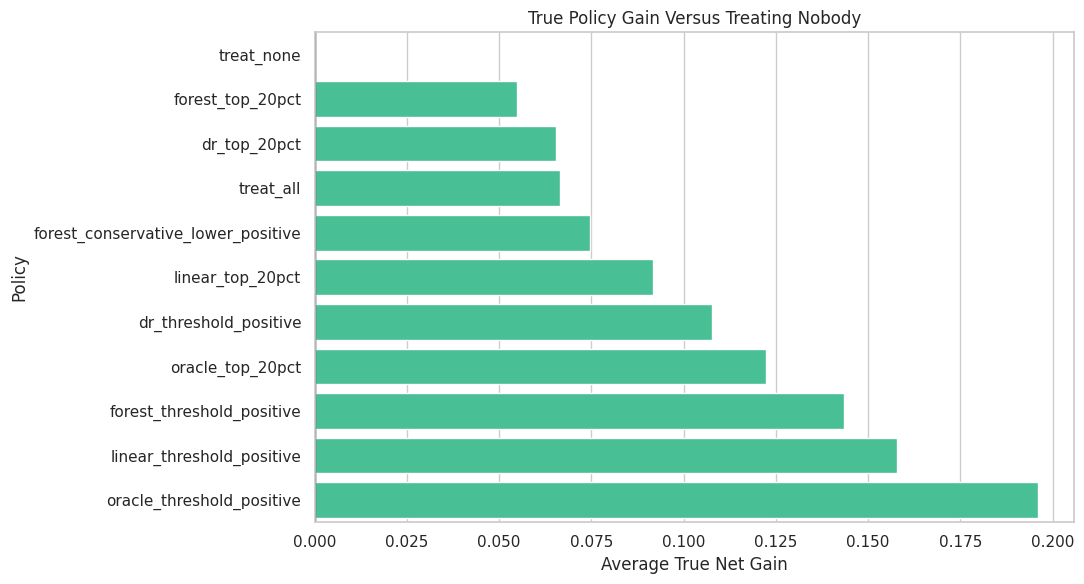
The best feasible score-based policy should get close to the oracle benchmark while treating a realistic share of the population and avoiding negative-benefit selections.
Budget Curve
We can examine policy gain across budget levels to understand how the targeting rule behaves. This is useful when treatment capacity is uncertain.
budget_grid = np.arange(0.05, 0.55, 0.05)
budget_rows = []
for budget in budget_grid:
    for score_name, score in [
        ("LinearDML", linear_net_cate_test),
        ("CausalForestDML", forest_net_cate_test),
        ("DRLearner", dr_net_cate_test),
        ("Oracle", true_net_cate_test),
        ("Random expected", rng.permutation(true_net_cate_test)),
    ]:
        if score_name == "Random expected":
            action = top_k_policy(score, budget)
        else:
            action = top_k_policy(score, budget)
        budget_rows.append(
            {
                "budget_fraction": budget,
                "policy_score": score_name,
                "true_policy_gain": np.mean(action * true_net_cate_test),
                "average_true_net_cate_selected": np.mean(true_net_cate_test[action == 1]),
            }
        )
budget_curve = pd.DataFrame(budget_rows)
budget_curve.to_csv(TABLE_DIR / "07_budget_curve.csv", index=False)
display(budget_curve.head(12))| budget_fraction | policy_score | true_policy_gain | average_true_net_cate_selected | |
|---|---|---|---|---|
| 0 | 0.0500 | LinearDML | 0.0330 | 0.6536 |
| 1 | 0.0500 | CausalForestDML | 0.0189 | 0.3736 |
| 2 | 0.0500 | DRLearner | 0.0211 | 0.4187 |
| 3 | 0.0500 | Oracle | 0.0412 | 0.8158 |
| 4 | 0.0500 | Random expected | 0.0065 | 0.1286 |
| 5 | 0.1000 | LinearDML | 0.0538 | 0.5381 |
| 6 | 0.1000 | CausalForestDML | 0.0325 | 0.3246 |
| 7 | 0.1000 | DRLearner | 0.0368 | 0.3680 |
| 8 | 0.1000 | Oracle | 0.0723 | 0.7232 |
| 9 | 0.1000 | Random expected | 0.0074 | 0.0739 |
| 10 | 0.1500 | LinearDML | 0.0735 | 0.4885 |
| 11 | 0.1500 | CausalForestDML | 0.0451 | 0.2998 |
A single top-k number can hide how policies behave as budget changes. Budget curves show whether a ranking remains useful beyond the very top slice.
Budget Curve Plot
The plot shows how true policy gain changes as the treatment budget increases.
fig, ax = plt.subplots(figsize=(10, 5))
sns.lineplot(
    data=budget_curve,
    x="budget_fraction",
    y="true_policy_gain",
    hue="policy_score",
    marker="o",
    linewidth=2,
    ax=ax,
)
ax.set_title("Policy Gain Across Treatment Budgets")
ax.set_xlabel("Budget Fraction Treated")
ax.set_ylabel("Average True Net Gain")
ax.yaxis.set_major_formatter(lambda x, _: f"{x:.3f}")
plt.tight_layout()
fig.savefig(FIGURE_DIR / "07_budget_curve.png", dpi=160, bbox_inches="tight")
plt.show()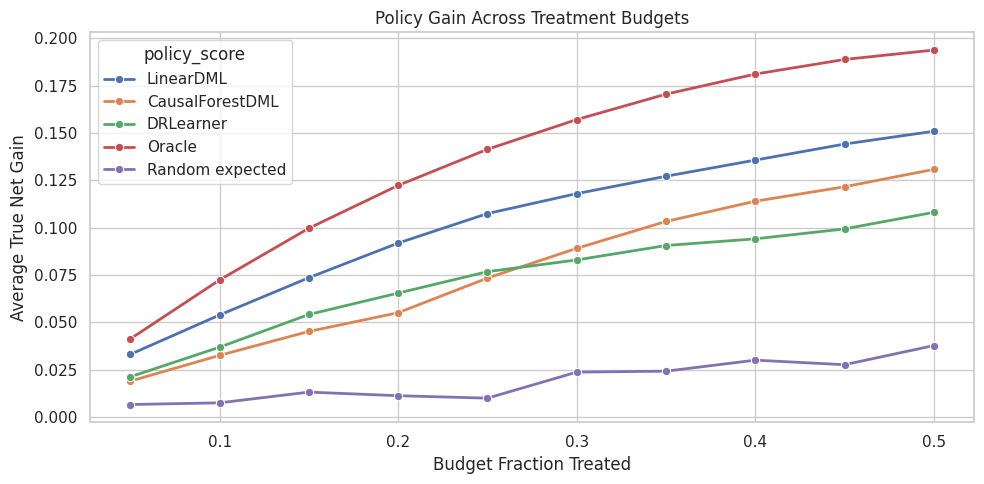
The oracle curve is the upper bound. A useful model stays clearly above random selection across the budget range where policy decisions are likely to be made.
Fit Direct EconML Policy Learners
EconML also includes direct policy learners. Here we fit:
DRPolicyTree: a shallow, interpretable policy tree;DRPolicyForest: an ensemble policy model.
Both are fit on observed net outcome, treatment, X, and W. The learned action is a direct recommendation rather than a post-hoc threshold on CATE estimates.
# Fit or evaluate the model objects used in the Fit Direct EconML Policy Learners section.
dr_policy_tree = DRPolicyTree(
    model_regression=RandomForestRegressor(n_estimators=130, min_samples_leaf=20, random_state=RANDOM_SEED + 5, n_jobs=-1),
    model_propensity=RandomForestClassifier(n_estimators=130, min_samples_leaf=20, random_state=RANDOM_SEED + 5, n_jobs=-1),
    min_propensity=0.035,
    cv=5,
    max_depth=3,
    min_samples_leaf=35,
    honest=True,
    random_state=RANDOM_SEED,
)
dr_policy_tree.fit(Y_net_train, T_train, X=X_train, W=W_train)
tree_policy_action = np.ravel(dr_policy_tree.predict(X_test)).astype(int)
dr_policy_forest = DRPolicyForest(
    model_regression=RandomForestRegressor(n_estimators=130, min_samples_leaf=20, random_state=RANDOM_SEED + 6, n_jobs=-1),
    model_propensity=RandomForestClassifier(n_estimators=130, min_samples_leaf=20, random_state=RANDOM_SEED + 6, n_jobs=-1),
    min_propensity=0.035,
    cv=5,
    n_estimators=80,
    max_depth=4,
    min_samples_leaf=35,
    max_samples=0.45,
    honest=True,
    n_jobs=-1,
    random_state=RANDOM_SEED,
)
dr_policy_forest.fit(Y_net_train, T_train, X=X_train, W=W_train)
forest_policy_action = np.ravel(dr_policy_forest.predict(X_test)).astype(int)
policy_learner_actions = {
    "DRPolicyTree": tree_policy_action,
    "DRPolicyForest": forest_policy_action,
}
policy_learner_summary = pd.DataFrame(
    [
        {"policy": name, **evaluate_policy(action, true_net_cate_test, baseline_mu0=baseline_mu0_test)}
        for name, action in policy_learner_actions.items()
    ]
)
policy_learner_summary.to_csv(TABLE_DIR / "07_direct_policy_learner_summary.csv", index=False)
display(policy_learner_summary)| policy | treatment_rate | treated_rows | true_policy_gain_vs_treat_none | true_total_policy_value | average_true_net_cate_among_treated_by_policy | share_selected_with_negative_true_net_cate | |
|---|---|---|---|---|---|---|---|
| 0 | DRPolicyTree | 0.9295 | 976 | 0.0565 | 2.3345 | 0.0608 | 0.4457 |
| 1 | DRPolicyForest | 0.7657 | 804 | 0.1504 | 2.4284 | 0.1964 | 0.3047 |
Direct policy learners output actions, not CATE scores. They are attractive when the final object needs to be a decision rule, especially an interpretable tree.
Combined Policy Comparison
Now we compare the strongest score-based rules with direct policy learners in one table.
selected_policy_names = [
    "treat_none",
    "treat_all",
    "forest_threshold_positive",
    "forest_conservative_lower_positive",
    "forest_top_20pct",
    "dr_top_20pct",
    "oracle_threshold_positive",
    "oracle_top_20pct",
]
combined_rows = []
for name in selected_policy_names:
    combined_rows.append({"policy": name, "policy_type": "score-based", **evaluate_policy(policy_actions[name], true_net_cate_test, baseline_mu0=baseline_mu0_test)})
for name, action in policy_learner_actions.items():
    combined_rows.append({"policy": name, "policy_type": "direct policy learner", **evaluate_policy(action, true_net_cate_test, baseline_mu0=baseline_mu0_test)})
combined_policy_comparison = pd.DataFrame(combined_rows)
combined_policy_comparison["regret_vs_oracle_threshold"] = oracle_unconstrained_gain - combined_policy_comparison["true_policy_gain_vs_treat_none"]
combined_policy_comparison["regret_vs_oracle_top_20pct"] = oracle_budget_gain - combined_policy_comparison["true_policy_gain_vs_treat_none"]
combined_policy_comparison.to_csv(TABLE_DIR / "07_combined_policy_comparison.csv", index=False)
display(combined_policy_comparison.sort_values("true_policy_gain_vs_treat_none", ascending=False))| policy | policy_type | treatment_rate | treated_rows | true_policy_gain_vs_treat_none | true_total_policy_value | average_true_net_cate_among_treated_by_policy | share_selected_with_negative_true_net_cate | regret_vs_oracle_threshold | regret_vs_oracle_top_20pct | |
|---|---|---|---|---|---|---|---|---|---|---|
| 6 | oracle_threshold_positive | score-based | 0.5581 | 586 | 0.1960 | 2.4740 | 0.3512 | 0.0000 | 0.0000 | -0.0738 |
| 9 | DRPolicyForest | direct policy learner | 0.7657 | 804 | 0.1504 | 2.4284 | 0.1964 | 0.3047 | 0.0456 | -0.0281 |
| 2 | forest_threshold_positive | score-based | 0.6533 | 686 | 0.1436 | 2.4216 | 0.2198 | 0.2813 | 0.0524 | -0.0214 |
| 7 | oracle_top_20pct | score-based | 0.2000 | 210 | 0.1223 | 2.4003 | 0.6113 | 0.0000 | 0.0738 | 0.0000 |
| 3 | forest_conservative_lower_positive | score-based | 0.2305 | 242 | 0.0748 | 2.3528 | 0.3244 | 0.1901 | 0.1213 | 0.0475 |
| 1 | treat_all | score-based | 1.0000 | 1050 | 0.0665 | 2.3445 | 0.0665 | 0.4419 | 0.1295 | 0.0558 |
| 5 | dr_top_20pct | score-based | 0.2000 | 210 | 0.0654 | 2.3434 | 0.3269 | 0.1952 | 0.1306 | 0.0569 |
| 8 | DRPolicyTree | direct policy learner | 0.9295 | 976 | 0.0565 | 2.3345 | 0.0608 | 0.4457 | 0.1395 | 0.0658 |
| 4 | forest_top_20pct | score-based | 0.2000 | 210 | 0.0550 | 2.3330 | 0.2750 | 0.2429 | 0.1410 | 0.0673 |
| 0 | treat_none | score-based | 0.0000 | 0 | 0.0000 | 2.2780 | 0.0000 | 0.0000 | 0.1960 | 0.1223 |
Direct policy learners and CATE-threshold policies answer the same decision problem in different ways. Their treatment rates may differ, so both value and action rate should be reported.
Combined Policy Plot
The plot compares score-based policies and direct policy learners by true net gain.
plot_combined = combined_policy_comparison.sort_values("true_policy_gain_vs_treat_none", ascending=True)
fig, ax = plt.subplots(figsize=(11, 6))
sns.barplot(
    data=plot_combined,
    x="true_policy_gain_vs_treat_none",
    y="policy",
    hue="policy_type",
    dodge=False,
    ax=ax,
)
ax.axvline(0, color="#111827", linewidth=1)
ax.set_title("Score-Based Policies Versus Direct Policy Learners")
ax.set_xlabel("Average True Net Gain")
ax.set_ylabel("Policy")
plt.tight_layout()
fig.savefig(FIGURE_DIR / "07_combined_policy_comparison.png", dpi=160, bbox_inches="tight")
plt.show()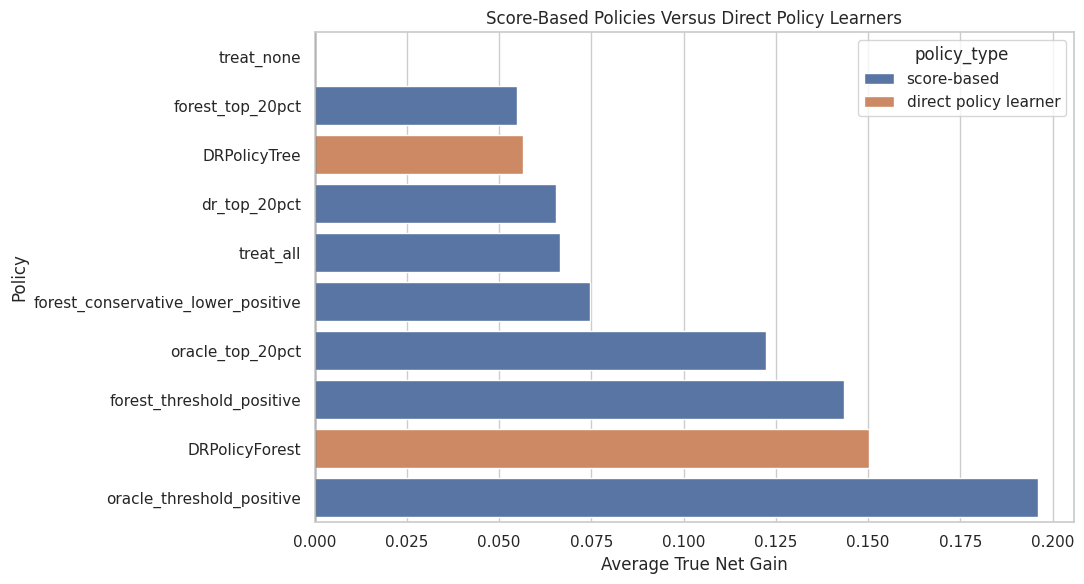
Policy choice is about more than which method is most sophisticated. A simpler rule can be competitive if the CATE score ranks units well.
Policy Feature Importance
Direct policy learners can expose feature importance. This table shows which features the policy tree and policy forest used most when forming decisions.
policy_importance = pd.concat(
    [
        pd.DataFrame({"feature": effect_modifier_cols, "importance": np.ravel(dr_policy_tree.feature_importances()), "policy_model": "DRPolicyTree"}),
        pd.DataFrame({"feature": effect_modifier_cols, "importance": np.ravel(dr_policy_forest.feature_importances()), "policy_model": "DRPolicyForest"}),
    ],
    ignore_index=True,
)
policy_importance["abs_importance"] = policy_importance["importance"].abs()
policy_importance = policy_importance.sort_values(["policy_model", "abs_importance"], ascending=[True, False])
policy_importance.to_csv(TABLE_DIR / "07_policy_feature_importance.csv", index=False)
display(policy_importance)| feature | importance | policy_model | abs_importance | |
|---|---|---|---|---|
| 9 | friction_score | 0.2560 | DRPolicyForest | 0.2560 |
| 8 | prior_engagement | 0.2072 | DRPolicyForest | 0.2072 |
| 10 | content_affinity | 0.1930 | DRPolicyForest | 0.1930 |
| 11 | price_sensitivity | 0.1872 | DRPolicyForest | 0.1872 |
| 7 | baseline_need | 0.1160 | DRPolicyForest | 0.1160 |
| 12 | region_risk | 0.0387 | DRPolicyForest | 0.0387 |
| 13 | high_need_segment | 0.0018 | DRPolicyForest | 0.0018 |
| 1 | prior_engagement | 1.0000 | DRPolicyTree | 1.0000 |
| 2 | friction_score | 0.0000 | DRPolicyTree | 0.0000 |
| 0 | baseline_need | 0.0000 | DRPolicyTree | 0.0000 |
| 3 | content_affinity | 0.0000 | DRPolicyTree | 0.0000 |
| 4 | price_sensitivity | 0.0000 | DRPolicyTree | 0.0000 |
| 5 | region_risk | 0.0000 | DRPolicyTree | 0.0000 |
| 6 | high_need_segment | 0.0000 | DRPolicyTree | 0.0000 |
Feature importance describes the fitted policy model, not the truth by itself. It helps explain which variables drove action recommendations.
The decision implication is that estimated gains need to be filtered through uncertainty, cost, support, and operational constraints before becoming actions.
Policy Feature Importance Plot
The plot compares the most important policy features across tree and forest policy learners.
fig, axes = plt.subplots(1, 2, figsize=(13, 5), sharex=False)
for ax, (model_name, model_df) in zip(axes, policy_importance.groupby("policy_model")):
    sns.barplot(data=model_df, x="importance", y="feature", color="#60a5fa", ax=ax)
    ax.axvline(0, color="#111827", linewidth=1)
    ax.set_title(model_name)
    ax.set_xlabel("Feature Importance")
    ax.set_ylabel("Feature")
plt.suptitle("Direct Policy Learner Feature Importance", y=1.03)
plt.tight_layout()
fig.savefig(FIGURE_DIR / "07_policy_feature_importance.png", dpi=160, bbox_inches="tight")
plt.show()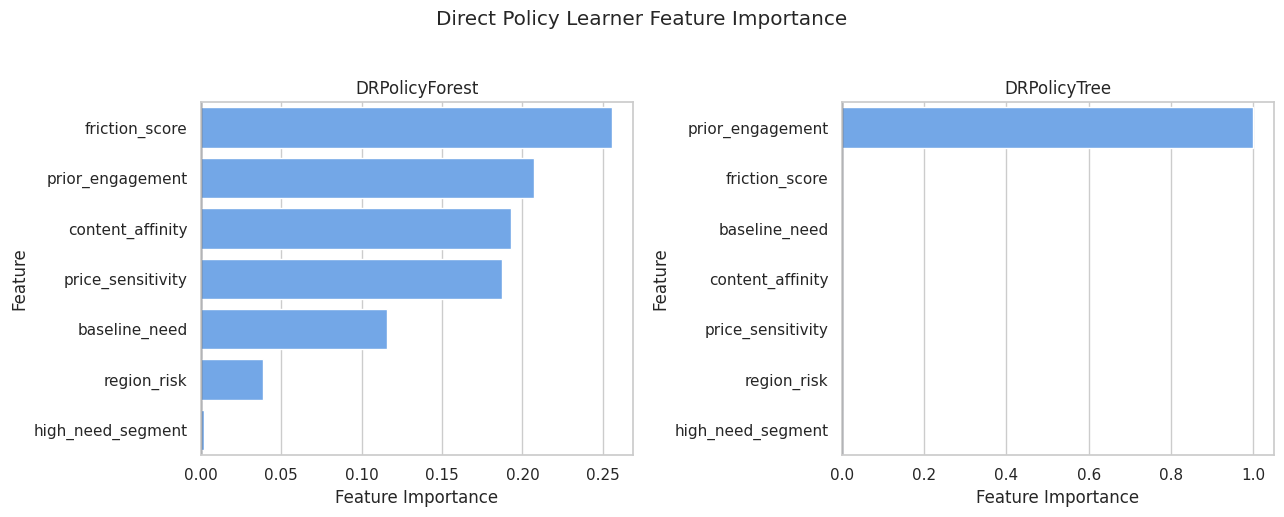
The tree and forest may emphasize different features. A shallow tree is easier to explain; a forest can average over more decision patterns.
Policy Tree Visualization
A shallow policy tree is valuable because it can be inspected directly. The next step plots the learned tree structure.
fig, ax = plt.subplots(figsize=(15, 7))
dr_policy_tree.policy_model_.plot(feature_names=effect_modifier_cols, treatment_names=dr_policy_tree.policy_treatment_names(), ax=ax)
ax.set_title("Learned DRPolicyTree")
plt.tight_layout()
fig.savefig(FIGURE_DIR / "07_dr_policy_tree.png", dpi=160, bbox_inches="tight")
plt.show()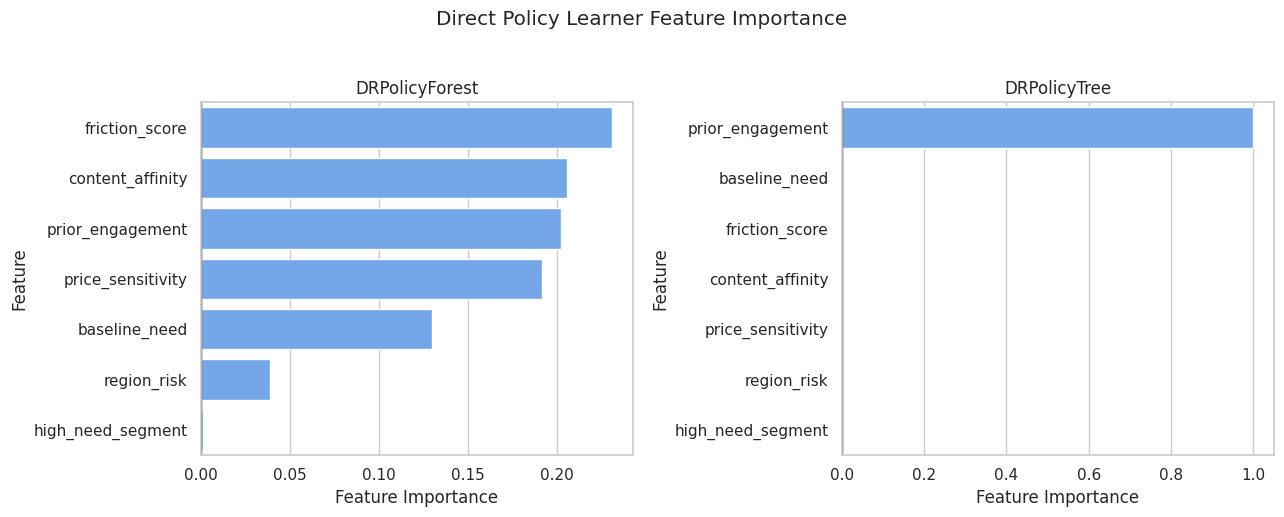
The tree is an interpretable decision rule. It should still be evaluated by policy value and support; readability alone does not make a policy credible.
Segment-Level Policy Behavior
A policy can have good overall value while concentrating treatment in particular segments. The next table summarizes treatment rates and true gain by segment for several policies.
segment_policy_frames = []
segment_policy_actions = {
    "observed_logging_policy": test_results["treatment"].to_numpy().astype(int),
    "forest_top_20pct": policy_actions["forest_top_20pct"],
    "forest_threshold_positive": policy_actions["forest_threshold_positive"],
    "DRPolicyTree": tree_policy_action,
    "DRPolicyForest": forest_policy_action,
    "oracle_top_20pct": policy_actions["oracle_top_20pct"],
}
for policy_name, action in segment_policy_actions.items():
    temp = test_results.assign(policy_action=action, policy=policy_name, selected_gain=action * true_net_cate_test)
    segment_summary = (
        temp.groupby(["policy", "high_need_segment", "region_risk"], observed=True)
        .agg(
            rows=("outcome", "size"),
            policy_treatment_rate=("policy_action", "mean"),
            true_policy_gain=("selected_gain", "mean"),
            true_net_cate_mean=("true_net_cate", "mean"),
            propensity_mean=("propensity", "mean"),
        )
        .reset_index()
    )
    segment_policy_frames.append(segment_summary)
segment_policy_summary = pd.concat(segment_policy_frames, ignore_index=True)
segment_policy_summary.to_csv(TABLE_DIR / "07_segment_policy_summary.csv", index=False)
display(segment_policy_summary)| policy | high_need_segment | region_risk | rows | policy_treatment_rate | true_policy_gain | true_net_cate_mean | propensity_mean | |
|---|---|---|---|---|---|---|---|---|
| 0 | observed_logging_policy | 0 | 0 | 495 | 0.3293 | 0.0364 | 0.0291 | 0.3297 |
| 1 | observed_logging_policy | 0 | 1 | 247 | 0.3401 | -0.0134 | -0.1325 | 0.3796 |
| 2 | observed_logging_policy | 1 | 0 | 204 | 0.7157 | 0.2798 | 0.3546 | 0.7067 |
| 3 | observed_logging_policy | 1 | 1 | 104 | 0.8365 | 0.1167 | 0.1517 | 0.7616 |
| 4 | forest_top_20pct | 0 | 0 | 495 | 0.2323 | 0.0581 | 0.0291 | 0.3297 |
| 5 | forest_top_20pct | 0 | 1 | 247 | 0.2510 | 0.0217 | -0.1325 | 0.3796 |
| 6 | forest_top_20pct | 1 | 0 | 204 | 0.1176 | 0.0897 | 0.3546 | 0.7067 |
| 7 | forest_top_20pct | 1 | 1 | 104 | 0.0865 | 0.0513 | 0.1517 | 0.7616 |
| 8 | forest_threshold_positive | 0 | 0 | 495 | 0.6222 | 0.1148 | 0.0291 | 0.3297 |
| 9 | forest_threshold_positive | 0 | 1 | 247 | 0.5911 | 0.0169 | -0.1325 | 0.3796 |
| 10 | forest_threshold_positive | 1 | 0 | 204 | 0.7990 | 0.3477 | 0.3546 | 0.7067 |
| 11 | forest_threshold_positive | 1 | 1 | 104 | 0.6635 | 0.1812 | 0.1517 | 0.7616 |
| 12 | DRPolicyTree | 0 | 0 | 495 | 0.9232 | 0.0228 | 0.0291 | 0.3297 |
| 13 | DRPolicyTree | 0 | 1 | 247 | 0.9271 | -0.1219 | -0.1325 | 0.3796 |
| 14 | DRPolicyTree | 1 | 0 | 204 | 0.9461 | 0.3203 | 0.3546 | 0.7067 |
| 15 | DRPolicyTree | 1 | 1 | 104 | 0.9327 | 0.1228 | 0.1517 | 0.7616 |
| 16 | DRPolicyForest | 0 | 0 | 495 | 0.7879 | 0.1113 | 0.0291 | 0.3297 |
| 17 | DRPolicyForest | 0 | 1 | 247 | 0.6680 | 0.0262 | -0.1325 | 0.3796 |
| 18 | DRPolicyForest | 1 | 0 | 204 | 0.8627 | 0.3680 | 0.3546 | 0.7067 |
| 19 | DRPolicyForest | 1 | 1 | 104 | 0.7019 | 0.2043 | 0.1517 | 0.7616 |
| 20 | oracle_top_20pct | 0 | 0 | 495 | 0.1475 | 0.0854 | 0.0291 | 0.3297 |
| 21 | oracle_top_20pct | 0 | 1 | 247 | 0.0648 | 0.0335 | -0.1325 | 0.3796 |
| 22 | oracle_top_20pct | 1 | 0 | 204 | 0.4804 | 0.3128 | 0.3546 | 0.7067 |
| 23 | oracle_top_20pct | 1 | 1 | 104 | 0.2212 | 0.1345 | 0.1517 | 0.7616 |
Segment behavior is part of policy reporting. A policy that gains value by ignoring or over-targeting certain segments may need additional review.
Segment Treatment Rate Plot
This plot compares how often each policy treats each segment.
segment_plot_df = segment_policy_summary.copy()
segment_plot_df["segment"] = (
    "need=" + segment_plot_df["high_need_segment"].astype(str)
    + ", region=" + segment_plot_df["region_risk"].astype(str)
)
fig, ax = plt.subplots(figsize=(13, 6))
sns.barplot(
    data=segment_plot_df,
    x="segment",
    y="policy_treatment_rate",
    hue="policy",
    ax=ax,
)
ax.set_title("Policy Treatment Rate By Segment")
ax.set_xlabel("Segment")
ax.set_ylabel("Treatment Rate")
ax.tick_params(axis="x", rotation=20)
ax.yaxis.set_major_formatter(lambda x, _: f"{x:.0%}")
plt.tight_layout()
fig.savefig(FIGURE_DIR / "07_segment_policy_treatment_rate.png", dpi=160, bbox_inches="tight")
plt.show()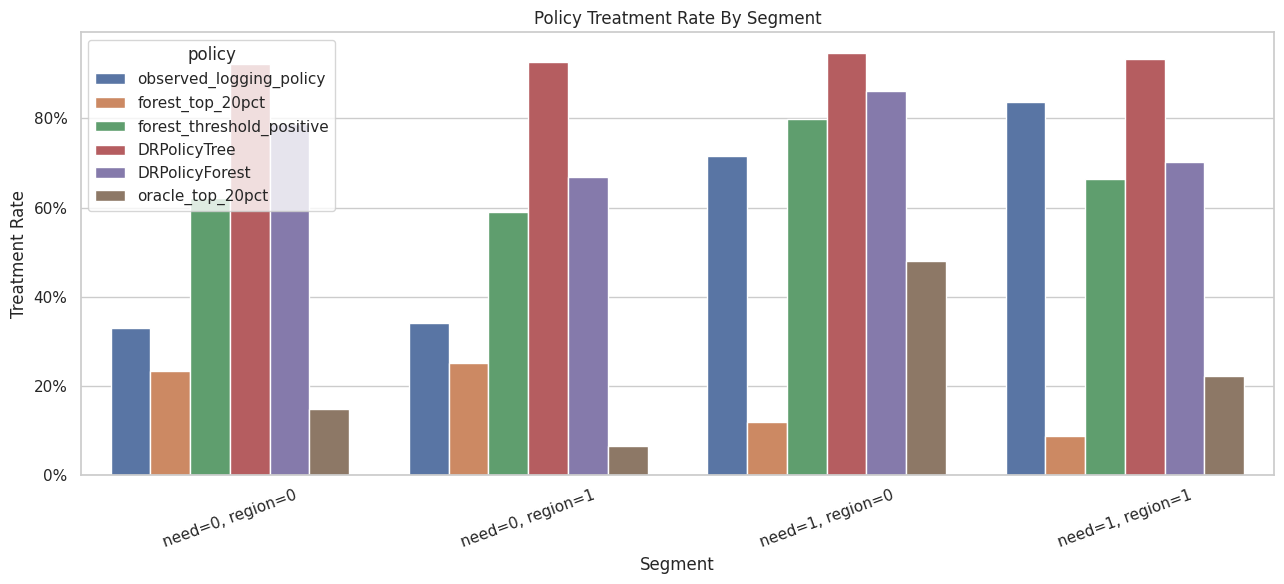
Policies encode priorities. Segment treatment-rate plots make those priorities explicit and easier to audit.
For the broader lesson, the estimate should be interpreted together with the identifying assumptions and diagnostics that make it credible.
Support-Aware Policy Diagnostics
A high-value policy can still be risky if it selects many rows from weak-overlap regions. The next table summarizes propensity and interval width among selected rows.
support_policy_actions = {
    "forest_threshold_positive": policy_actions["forest_threshold_positive"],
    "forest_conservative_lower_positive": policy_actions["forest_conservative_lower_positive"],
    "forest_top_20pct": policy_actions["forest_top_20pct"],
    "DRPolicyTree": tree_policy_action,
    "DRPolicyForest": forest_policy_action,
    "oracle_top_20pct": policy_actions["oracle_top_20pct"],
}
support_rows = []
for policy_name, action in support_policy_actions.items():
    selected = test_results.loc[action == 1]
    support_rows.append(
        {
            "policy": policy_name,
            "treated_rows": len(selected),
            "treatment_rate": action.mean(),
            "average_propensity_selected": selected["propensity"].mean() if len(selected) else np.nan,
            "share_selected_propensity_below_0_10": (selected["propensity"] < 0.10).mean() if len(selected) else 0.0,
            "share_selected_propensity_above_0_90": (selected["propensity"] > 0.90).mean() if len(selected) else 0.0,
            "average_forest_interval_width_selected": selected["forest_ci_width"].mean() if len(selected) else np.nan,
            "share_selected_negative_true_net_cate": (selected["true_net_cate"] < 0).mean() if len(selected) else 0.0,
        }
    )
support_policy_summary = pd.DataFrame(support_rows)
support_policy_summary.to_csv(TABLE_DIR / "07_support_policy_summary.csv", index=False)
display(support_policy_summary)| policy | treated_rows | treatment_rate | average_propensity_selected | share_selected_propensity_below_0_10 | share_selected_propensity_above_0_90 | average_forest_interval_width_selected | share_selected_negative_true_net_cate | |
|---|---|---|---|---|---|---|---|---|
| 0 | forest_threshold_positive | 686 | 0.6533 | 0.4723 | 0.0816 | 0.0423 | 0.5751 | 0.2813 |
| 1 | forest_conservative_lower_positive | 242 | 0.2305 | 0.4001 | 0.0992 | 0.0083 | 0.5255 | 0.1901 |
| 2 | forest_top_20pct | 210 | 0.2000 | 0.3580 | 0.1333 | 0.0238 | 0.5994 | 0.2429 |
| 3 | DRPolicyTree | 976 | 0.9295 | 0.4605 | 0.0523 | 0.0256 | 0.5394 | 0.4457 |
| 4 | DRPolicyForest | 804 | 0.7657 | 0.4793 | 0.0585 | 0.0373 | 0.5531 | 0.3047 |
| 5 | oracle_top_20pct | 210 | 0.2000 | 0.6500 | 0.0000 | 0.0762 | 0.5410 | 0.0000 |
Policy value should be reported alongside support diagnostics. A policy that relies on extreme-propensity rows may need experimental validation before deployment.
Threshold Sensitivity
A zero threshold is natural for net benefit, but analysts may choose a higher threshold to be conservative. The code below evaluates causal-forest threshold policies across several thresholds.
threshold_grid = np.round(np.arange(-0.15, 0.36, 0.05), 2)
threshold_rows = []
for threshold in threshold_grid:
    action = (forest_net_cate_test > threshold).astype(int)
    row = {"threshold": threshold}
    row.update(evaluate_policy(action, true_net_cate_test, baseline_mu0=baseline_mu0_test))
    threshold_rows.append(row)
threshold_sensitivity = pd.DataFrame(threshold_rows)
threshold_sensitivity.to_csv(TABLE_DIR / "07_threshold_sensitivity.csv", index=False)
display(threshold_sensitivity)| threshold | treatment_rate | treated_rows | true_policy_gain_vs_treat_none | true_total_policy_value | average_true_net_cate_among_treated_by_policy | share_selected_with_negative_true_net_cate | |
|---|---|---|---|---|---|---|---|
| 0 | -0.1500 | 0.9162 | 962 | 0.1103 | 2.3883 | 0.1204 | 0.3909 |
| 1 | -0.1000 | 0.8276 | 869 | 0.1334 | 2.4114 | 0.1612 | 0.3418 |
| 2 | -0.0500 | 0.7371 | 774 | 0.1442 | 2.4222 | 0.1956 | 0.3010 |
| 3 | 0.0000 | 0.6533 | 686 | 0.1436 | 2.4216 | 0.2198 | 0.2813 |
| 4 | 0.0500 | 0.5590 | 587 | 0.1398 | 2.4178 | 0.2500 | 0.2572 |
| 5 | 0.1000 | 0.4724 | 496 | 0.1283 | 2.4063 | 0.2716 | 0.2440 |
| 6 | 0.1500 | 0.3848 | 404 | 0.1107 | 2.3887 | 0.2876 | 0.2327 |
| 7 | 0.2000 | 0.3076 | 323 | 0.0917 | 2.3697 | 0.2980 | 0.2229 |
| 8 | 0.2500 | 0.2486 | 261 | 0.0730 | 2.3510 | 0.2936 | 0.2299 |
| 9 | 0.3000 | 0.2057 | 216 | 0.0572 | 2.3352 | 0.2780 | 0.2454 |
| 10 | 0.3500 | 0.1619 | 170 | 0.0454 | 2.3234 | 0.2802 | 0.2235 |
Raising the threshold usually treats fewer rows with higher average benefit among selected units. The best threshold depends on policy goals, costs, and risk tolerance.
Threshold Sensitivity Plot
The plot shows the tradeoff between treatment rate and true policy gain as the threshold changes.
fig, ax1 = plt.subplots(figsize=(10, 5))
sns.lineplot(data=threshold_sensitivity, x="threshold", y="true_policy_gain_vs_treat_none", marker="o", color="#2563eb", ax=ax1, label="policy gain")
ax1.set_ylabel("Average True Net Gain")
ax1.set_xlabel("Forest Net CATE Threshold")
ax2 = ax1.twinx()
sns.lineplot(data=threshold_sensitivity, x="threshold", y="treatment_rate", marker="o", color="#dc2626", ax=ax2, label="treatment rate")
ax2.set_ylabel("Treatment Rate")
ax2.yaxis.set_major_formatter(lambda x, _: f"{x:.0%}")
ax1.set_title("Threshold Sensitivity For CausalForestDML Policy")
fig.tight_layout()
fig.savefig(FIGURE_DIR / "07_threshold_sensitivity.png", dpi=160, bbox_inches="tight")
plt.show()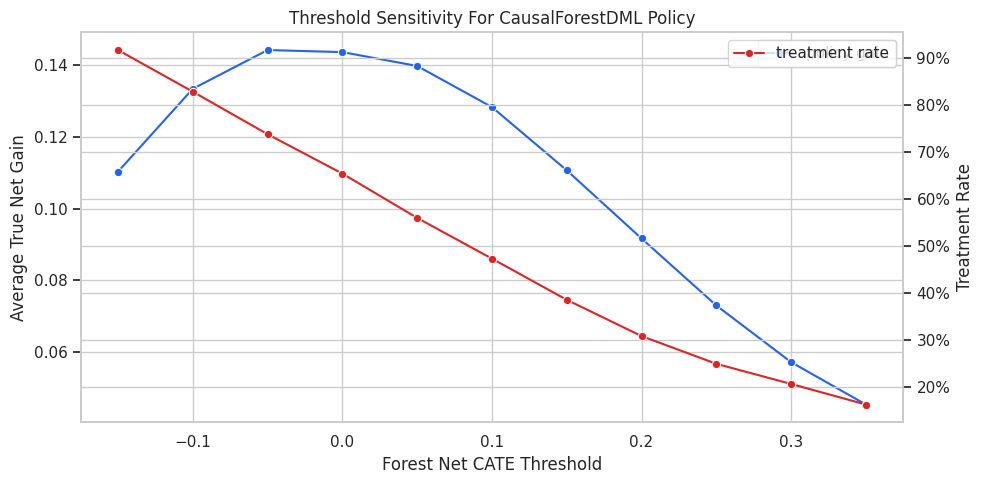
Policy thresholds are business and risk decisions, not purely statistical choices. The curve makes the tradeoff visible.
The lesson is robustness: a publishable conclusion should not hinge on one arbitrary threshold, one lucky sample split, or one narrow tuning choice.
Reporting and Takeaways
Policy Learning Guidance
This table summarizes when to use different policy approaches.
| situation | reasonable policy | watchout |
|---|---|---|
| No fixed budget and treatment cost is known | Treat if estimated net CATE is above zero | Point estimates near zero are fragile; consider uncertainty or a margin. |
| Fixed treatment capacity | Top-k ranking by estimated net CATE | Budget curves should be checked instead of relying on one k value. |
| Need an interpretable action rule | DRPolicyTree or shallow tree over CATE scores | Interpretability can cost value; compare against score-based policies. |
| Need stronger predictive action performance | DRPolicyForest or flexible CATE ranking | The rule may be harder to explain and still needs support checks. |
| Offline observational data only | Treat learned policy as a candidate for evaluation | Real deployment should use experiments or valid off-policy evaluation. |
Policy choice depends on operational constraints. The same CATE model can lead to different action rules under different costs, budgets, and risk tolerances.
Policy Learning Checklist
Before presenting a treatment policy, it is worth checking the items below.
| check | why_it_matters |
|---|---|
| Treatment and outcome are clearly defined | A policy acts on a specific intervention and optimizes a specific response. |
| Treatment cost is included or explicitly justified | Positive gross effects can become negative net effects after cost. |
| All features are pre-treatment | Policy rules must be available before deciding treatment. |
| Overlap is inspected | Unsupported regions make action recommendations extrapolative. |
| CATE ranking quality is evaluated | Targeting depends on ranking more than average effect alone. |
| Policy value is compared with simple baselines | A learned policy should beat treat-none, treat-all, random, and simple top-k rules. |
| Treatment rate and budget are reported | Policy value depends on how many units are treated. |
| Segment-level action rates are audited | Overall gain can hide uneven treatment allocation. |
| Uncertainty or conservative margins are considered | Policies based on noisy effects can over-treat borderline units. |
| Deployment requires evaluation | Offline policy value from observational data is not enough by itself. |
Policy learning is a decision workflow, more than a model-fitting exercise. Good reporting includes value, support, uncertainty, and action-distribution diagnostics.
The decision implication is that estimated gains need to be filtered through uncertainty, cost, support, and operational constraints before becoming actions.
Summary
This lesson turned CATE estimates into treatment policies.
The main takeaways are:
- policy learning is about choosing actions, more than estimating effects;
- treatment cost should be included when defining net benefit;
- threshold policies and budgeted top-k policies answer different operational problems;
- direct EconML policy learners can learn action rules without first exposing CATE scores;
- policy value should be compared against simple baselines and oracle benchmarks when available;
- segment treatment rates, support diagnostics, and uncertainty checks are essential for responsible policy reporting;
- real-world deployment requires prospective evaluation or valid off-policy evaluation.
The sequence next focuses on interpreting CATE models more deeply with feature importance, SHAP-style explanations, and segment-level summaries.