01. MovieLens Interference Setup and EDA
Introduces the user-item setting, constructs the networked structure, and explains why ordinary no-interference assumptions are too strong for this lab.
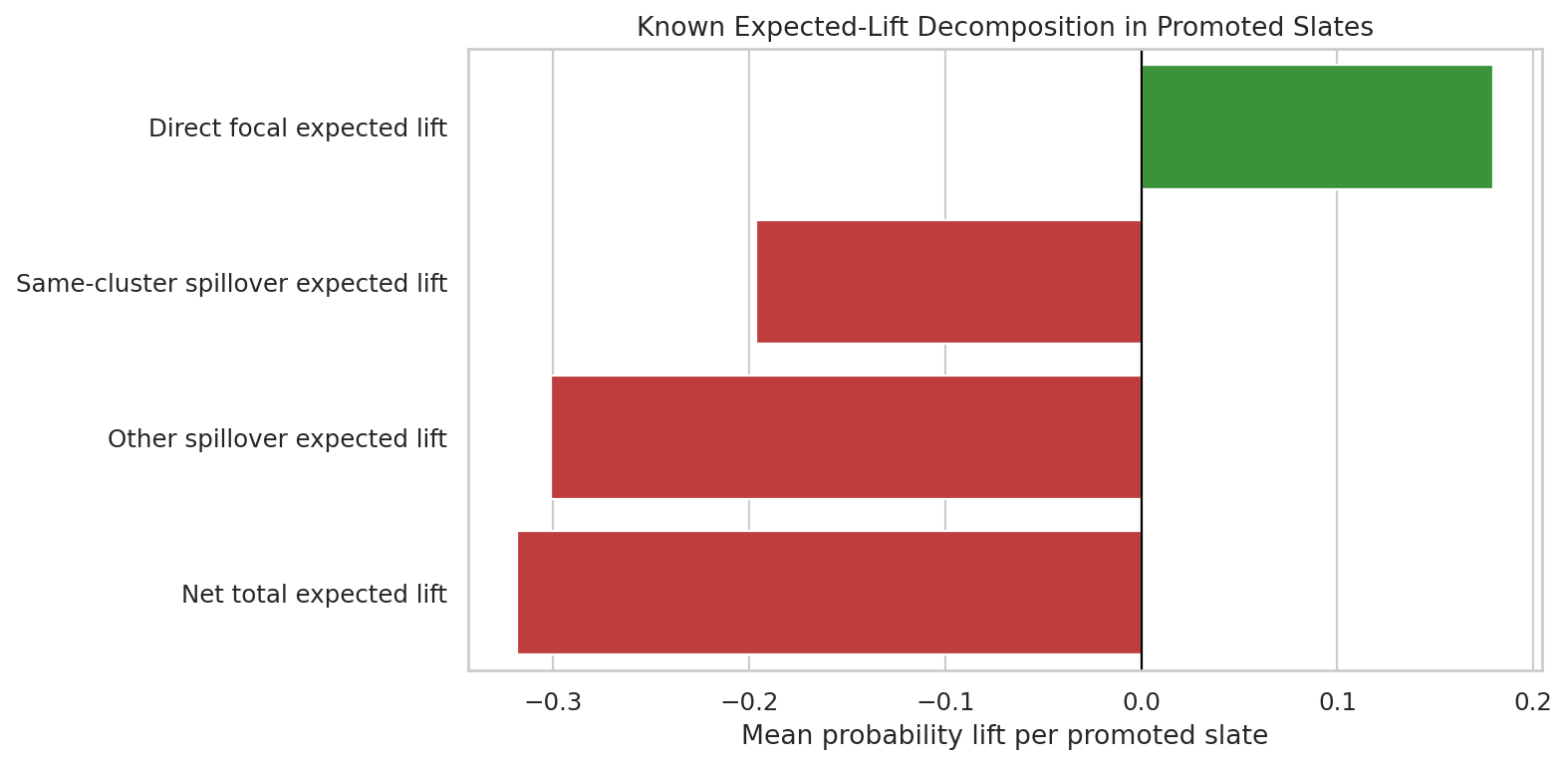
This lab studies settings where one unit’s treatment can affect another unit’s outcome. That matters in recommendation, marketplace, and networked systems because exposure can propagate through shared items, users, clusters, or local neighborhoods.
The workflow starts by defining exposure before estimation. It then compares naive estimators with exposure-aware designs, separates direct and indirect effects, and studies how conclusions change when the spillover definition changes.
01. MovieLens Interference Setup and EDA
Introduces the user-item setting, constructs the networked structure, and explains why ordinary no-interference assumptions are too strong for this lab.
02. Spillover Exposure Mapping
Defines exposure summaries that translate neighboring treatment assignments into measurable spillover conditions.
03. Cluster Randomized Estimators
Uses clustered assignment logic to estimate effects when correlated exposure and spillover risk make individual assignment less credible.
04. Direct, Indirect, and Total Effects
Decomposes the overall effect into direct treatment effects and spillover pathways, making the estimand match the system behavior.
Adds richer modeling and targeting analyses to study where spillovers are strongest and how policy value changes under network-aware estimation.