Builds the sequential user-item setting and introduces the data structure needed to study effects that unfold over time.
Long-Term Effects in Recommender Systems
Causal Inference
Recommender Systems
Project Lab
An applied causal inference lab on short- and long-term recommender-system effects under time-varying confounding.
This lab studies the difference between immediate engagement and longer-term user response in recommender systems. A recommendation intervention can change what a user watches now and can also shape future exposure, future preferences, and later engagement. That makes the causal problem sequential and history-dependent.
The lab builds a time-indexed workflow with treatment history, outcome windows, time-varying confounders, and policy-relevant estimands. It introduces marginal structural models and g-computation as practical tools for reasoning about sequential effects when earlier exposure changes later context.
Key Takeaway
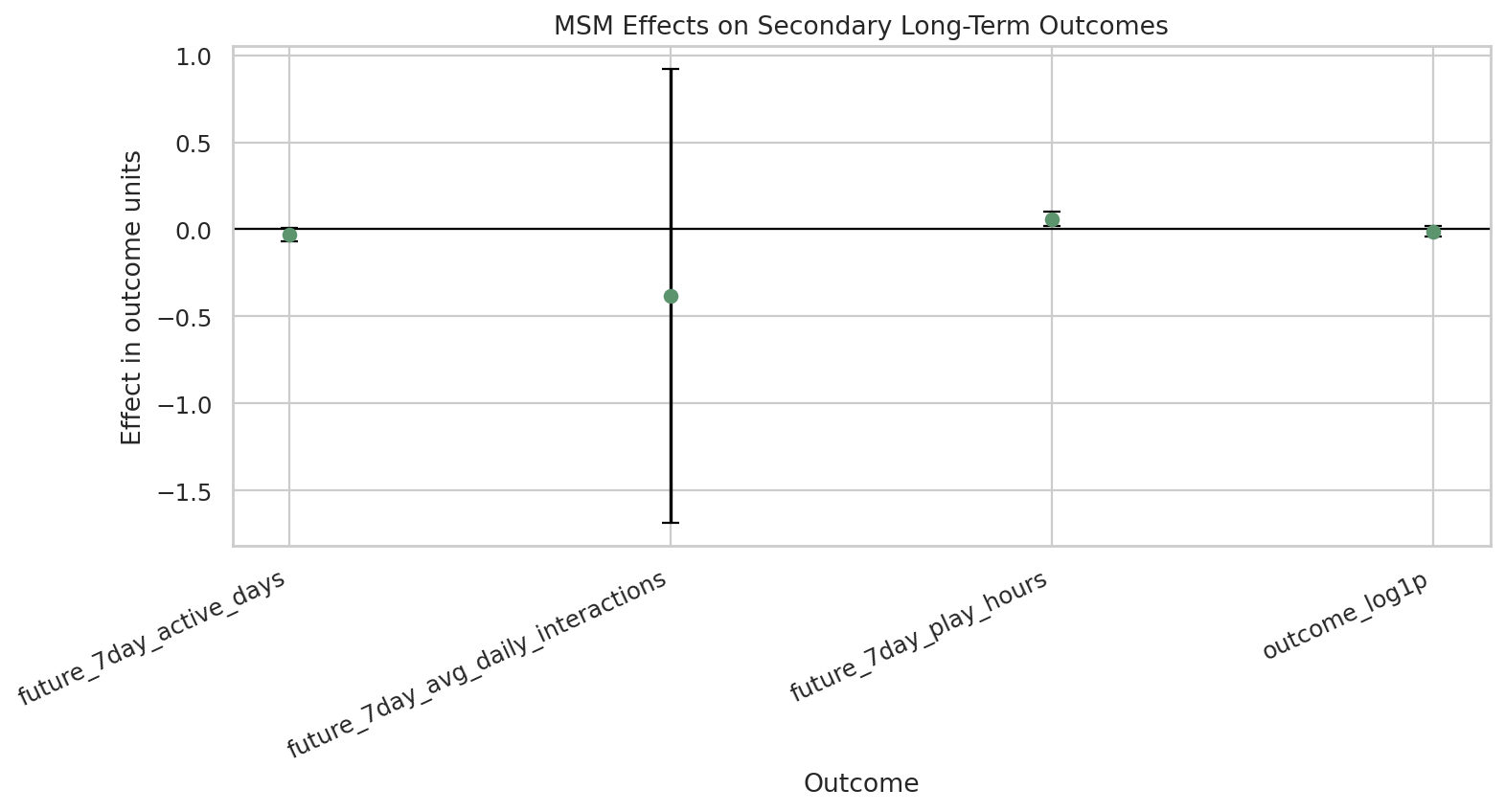
Across marginal structural models, g-computation, and doubly robust estimation, the KuaiRec evidence is weak for a clear average long-term interaction-volume gain from short-term high-watch exposure. The project is most useful as a diagnostic workflow. Logged recommender data can identify where short-term engagement may be fragile, which user-history segments deserve follow-up tests, and what evidence should be collected before changing a ranking or recommendation policy.
Lab Sequence
02. Long-Term Outcome Definition
Defines short- and long-term outcomes, clarifies the timing of treatment and response, and shows why outcome windows are design choices.
03. Time-Varying Confounding and Propensity
Models treatment assignment across time and shows how prior behavior can affect both future exposure and future outcomes.
Uses inverse probability weights to estimate sequential effects while accounting for time-varying confounders affected by earlier exposure.
Builds outcome models for counterfactual trajectories and compares model-based sequential estimates with weighted approaches.
06. Doubly Robust Heterogeneous Effects
Studies how longer-term effects vary across users and contexts while combining outcome and propensity information for more stable estimation.