from pathlib import Path
import warnings
import matplotlib.pyplot as plt
import numpy as np
import pandas as pd
import seaborn as sns
from IPython.display import display
from lightgbm import LGBMRegressor
from sklearn.base import clone
from sklearn.compose import ColumnTransformer
from sklearn.metrics import mean_absolute_error, mean_squared_error, r2_score
from sklearn.model_selection import GroupKFold
from sklearn.pipeline import Pipeline
from sklearn.preprocessing import OneHotEncoder
warnings.filterwarnings("ignore", category=FutureWarning)
warnings.filterwarnings("ignore", message="X does not have valid feature names")
pd.set_option("display.max_columns", 150)
pd.set_option("display.max_rows", 150)
pd.set_option("display.float_format", lambda value: f"{value:,.4f}")
sns.set_theme(style="whitegrid", context="notebook")
RANDOM_STATE = 4206: Doubly Robust Heterogeneous Effects
The project now has two complementary average-effect estimators:
- Marginal structural model from Notebook 04: models treatment assignment and uses inverse probability weights.
- G-computation from Notebook 05: models the future outcome directly and simulates treatment versus control.
This notebook adds a third strategy: doubly robust estimation with AIPW scores. AIPW stands for augmented inverse probability weighting. It combines the propensity model from Notebook 03 with the outcome models from Notebook 05.
The main question remains the same:
What is the effect of a high-watch-exposure day on future 7-day interaction volume?
The new question in this notebook is:
Even if the average effect is small, are there user-history segments where high-watch exposure appears more helpful or more harmful?
That second question matters in recommender systems because a global average can hide useful personalization signals. The same exposure pattern may help some user states and hurt others.
Dataset and Sequential Design Context
This project uses KuaiRec interaction logs organized into a user-day panel. The raw data contain user-video interactions, watch behavior, user features, item metadata, and item daily popularity information.
The data come from a real observational sequential recommendation log. Daily exposure was created by the recommender system, so assignment must be treated as time-varying and confounded. The treatment is a constructed high-watch-exposure day, the primary outcome is future seven-day engagement, and lagged user behavior is both a predictor of treatment and a predictor of future outcomes.
The project studies a sequential causal question: whether short-term exposure is associated with later engagement after adjusting for observed history. Marginal structural models, g-computation, doubly robust estimation, overlap diagnostics, and heterogeneity checks are used to decide whether the evidence is credible enough to motivate a future online test.
Role of this notebook. This notebook combines nuisance models in a doubly robust workflow and studies heterogeneity by recent engagement and watch-quality history.
Mathematical Setup
This notebook combines doubly robust scores with segment-level summaries. The AIPW pseudo-outcome for row (i) is
\[ \widehat\phi_i= \widehat\mu_1(X_i)-\widehat\mu_0(X_i) +\frac{A_i\{Y_i-\widehat\mu_1(X_i)\}}{\widehat e(X_i)} -\frac{(1-A_i)\{Y_i-\widehat\mu_0(X_i)\}}{1-\widehat e(X_i)}. \]
For a segment (S_i=s), the heterogeneous effect estimate is
\[ \widehat\tau(s)=\frac{1}{n_s}\sum_{i:S_i=s}\widehat\phi_i. \]
This framing separates the average effect of short-term high-watch exposure from the user histories where that effect appears larger or smaller.
Why Doubly Robust Estimation Helps
AIPW is useful because it combines two nuisance models:
- a propensity model:
P(treatment = 1 | pre-treatment history); - an outcome model:
E[outcome | treatment, pre-treatment history].
The AIPW score for each row is:
m1(X) - m0(X)
+ A * (Y - m1(X)) / e(X)
- (1 - A) * (Y - m0(X)) / (1 - e(X))
Where:
Ais treatment;Yis the observed future outcome;e(X)is the propensity score;m1(X)is the predicted outcome under treatment;m0(X)is the predicted outcome under control.
AIPW is called doubly robust because, under standard assumptions, it can remain consistent if either the propensity model or the outcome model is correctly specified. In practice, it is also a useful diagnostic. Agreement among MSM, g-computation, and AIPW makes the conclusion more credible.
Setup
This cell imports the tools used for AIPW scoring, clustered bootstrap uncertainty, segment summaries, and effect-smoothing models. The effect-smoothing model is used as a diagnostic smoother; it is used to make noisy AIPW pseudo-effects easier to summarize.
The notebook environment is ready for doubly robust estimation. The key inputs will be loaded from earlier notebooks, so this notebook focuses on combining nuisance predictions and summarizing heterogeneity.
Locate Saved Project Outputs
This notebook reuses three saved outputs:
- the weighted panel with propensity scores from Notebook 03;
- the counterfactual outcome predictions from Notebook 05;
- the estimator comparison table from Notebook 05.
Loading these files keeps the project modular and avoids refitting nuisance models unnecessarily.
WEIGHTED_PANEL_RELATIVE_PATH = Path("data/processed/kuairec_long_term_weighted_panel.parquet")
GCOMP_COUNTERFACTUALS_RELATIVE_PATH = Path("data/processed/kuairec_long_term_gcomp_counterfactuals.parquet")
ESTIMATOR_COMPARISON_RELATIVE_PATH = Path("data/processed/kuairec_long_term_estimator_comparison.csv")

candidate_roots = [Path.cwd(), *Path.cwd().parents]
PROJECT_ROOT = next(
    (path for path in candidate_roots if (path / WEIGHTED_PANEL_RELATIVE_PATH).exists()),
    None,
)

if PROJECT_ROOT is None:
    raise FileNotFoundError(
        f"Could not find {WEIGHTED_PANEL_RELATIVE_PATH}. Run Notebooks 03-05 first or run this notebook inside the project."
    )

PROCESSED_DIR = PROJECT_ROOT / "data" / "processed"
PANEL_PATH = PROJECT_ROOT / WEIGHTED_PANEL_RELATIVE_PATH
COUNTERFACTUALS_PATH = PROJECT_ROOT / GCOMP_COUNTERFACTUALS_RELATIVE_PATH
ESTIMATOR_COMPARISON_PATH = PROJECT_ROOT / ESTIMATOR_COMPARISON_RELATIVE_PATH

print(f"Project root: {PROJECT_ROOT}")
print(f"Weighted panel: {PANEL_PATH}")
print(f"G-computation counterfactuals: {COUNTERFACTUALS_PATH}")
print(f"Estimator comparison: {ESTIMATOR_COMPARISON_PATH}")
print(f"Processed output folder: {PROCESSED_DIR}")
The required saved outputs are present. This confirms the notebook can reuse the propensity and outcome nuisance predictions that were already created in a cross-fitted way. This keeps the analysis auditable because a reader can trace the final claim back to the exact table or figure that produced it.
Load Propensity Scores and Outcome Nuisance Predictions
The weighted panel contains the treatment, outcome, propensity scores, and pre-treatment history. The counterfactual table contains pred_y1 and pred_y0 from the linear and LightGBM g-computation models.
panel = pd.read_parquet(PANEL_PATH)
panel["event_date"] = pd.to_datetime(panel["event_date"])
panel = panel.sort_values(["user_id", "event_date"]).reset_index(drop=True)

counterfactuals = pd.read_parquet(COUNTERFACTUALS_PATH)
counterfactuals["event_date"] = pd.to_datetime(counterfactuals["event_date"])

estimator_comparison = pd.read_csv(ESTIMATOR_COMPARISON_PATH)

PRIMARY_TREATMENT = "treatment"
PRIMARY_OUTCOME = "outcome"

print(f"Weighted panel shape: {panel.shape}")
print(f"Counterfactual table shape: {counterfactuals.shape}")
print(f"Outcome nuisance models: {sorted(counterfactuals['model'].unique())}")

display(panel[["user_id", "event_date", PRIMARY_TREATMENT, PRIMARY_OUTCOME, "propensity_logistic", "propensity_lightgbm"]].head())
display(counterfactuals.head())
Weighted panel shape: (4698, 40)
Counterfactual table shape: (9396, 10)
Outcome nuisance models: ['lightgbm', 'linear_ridge']| user_id | event_date | treatment | outcome | propensity_logistic | propensity_lightgbm | |
|---|---|---|---|---|---|---|
| 0 | 14 | 2020-07-08 | 1 | 279.0000 | 0.5471 | 0.5266 |
| 1 | 14 | 2020-07-09 | 0 | 311.0000 | 0.6333 | 0.5373 |
| 2 | 14 | 2020-07-10 | 1 | 352.0000 | 0.4140 | 0.5234 |
| 3 | 14 | 2020-07-11 | 1 | 437.0000 | 0.5654 | 0.6503 |
| 4 | 14 | 2020-07-12 | 0 | 437.0000 | 0.5986 | 0.7418 |
| user_id | event_date | model | treatment | outcome | pred_observed | pred_y1 | pred_y0 | cate_hat | residual | |
|---|---|---|---|---|---|---|---|---|---|---|
| 0 | 14 | 2020-07-08 | linear_ridge | 1 | 279.0000 | 519.6987 | 519.6987 | 515.8710 | 3.8276 | -240.6987 |
| 1 | 14 | 2020-07-09 | linear_ridge | 0 | 311.0000 | 497.2763 | 501.1040 | 497.2763 | 3.8276 | -186.2763 |
| 2 | 14 | 2020-07-10 | linear_ridge | 1 | 352.0000 | 520.0026 | 520.0026 | 516.1750 | 3.8276 | -168.0026 |
| 3 | 14 | 2020-07-11 | linear_ridge | 1 | 437.0000 | 495.6651 | 495.6651 | 491.8375 | 3.8276 | -58.6651 |
| 4 | 14 | 2020-07-12 | linear_ridge | 0 | 437.0000 | 497.5665 | 501.3941 | 497.5665 | 3.8276 | -60.5665 |
The loaded tables line up at the user-day level. The counterfactual table has one row per user-day per outcome model, which lets us compute AIPW estimates for multiple propensity/outcome model combinations.
Merge Nuisance Predictions into an AIPW Base Table
The next cell joins propensity scores and pre-treatment covariates onto the counterfactual predictions. This produces the row-level table needed for AIPW scoring.
# Merge nuisance predictions into an AIPW base table.
pre_treatment_covariates = [
    "lag_1_active_day",
    "lag_1_interactions",
    "lag_1_total_play_duration_sec",
    "lag_1_avg_watch_ratio",
    "lag_1_high_watch_share",
    "prior_3day_active_day",
    "prior_3day_interactions",
    "prior_3day_total_play_duration_sec",
    "prior_3day_avg_watch_ratio",
    "prior_3day_high_watch_share",
    "calendar_day_index",
    "panel_day_index",
    "day_of_week",
]

panel_for_merge = panel[
    [
        "user_id",
        "event_date",
        "propensity_logistic",
        "propensity_lightgbm",
        "analysis_weight",
        *pre_treatment_covariates,
    ]
].copy()

aipw_base = counterfactuals.merge(
    panel_for_merge,
    on=["user_id", "event_date"],
    how="left",
    validate="many_to_one",
)

required_aipw_columns = [
    PRIMARY_TREATMENT,
    PRIMARY_OUTCOME,
    "pred_y1",
    "pred_y0",
    "propensity_logistic",
    "propensity_lightgbm",
]
missing_rates = aipw_base[required_aipw_columns].isna().mean().rename("missing_rate").reset_index().rename(columns={"index": "column"})

display(missing_rates)
display(aipw_base.head())| column | missing_rate | |
|---|---|---|
| 0 | treatment | 0.0000 |
| 1 | outcome | 0.0000 |
| 2 | pred_y1 | 0.0000 |
| 3 | pred_y0 | 0.0000 |
| 4 | propensity_logistic | 0.0000 |
| 5 | propensity_lightgbm | 0.0000 |
| user_id | event_date | model | treatment | outcome | pred_observed | pred_y1 | pred_y0 | cate_hat | residual | propensity_logistic | propensity_lightgbm | analysis_weight | lag_1_active_day | lag_1_interactions | lag_1_total_play_duration_sec | lag_1_avg_watch_ratio | lag_1_high_watch_share | prior_3day_active_day | prior_3day_interactions | prior_3day_total_play_duration_sec | prior_3day_avg_watch_ratio | prior_3day_high_watch_share | calendar_day_index | panel_day_index | day_of_week | |
|---|---|---|---|---|---|---|---|---|---|---|---|---|---|---|---|---|---|---|---|---|---|---|---|---|---|---|
| 0 | 14 | 2020-07-08 | linear_ridge | 1 | 279.0000 | 519.6987 | 519.6987 | 515.8710 | 3.8276 | -240.6987 | 0.5471 | 0.5266 | 0.9131 | 1.0000 | 78.0000 | 655.4890 | 0.8415 | 0.4615 | 3.0000 | 127.0000 | 1,144.8080 | 2.9900 | 1.5602 | 3 | 3 | Wednesday |
| 1 | 14 | 2020-07-09 | linear_ridge | 0 | 311.0000 | 497.2763 | 501.1040 | 497.2763 | 3.8276 | -186.2763 | 0.6333 | 0.5373 | 1.3647 | 1.0000 | 22.0000 | 201.9010 | 0.9828 | 0.5000 | 3.0000 | 123.0000 | 1,105.7340 | 2.8883 | 1.4833 | 4 | 4 | Thursday |
| 2 | 14 | 2020-07-10 | linear_ridge | 1 | 352.0000 | 520.0026 | 520.0026 | 516.1750 | 3.8276 | -168.0026 | 0.4140 | 0.5234 | 1.2067 | 1.0000 | 55.0000 | 485.0390 | 0.8619 | 0.3636 | 3.0000 | 155.0000 | 1,342.4290 | 2.6862 | 1.3252 | 5 | 5 | Friday |
| 3 | 14 | 2020-07-11 | linear_ridge | 1 | 437.0000 | 495.6651 | 495.6651 | 491.8375 | 3.8276 | -58.6651 | 0.5654 | 0.6503 | 0.8836 | 1.0000 | 52.0000 | 606.2440 | 1.1380 | 0.5769 | 3.0000 | 129.0000 | 1,293.1840 | 2.9827 | 1.4406 | 6 | 6 | Saturday |
| 4 | 14 | 2020-07-12 | linear_ridge | 0 | 437.0000 | 497.5665 | 501.3941 | 497.5665 | 3.8276 | -60.5665 | 0.5986 | 0.7418 | 1.2466 | 1.0000 | 32.0000 | 284.7470 | 0.9337 | 0.5000 | 3.0000 | 139.0000 | 1,376.0300 | 2.9336 | 1.4406 | 7 | 7 | Sunday |
The merged table has the ingredients for doubly robust scores: observed treatment, observed outcome, propensity scores, and predicted potential outcomes. Missingness should be zero for the required columns before any AIPW estimate is trusted.
Define the AIPW Score
This helper computes the AIPW score for one propensity model and one outcome model. Propensities are clipped away from 0 and 1 to prevent a small number of near-impossible treatment assignments from dominating the residual correction.
# Define the AIPW score.
def add_aipw_score(data, propensity_col, score_col, eps=0.01):
    """
    Add a doubly robust AIPW score to each user-day row.

    Idea
    ----
    The score combines outcome-model predictions, observed outcomes, treatment, and propensity scores so average and segment effects can be estimated from row-level scores.

    Parameters
    ----------
    data : object
        Input analysis table for the current project step.
    propensity_col : object
        Project-specific input named `propensity_col` used by this helper.
    score_col : object
        Project-specific input named `score_col` used by this helper.
    eps : object
        Small positive value used to avoid division by zero.

    Returns
    -------
    pandas.DataFrame
        Copy of the input panel with an AIPW score column.
    """
    result = data.copy()
    treatment = result[PRIMARY_TREATMENT].astype(float)
    outcome = result[PRIMARY_OUTCOME].astype(float)
    e_hat = result[propensity_col].astype(float).clip(eps, 1 - eps)
    m1_hat = result["pred_y1"].astype(float)
    m0_hat = result["pred_y0"].astype(float)

    result[f"{score_col}_e_clipped"] = e_hat
    result[score_col] = (
        (m1_hat - m0_hat)
        + treatment * (outcome - m1_hat) / e_hat
        - (1 - treatment) * (outcome - m0_hat) / (1 - e_hat)
    )
    return result

print("Defined AIPW score helper.")
Defined AIPW score helper.The helper implements the doubly robust score formula. The score combines the model-implied treatment contrast with residual corrections from the observed treated and control rows. The practical implication is that poor overlap or extreme propensity scores would make the adjusted estimate depend on a narrow slice of comparable observations.
Compute AIPW Scores for Nuisance Model Combinations
This cell computes AIPW scores for four combinations:
- logistic propensity + linear outcome;
- logistic propensity + LightGBM outcome;
- LightGBM propensity + linear outcome;
- LightGBM propensity + LightGBM outcome.
The primary doubly robust specification is logistic propensity plus LightGBM outcome, because Notebook 03 showed logistic propensities were stable and Notebook 05 showed LightGBM had better outcome prediction.
propensity_specs = {
    "logistic_propensity": "propensity_logistic",
    "lightgbm_propensity": "propensity_lightgbm",
}

score_frames = []
for outcome_model in sorted(aipw_base["model"].unique()):
    model_data = aipw_base.query("model == @outcome_model").copy()
    for propensity_name, propensity_col in propensity_specs.items():
        score_name = f"aipw_{propensity_name}_{outcome_model}_outcome"
        scored = add_aipw_score(model_data, propensity_col, score_name, eps=0.01)
        scored["propensity_model"] = propensity_name
        scored["outcome_model"] = outcome_model
        scored["aipw_score"] = scored[score_name]
        scored["aipw_score_name"] = score_name
        score_frames.append(scored)

aipw_scores = pd.concat(score_frames, ignore_index=True)
PRIMARY_AIPW_SCORE_NAME = "aipw_logistic_propensity_lightgbm_outcome"

print(f"AIPW score rows: {len(aipw_scores):,}")
print(f"Primary AIPW score: {PRIMARY_AIPW_SCORE_NAME}")
display(aipw_scores[["user_id", "event_date", "propensity_model", "outcome_model", "aipw_score"]].head())
AIPW score rows: 18,792
Primary AIPW score: aipw_logistic_propensity_lightgbm_outcome| user_id | event_date | propensity_model | outcome_model | aipw_score | |
|---|---|---|---|---|---|
| 0 | 14 | 2020-07-08 | logistic_propensity | lightgbm | -182.3750 |
| 1 | 14 | 2020-07-09 | logistic_propensity | lightgbm | 245.6311 |
| 2 | 14 | 2020-07-10 | logistic_propensity | lightgbm | -144.5768 |
| 3 | 14 | 2020-07-11 | logistic_propensity | lightgbm | 7.5475 |
| 4 | 14 | 2020-07-12 | logistic_propensity | lightgbm | 25.5266 |
The AIPW table now contains one score per user-day for each nuisance-model combination. The average of each score column is the corresponding doubly robust estimate. The practical implication is that poor overlap or extreme propensity scores would make the adjusted estimate depend on a narrow slice of comparable observations.
Summarize Doubly Robust Average Effects
This table averages the AIPW scores by nuisance model combination. It also reports the model-implied counterfactual means and the distribution of row-level scores.
aipw_results = (
    aipw_scores.groupby(["propensity_model", "outcome_model", "aipw_score_name"])
    .agg(
        n_rows=("aipw_score", "size"),
        n_users=("user_id", "nunique"),
        mean_y1_hat=("pred_y1", "mean"),
        mean_y0_hat=("pred_y0", "mean"),
        gcomp_component=("cate_hat", "mean"),
        aipw_ate=("aipw_score", "mean"),
        aipw_score_std=("aipw_score", "std"),
        aipw_p05=("aipw_score", lambda values: values.quantile(0.05)),
        aipw_median=("aipw_score", "median"),
        aipw_p95=("aipw_score", lambda values: values.quantile(0.95)),
        share_positive_score=("aipw_score", lambda values: (values > 0).mean()),
    )
    .reset_index()
)

aipw_results["relative_lift_vs_y0"] = aipw_results["aipw_ate"] / aipw_results["mean_y0_hat"]
aipw_results["is_primary_aipw"] = aipw_results["aipw_score_name"].eq(PRIMARY_AIPW_SCORE_NAME)

display(aipw_results)| propensity_model | outcome_model | aipw_score_name | n_rows | n_users | mean_y1_hat | mean_y0_hat | gcomp_component | aipw_ate | aipw_score_std | aipw_p05 | aipw_median | aipw_p95 | share_positive_score | relative_lift_vs_y0 | is_primary_aipw | |
|---|---|---|---|---|---|---|---|---|---|---|---|---|---|---|---|---|
| 0 | lightgbm_propensity | lightgbm | aipw_lightgbm_propensity_lightgbm_outcome | 4698 | 91 | 382.3398 | 382.3040 | 0.0359 | 1.9929 | 210.8940 | -230.0220 | 2.0653 | 218.2429 | 0.5109 | 0.0052 | False |
| 1 | lightgbm_propensity | linear_ridge | aipw_lightgbm_propensity_linear_ridge_outcome | 4698 | 91 | 383.2312 | 380.9024 | 2.3288 | 0.0236 | 325.4178 | -353.3088 | 6.5009 | 329.7477 | 0.5153 | 0.0001 | False |
| 2 | logistic_propensity | lightgbm | aipw_logistic_propensity_lightgbm_outcome | 4698 | 91 | 382.3398 | 382.3040 | 0.0359 | 1.0940 | 325.5438 | -227.4167 | 1.9645 | 214.8106 | 0.5109 | 0.0029 | True |
| 3 | logistic_propensity | linear_ridge | aipw_logistic_propensity_linear_ridge_outcome | 4698 | 91 | 383.2312 | 380.9024 | 2.3288 | -4.2621 | 462.7484 | -351.1020 | 6.3363 | 322.5791 | 0.5151 | -0.0112 | False |
The AIPW estimates add a third view of the average effect. Agreement across nuisance combinations would suggest the result is stable across propensity and outcome model choices.
User-Cluster Bootstrap for AIPW Estimates
Each user contributes multiple days, so uncertainty should be clustered by user. This bootstrap resamples users and recomputes the average AIPW score for each nuisance combination. The nuisance predictions are kept fixed, making this a practical uncertainty check for the score average.
# Prepare user-Cluster bootstrap for AIPW estimates.
def cluster_bootstrap_score_mean(data, score_col="aipw_score", group_col="user_id", n_bootstrap=400, random_state=RANDOM_STATE):
    """
    Bootstrap the mean AIPW score by user cluster.

    Idea
    ----
    Resampling users respects repeated user-day observations when forming uncertainty intervals for long-term effects.

    Parameters
    ----------
    data : object
        Input analysis table for the current project step.
    score_col : object
        Project-specific input named `score_col` used by this helper.
    group_col : object
        Project-specific input named `group_col` used by this helper.
    n_bootstrap : object
        Number of bootstrap resamples.
    random_state : object
        Random seed for reproducible resampling.

    Returns
    -------
    dict
        Bootstrap mean, standard error, and confidence interval.
    """
    rng = np.random.default_rng(random_state)
    user_ids = data[group_col].unique()
    user_groups = {user_id: group for user_id, group in data.groupby(group_col, sort=False)}
    rows = []
    for bootstrap_id in range(n_bootstrap):
        sampled_users = rng.choice(user_ids, size=len(user_ids), replace=True)
        sample = pd.concat([user_groups[user_id] for user_id in sampled_users], ignore_index=True)
        rows.append({"bootstrap_id": bootstrap_id, "estimate": sample[score_col].mean()})
    return pd.DataFrame(rows)

N_AIPW_BOOTSTRAP = 400
bootstrap_frames = []
for (propensity_model, outcome_model, score_name), group in aipw_scores.groupby(
    ["propensity_model", "outcome_model", "aipw_score_name"]
):
    boot = cluster_bootstrap_score_mean(group, n_bootstrap=N_AIPW_BOOTSTRAP)
    boot["propensity_model"] = propensity_model
    boot["outcome_model"] = outcome_model
    boot["aipw_score_name"] = score_name
    bootstrap_frames.append(boot)

aipw_bootstrap = pd.concat(bootstrap_frames, ignore_index=True)

aipw_bootstrap_summary = (
    aipw_bootstrap.groupby(["propensity_model", "outcome_model", "aipw_score_name"])
    .agg(
        bootstrap_reps=("estimate", "size"),
        bootstrap_mean=("estimate", "mean"),
        bootstrap_std=("estimate", "std"),
        ci_95_lower=("estimate", lambda values: values.quantile(0.025)),
        ci_95_upper=("estimate", lambda values: values.quantile(0.975)),
    )
    .reset_index()
)

aipw_results = aipw_results.merge(
    aipw_bootstrap_summary,
    on=["propensity_model", "outcome_model", "aipw_score_name"],
    how="left",
)

display(aipw_results)| propensity_model | outcome_model | aipw_score_name | n_rows | n_users | mean_y1_hat | mean_y0_hat | gcomp_component | aipw_ate | aipw_score_std | aipw_p05 | aipw_median | aipw_p95 | share_positive_score | relative_lift_vs_y0 | is_primary_aipw | bootstrap_reps | bootstrap_mean | bootstrap_std | ci_95_lower | ci_95_upper | |
|---|---|---|---|---|---|---|---|---|---|---|---|---|---|---|---|---|---|---|---|---|---|
| 0 | lightgbm_propensity | lightgbm | aipw_lightgbm_propensity_lightgbm_outcome | 4698 | 91 | 382.3398 | 382.3040 | 0.0359 | 1.9929 | 210.8940 | -230.0220 | 2.0653 | 218.2429 | 0.5109 | 0.0052 | False | 400 | 1.8301 | 2.8635 | -3.4280 | 7.5135 |
| 1 | lightgbm_propensity | linear_ridge | aipw_lightgbm_propensity_linear_ridge_outcome | 4698 | 91 | 383.2312 | 380.9024 | 2.3288 | 0.0236 | 325.4178 | -353.3088 | 6.5009 | 329.7477 | 0.5153 | 0.0001 | False | 400 | -0.3441 | 4.8857 | -9.9116 | 8.8830 |
| 2 | logistic_propensity | lightgbm | aipw_logistic_propensity_lightgbm_outcome | 4698 | 91 | 382.3398 | 382.3040 | 0.0359 | 1.0940 | 325.5438 | -227.4167 | 1.9645 | 214.8106 | 0.5109 | 0.0029 | True | 400 | 1.1991 | 5.0298 | -7.3428 | 12.0178 |
| 3 | logistic_propensity | linear_ridge | aipw_logistic_propensity_linear_ridge_outcome | 4698 | 91 | 383.2312 | 380.9024 | 2.3288 | -4.2621 | 462.7484 | -351.1020 | 6.3363 | 322.5791 | 0.5151 | -0.0112 | False | 400 | -4.6326 | 7.2876 | -21.6843 | 8.2386 |
The bootstrap intervals add uncertainty to the doubly robust estimates. If the intervals cross zero, the doubly robust estimate should be reported as uncertain even if the point estimate has a direction.
Plot AIPW Estimates Across Nuisance Combinations
This plot shows the doubly robust estimates and bootstrap intervals. It helps diagnose whether one nuisance combination is an outlier.
aipw_plot = aipw_results.copy()
aipw_plot["label"] = aipw_plot["propensity_model"] + "\n" + aipw_plot["outcome_model"]
aipw_plot["lower_error"] = aipw_plot["aipw_ate"] - aipw_plot["ci_95_lower"]
aipw_plot["upper_error"] = aipw_plot["ci_95_upper"] - aipw_plot["aipw_ate"]

fig, ax = plt.subplots(figsize=(9, 5))
ax.errorbar(
    x=np.arange(len(aipw_plot)),
    y=aipw_plot["aipw_ate"],
    yerr=[aipw_plot["lower_error"], aipw_plot["upper_error"]],
    fmt="o",
    color="#2A6F97",
    ecolor="black",
    capsize=4,
)
ax.axhline(0, color="black", linewidth=1)
ax.set_xticks(np.arange(len(aipw_plot)))
ax.set_xticklabels(aipw_plot["label"], rotation=20, ha="right")
ax.set_title("AIPW Estimates Across Nuisance Model Combinations")
ax.set_ylabel("Effect on future 7-day interactions")
ax.set_xlabel("Propensity model / outcome model")
plt.tight_layout()
plt.show()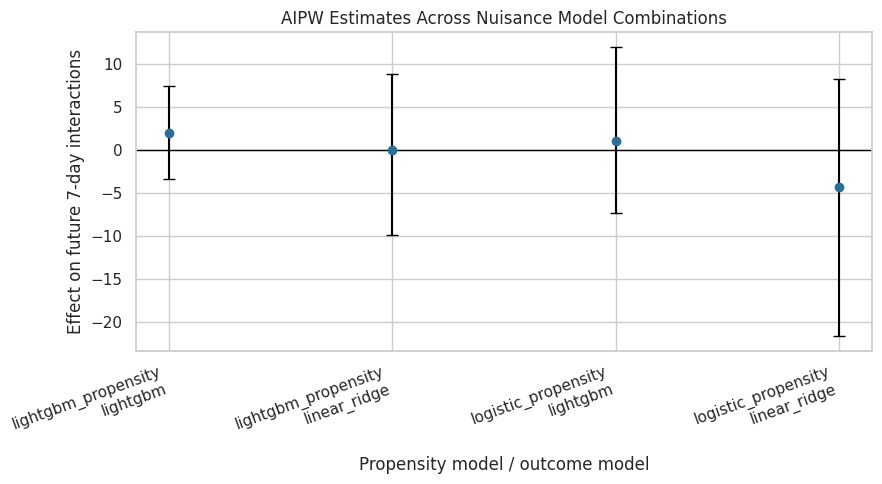
The plot makes cross-model stability easy to assess. If all AIPW intervals overlap heavily around zero, that reinforces the earlier MSM and g-computation conclusion that the average effect is small and uncertain.
Compare MSM, G-Computation, and AIPW
This cell appends the primary AIPW result to the existing estimator comparison table. This creates the main cross-estimator summary for the project conclusion.
# Compare MSM, g-computation, and AIPW.
primary_aipw = aipw_results.query("is_primary_aipw").iloc[0]
msm_control_mean = estimator_comparison.loc[
    estimator_comparison["method"].str.startswith("MSM"),
    "estimate",
].index

# Use the MSM comparison table's relative-lift denominator if available; otherwise use the AIPW m0 mean.
comparison_denominator = primary_aipw["mean_y0_hat"]
if "relative_lift_vs_msm_control_mean" in estimator_comparison.columns:
    msm_row = estimator_comparison.query("method.str.startswith('MSM')", engine="python").iloc[0]
    if pd.notna(msm_row["relative_lift_vs_msm_control_mean"]) and msm_row["relative_lift_vs_msm_control_mean"] != 0:
        comparison_denominator = msm_row["estimate"] / msm_row["relative_lift_vs_msm_control_mean"]

primary_aipw_row = pd.DataFrame(
    [
        {
            "method": "Doubly robust AIPW",
            "model": "logistic propensity + LightGBM outcome",
            "estimate": primary_aipw["aipw_ate"],
            "ci_95_lower": primary_aipw["ci_95_lower"],
            "ci_95_upper": primary_aipw["ci_95_upper"],
            "source": "Notebook 06 user-cluster bootstrap over AIPW scores",
            "relative_lift_vs_msm_control_mean": primary_aipw["aipw_ate"] / comparison_denominator,
        }
    ]
)

estimator_comparison_with_aipw = pd.concat(
    [estimator_comparison, primary_aipw_row],
    ignore_index=True,
)

display(estimator_comparison_with_aipw)| method | model | estimate | ci_95_lower | ci_95_upper | source | relative_lift_vs_msm_control_mean | |
|---|---|---|---|---|---|---|---|
| 0 | MSM: weighted calendar-adjusted | propensity_weighted_msm | -2.6877 | -12.2706 | 5.7291 | Notebook 04 user-cluster bootstrap | -0.0072 |
| 1 | G-computation | lightgbm | 0.0359 | -0.6384 | 1.8656 | Notebook 05 user-cluster bootstrap | 0.0001 |
| 2 | G-computation | linear_ridge | 2.3288 | -6.3238 | 9.3565 | Notebook 05 user-cluster bootstrap | 0.0062 |
| 3 | Doubly robust AIPW | logistic propensity + LightGBM outcome | 1.0940 | -7.3428 | 12.0178 | Notebook 06 user-cluster bootstrap over AIPW s... | 0.0029 |
The combined table now includes all three causal strategies. It shows whether weighting, outcome modeling, and doubly robust estimation tell a consistent story.
Plot Cross-Estimator Comparison Including AIPW
This plot places MSM, g-computation, and AIPW estimates on the same scale. The intervals come from the user-cluster bootstrap outputs in the relevant notebooks.
comparison_plot = estimator_comparison_with_aipw.copy()
comparison_plot["label"] = comparison_plot["method"] + "\n" + comparison_plot["model"]
comparison_plot["lower_error"] = comparison_plot["estimate"] - comparison_plot["ci_95_lower"]
comparison_plot["upper_error"] = comparison_plot["ci_95_upper"] - comparison_plot["estimate"]

fig, ax = plt.subplots(figsize=(10, 5.5))
ax.errorbar(
    x=np.arange(len(comparison_plot)),
    y=comparison_plot["estimate"],
    yerr=[comparison_plot["lower_error"], comparison_plot["upper_error"]],
    fmt="o",
    color="#2A6F97",
    ecolor="black",
    capsize=4,
)
ax.axhline(0, color="black", linewidth=1)
ax.set_xticks(np.arange(len(comparison_plot)))
ax.set_xticklabels(comparison_plot["label"], rotation=20, ha="right")
ax.set_title("Long-Term Effect Estimates Across Causal Strategies")
ax.set_ylabel("Effect on future 7-day interactions")
ax.set_xlabel("Estimator")
plt.tight_layout()
plt.show()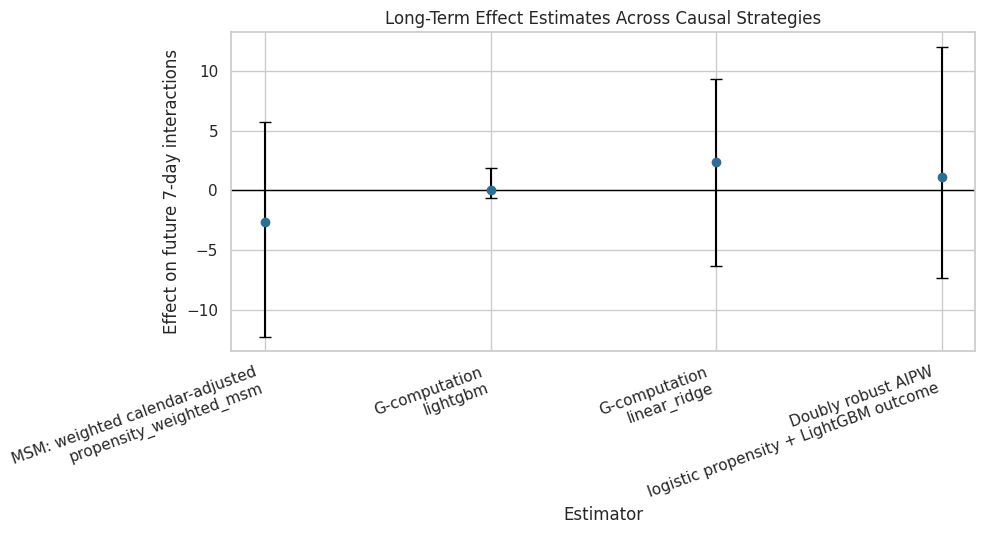
The cross-estimator plot is a clean final-modeling diagnostic. Agreement near zero is informative because the data provide weak support for a clear average long-term lift from this treatment definition.
Create User-History Segments for Heterogeneity
The average effect may hide differences across user states. This cell creates readable segments based on recent interaction volume, recent high-watch share, recent watch ratio, and day of week.
# Create user-History segments for heterogeneity.
segment_data = panel[
    [
        "user_id",
        "event_date",
        "day_of_week",
        "prior_3day_interactions",
        "prior_3day_high_watch_share",
        "prior_3day_avg_watch_ratio",
        "lag_1_interactions",
    ]
].copy()

segment_data["prior_interactions_bucket"] = pd.qcut(
    segment_data["prior_3day_interactions"],
    q=4,
    duplicates="drop",
).astype(str)
segment_data["prior_high_watch_bucket"] = pd.qcut(
    segment_data["prior_3day_high_watch_share"],
    q=4,
    duplicates="drop",
).astype(str)
segment_data["prior_watch_ratio_bucket"] = pd.qcut(
    segment_data["prior_3day_avg_watch_ratio"],
    q=4,
    duplicates="drop",
).astype(str)
segment_data["lag_interactions_bucket"] = pd.qcut(
    segment_data["lag_1_interactions"],
    q=4,
    duplicates="drop",
).astype(str)

segment_columns = [
    "prior_interactions_bucket",
    "prior_high_watch_bucket",
    "prior_watch_ratio_bucket",
    "lag_interactions_bucket",
    "day_of_week",
]

primary_scores = aipw_scores.query("aipw_score_name == @PRIMARY_AIPW_SCORE_NAME").copy()
primary_scores = primary_scores.merge(
    segment_data[["user_id", "event_date", *[col for col in segment_columns if col != "day_of_week"]]],
    on=["user_id", "event_date"],
    how="left",
    validate="one_to_one",
)

print("Created segment columns:")
for segment_col in segment_columns:
    print(f"- {segment_col}: {primary_scores[segment_col].nunique()} levels")
Created segment columns:
- prior_interactions_bucket: 4 levels
- prior_high_watch_bucket: 4 levels
- prior_watch_ratio_bucket: 4 levels
- lag_interactions_bucket: 4 levels
- day_of_week: 7 levelsThe segment columns translate continuous user histories into product-readable groups. This lets us ask whether the doubly robust score is systematically higher or lower for different recent engagement states.
Segment-Level Doubly Robust Effects
Segment-level effects are computed by averaging the primary AIPW score within each segment. This is a descriptive heterogeneity view, so the table includes minimum row and user counts to keep tiny segments from being overinterpreted.
# Estimate segment-level doubly robust effects.
def summarize_segment_effects(data, segment_col, score_col="aipw_score", min_rows=100, min_users=10):
    """
    Summarize doubly robust scores by segment.

    Idea
    ----
    This helper turns row-level AIPW scores into subgroup estimates so long-term effects can be compared across user-history segments.

    Parameters
    ----------
    data : object
        Input analysis table for the current project step.
    segment_col : object
        Column defining the segment to summarize.
    score_col : object
        Project-specific input named `score_col` used by this helper.
    min_rows : object
        Minimum rows required to keep a segment.
    min_users : object
        Minimum unique users required to keep a segment.

    Returns
    -------
    pandas.DataFrame
        Segment-level effect estimates with sample-size diagnostics.
    """
    summary = (
        data.groupby(segment_col, observed=True)
        .agg(
            rows=(score_col, "size"),
            users=("user_id", "nunique"),
            treatment_rate=(PRIMARY_TREATMENT, "mean"),
            observed_outcome_mean=(PRIMARY_OUTCOME, "mean"),
            aipw_ate=(score_col, "mean"),
            aipw_score_std=(score_col, "std"),
            gcomp_component=("cate_hat", "mean"),
            mean_propensity=("propensity_logistic", "mean"),
        )
        .reset_index()
        .rename(columns={segment_col: "segment"})
    )
    summary.insert(0, "segment_type", segment_col)
    summary["passes_size_filter"] = (summary["rows"] >= min_rows) & (summary["users"] >= min_users)
    return summary

segment_effect_tables = [summarize_segment_effects(primary_scores, segment_col) for segment_col in segment_columns]
segment_effects = pd.concat(segment_effect_tables, ignore_index=True)
segment_effects = segment_effects.sort_values(["segment_type", "aipw_ate"], ascending=[True, False])

display(segment_effects)| segment_type | segment | rows | users | treatment_rate | observed_outcome_mean | aipw_ate | aipw_score_std | gcomp_component | mean_propensity | passes_size_filter | |
|---|---|---|---|---|---|---|---|---|---|---|---|
| 21 | day_of_week | Tuesday | 623 | 91 | 0.4912 | 390.4575 | 20.0321 | 750.2361 | 0.0096 | 0.4917 | True |
| 22 | day_of_week | Wednesday | 711 | 91 | 0.4684 | 383.1899 | 1.8366 | 168.8665 | 0.0151 | 0.4673 | True |
| 16 | day_of_week | Friday | 702 | 91 | 0.5199 | 370.7877 | 0.6318 | 205.5002 | 0.0605 | 0.5201 | True |
| 20 | day_of_week | Thursday | 706 | 91 | 0.5057 | 375.7663 | -0.8262 | 221.5878 | 0.0502 | 0.5056 | True |
| 18 | day_of_week | Saturday | 710 | 91 | 0.4831 | 364.3127 | -3.2785 | 165.9187 | 0.0524 | 0.4826 | True |
| 19 | day_of_week | Sunday | 621 | 91 | 0.5523 | 400.9678 | -3.4574 | 201.6585 | 0.0243 | 0.5517 | True |
| 17 | day_of_week | Monday | 625 | 91 | 0.4800 | 393.7184 | -6.4503 | 170.7878 | 0.0344 | 0.4809 | True |
| 15 | lag_interactions_bucket | (75.0, 375.0] | 1146 | 91 | 0.4852 | 448.0070 | 16.2174 | 575.5850 | 0.0829 | 0.4860 | True |
| 13 | lag_interactions_bucket | (36.0, 53.0] | 1158 | 91 | 0.5052 | 384.2660 | -1.3738 | 193.1010 | -0.0205 | 0.4985 | True |
| 12 | lag_interactions_bucket | (-0.001, 36.0] | 1202 | 91 | 0.4917 | 290.3095 | -4.3047 | 166.3770 | -0.0194 | 0.5013 | True |
| 14 | lag_interactions_bucket | (53.0, 75.0] | 1192 | 91 | 0.5159 | 409.1242 | -5.6043 | 187.1179 | 0.1011 | 0.5115 | True |
| 4 | prior_high_watch_bucket | (-0.001, 1.127] | 1175 | 73 | 0.1677 | 368.0732 | 12.5337 | 549.1163 | 0.0551 | 0.1685 | True |
| 5 | prior_high_watch_bucket | (1.127, 1.414] | 1174 | 84 | 0.3424 | 386.3526 | 2.4564 | 154.8324 | 0.1259 | 0.3521 | True |
| 6 | prior_high_watch_bucket | (1.414, 1.708] | 1174 | 85 | 0.6235 | 384.5980 | -1.5016 | 147.9427 | -0.0251 | 0.6104 | True |
| 7 | prior_high_watch_bucket | (1.708, 2.735] | 1175 | 65 | 0.8647 | 389.3123 | -9.1134 | 276.4264 | -0.0124 | 0.8668 | True |
| 3 | prior_interactions_bucket | (217.0, 581.0] | 1169 | 91 | 0.4688 | 445.8435 | 25.6170 | 548.5773 | 0.1569 | 0.4787 | True |
| 0 | prior_interactions_bucket | (-0.001, 123.0] | 1183 | 91 | 0.4920 | 276.2113 | -0.7281 | 163.7490 | -0.0428 | 0.5010 | True |
| 1 | prior_interactions_bucket | (123.0, 166.0] | 1182 | 91 | 0.5178 | 386.9205 | -8.0145 | 233.7360 | 0.0062 | 0.5061 | True |
| 2 | prior_interactions_bucket | (166.0, 217.0] | 1164 | 91 | 0.5198 | 420.7345 | -12.4330 | 205.3765 | 0.0244 | 0.5120 | True |
| 8 | prior_watch_ratio_bucket | (-0.001, 2.26] | 1175 | 75 | 0.2119 | 371.7200 | 12.7319 | 549.7271 | 0.1169 | 0.2241 | True |
| 9 | prior_watch_ratio_bucket | (2.26, 2.59] | 1174 | 89 | 0.4421 | 376.9199 | 4.2636 | 157.1119 | 0.1366 | 0.4355 | True |
| 10 | prior_watch_ratio_bucket | (2.59, 3.004] | 1174 | 83 | 0.6550 | 391.3833 | 0.6755 | 157.5448 | -0.0435 | 0.6321 | True |
| 11 | prior_watch_ratio_bucket | (3.004, 11.372] | 1175 | 73 | 0.6894 | 388.3106 | -13.2926 | 268.3096 | -0.0665 | 0.7063 | True |
The segment table shows where the AIPW score is more positive or more negative. These patterns are useful for hypothesis generation and should be interpreted with uncertainty and support diagnostics.
Bootstrap Segment-Level Effects
This bootstrap resamples users and recomputes segment-level AIPW means. It gives uncertainty intervals for segment effects while respecting repeated user-days.
# Bootstrap segment-level effects.
def bootstrap_segment_effects(data, segment_col, score_col="aipw_score", n_bootstrap=250, random_state=RANDOM_STATE):
    """
    Bootstrap segment-level AIPW effects by user cluster.

    Idea
    ----
    The bootstrap respects repeated user-day observations and gives uncertainty intervals for heterogeneous long-term effect summaries.

    Parameters
    ----------
    data : object
        Input analysis table for the current project step.
    segment_col : object
        Column defining the segment to summarize.
    score_col : object
        Project-specific input named `score_col` used by this helper.
    n_bootstrap : object
        Number of bootstrap resamples.
    random_state : object
        Random seed for reproducible resampling.

    Returns
    -------
    pandas.DataFrame
        Segment estimates with bootstrap confidence intervals.
    """
    rng = np.random.default_rng(random_state)
    user_ids = data["user_id"].unique()
    user_groups = {user_id: group for user_id, group in data.groupby("user_id", sort=False)}
    rows = []
    for bootstrap_id in range(n_bootstrap):
        sampled_users = rng.choice(user_ids, size=len(user_ids), replace=True)
        sample = pd.concat([user_groups[user_id] for user_id in sampled_users], ignore_index=True)
        boot_summary = sample.groupby(segment_col, observed=True)[score_col].mean().reset_index()
        boot_summary["bootstrap_id"] = bootstrap_id
        rows.append(boot_summary.rename(columns={segment_col: "segment", score_col: "aipw_ate"}))
    result = pd.concat(rows, ignore_index=True)
    result.insert(0, "segment_type", segment_col)
    return result

segment_bootstrap_frames = []
for segment_col in segment_columns:
    segment_bootstrap_frames.append(bootstrap_segment_effects(primary_scores, segment_col))

segment_bootstrap = pd.concat(segment_bootstrap_frames, ignore_index=True)
segment_bootstrap_summary = (
    segment_bootstrap.groupby(["segment_type", "segment"])
    .agg(
        bootstrap_reps=("aipw_ate", "size"),
        bootstrap_mean=("aipw_ate", "mean"),
        bootstrap_std=("aipw_ate", "std"),
        ci_95_lower=("aipw_ate", lambda values: values.quantile(0.025)),
        ci_95_upper=("aipw_ate", lambda values: values.quantile(0.975)),
    )
    .reset_index()
)

segment_effects_with_ci = segment_effects.merge(
    segment_bootstrap_summary,
    on=["segment_type", "segment"],
    how="left",
)

display(segment_effects_with_ci)| segment_type | segment | rows | users | treatment_rate | observed_outcome_mean | aipw_ate | aipw_score_std | gcomp_component | mean_propensity | passes_size_filter | bootstrap_reps | bootstrap_mean | bootstrap_std | ci_95_lower | ci_95_upper | |
|---|---|---|---|---|---|---|---|---|---|---|---|---|---|---|---|---|
| 0 | day_of_week | Tuesday | 623 | 91 | 0.4912 | 390.4575 | 20.0321 | 750.2361 | 0.0096 | 0.4917 | True | 250 | 20.4314 | 32.7418 | -24.3380 | 90.8593 |
| 1 | day_of_week | Wednesday | 711 | 91 | 0.4684 | 383.1899 | 1.8366 | 168.8665 | 0.0151 | 0.4673 | True | 250 | 2.1471 | 7.8816 | -12.4635 | 18.6481 |
| 2 | day_of_week | Friday | 702 | 91 | 0.5199 | 370.7877 | 0.6318 | 205.5002 | 0.0605 | 0.5201 | True | 250 | 0.1500 | 7.1439 | -13.5674 | 13.8208 |
| 3 | day_of_week | Thursday | 706 | 91 | 0.5057 | 375.7663 | -0.8262 | 221.5878 | 0.0502 | 0.5056 | True | 250 | -1.4476 | 8.9724 | -19.8088 | 15.7126 |
| 4 | day_of_week | Saturday | 710 | 91 | 0.4831 | 364.3127 | -3.2785 | 165.9187 | 0.0524 | 0.4826 | True | 250 | -3.6206 | 5.5464 | -13.7823 | 7.3680 |
| 5 | day_of_week | Sunday | 621 | 91 | 0.5523 | 400.9678 | -3.4574 | 201.6585 | 0.0243 | 0.5517 | True | 250 | -4.0013 | 7.8748 | -20.5009 | 9.5415 |
| 6 | day_of_week | Monday | 625 | 91 | 0.4800 | 393.7184 | -6.4503 | 170.7878 | 0.0344 | 0.4809 | True | 250 | -6.1623 | 5.8209 | -18.4649 | 4.0985 |
| 7 | lag_interactions_bucket | (75.0, 375.0] | 1146 | 91 | 0.4852 | 448.0070 | 16.2174 | 575.5850 | 0.0829 | 0.4860 | True | 250 | 16.0696 | 18.4124 | -9.9926 | 57.4826 |
| 8 | lag_interactions_bucket | (36.0, 53.0] | 1158 | 91 | 0.5052 | 384.2660 | -1.3738 | 193.1010 | -0.0205 | 0.4985 | True | 250 | -1.6926 | 5.6757 | -12.9051 | 9.4193 |
| 9 | lag_interactions_bucket | (-0.001, 36.0] | 1202 | 91 | 0.4917 | 290.3095 | -4.3047 | 166.3770 | -0.0194 | 0.5013 | True | 250 | -4.3555 | 3.9523 | -11.8921 | 3.5914 |
| 10 | lag_interactions_bucket | (53.0, 75.0] | 1192 | 91 | 0.5159 | 409.1242 | -5.6043 | 187.1179 | 0.1011 | 0.5115 | True | 250 | -5.6611 | 5.3270 | -15.8618 | 5.4620 |
| 11 | prior_high_watch_bucket | (-0.001, 1.127] | 1175 | 73 | 0.1677 | 368.0732 | 12.5337 | 549.1163 | 0.0551 | 0.1685 | True | 250 | 11.9216 | 17.3031 | -11.3159 | 52.9259 |
| 12 | prior_high_watch_bucket | (1.127, 1.414] | 1174 | 84 | 0.3424 | 386.3526 | 2.4564 | 154.8324 | 0.1259 | 0.3521 | True | 250 | 2.5918 | 4.6737 | -6.3520 | 12.5274 |
| 13 | prior_high_watch_bucket | (1.414, 1.708] | 1174 | 85 | 0.6235 | 384.5980 | -1.5016 | 147.9427 | -0.0251 | 0.6104 | True | 250 | -1.5291 | 4.6744 | -10.6043 | 7.8901 |
| 14 | prior_high_watch_bucket | (1.708, 2.735] | 1175 | 65 | 0.8647 | 389.3123 | -9.1134 | 276.4264 | -0.0124 | 0.8668 | True | 250 | -9.4140 | 9.0052 | -27.9388 | 7.2418 |
| 15 | prior_interactions_bucket | (217.0, 581.0] | 1169 | 91 | 0.4688 | 445.8435 | 25.6170 | 548.5773 | 0.1569 | 0.4787 | True | 250 | 25.7353 | 17.6855 | 1.8847 | 66.3297 |
| 16 | prior_interactions_bucket | (-0.001, 123.0] | 1183 | 91 | 0.4920 | 276.2113 | -0.7281 | 163.7490 | -0.0428 | 0.5010 | True | 250 | -1.0646 | 4.8685 | -9.6046 | 8.7503 |
| 17 | prior_interactions_bucket | (123.0, 166.0] | 1182 | 91 | 0.5178 | 386.9205 | -8.0145 | 233.7360 | 0.0062 | 0.5061 | True | 250 | -8.5057 | 6.1431 | -20.4152 | 2.5367 |
| 18 | prior_interactions_bucket | (166.0, 217.0] | 1164 | 91 | 0.5198 | 420.7345 | -12.4330 | 205.3765 | 0.0244 | 0.5120 | True | 250 | -12.2267 | 6.6019 | -26.7004 | 0.3019 |
| 19 | prior_watch_ratio_bucket | (-0.001, 2.26] | 1175 | 75 | 0.2119 | 371.7200 | 12.7319 | 549.7271 | 0.1169 | 0.2241 | True | 250 | 12.4139 | 17.3878 | -9.3683 | 52.2110 |
| 20 | prior_watch_ratio_bucket | (2.26, 2.59] | 1174 | 89 | 0.4421 | 376.9199 | 4.2636 | 157.1119 | 0.1366 | 0.4355 | True | 250 | 3.9070 | 5.0899 | -5.4912 | 13.3243 |
| 21 | prior_watch_ratio_bucket | (2.59, 3.004] | 1174 | 83 | 0.6550 | 391.3833 | 0.6755 | 157.5448 | -0.0435 | 0.6321 | True | 250 | 0.8840 | 5.2983 | -9.0288 | 11.3917 |
| 22 | prior_watch_ratio_bucket | (3.004, 11.372] | 1175 | 73 | 0.6894 | 388.3106 | -13.2926 | 268.3096 | -0.0665 | 0.7063 | True | 250 | -13.5921 | 7.0527 | -27.1569 | -0.8128 |
The segment bootstrap intervals show how noisy the heterogeneous effect patterns are. A segment with a large point estimate and a wide interval is best treated as a hypothesis for follow-up validation.
Plot Segment Effects by Recent Interaction Volume
Recent interaction volume is a natural recommender-system state variable. This plot shows whether users with lower or higher recent activity appear to have different doubly robust effects.
interaction_segment_plot = segment_effects_with_ci.query("segment_type == 'prior_interactions_bucket'").copy()
interaction_segment_plot = interaction_segment_plot.sort_values("segment")
interaction_segment_plot["lower_error"] = interaction_segment_plot["aipw_ate"] - interaction_segment_plot["ci_95_lower"]
interaction_segment_plot["upper_error"] = interaction_segment_plot["ci_95_upper"] - interaction_segment_plot["aipw_ate"]

fig, ax = plt.subplots(figsize=(9, 5))
ax.errorbar(
    x=np.arange(len(interaction_segment_plot)),
    y=interaction_segment_plot["aipw_ate"],
    yerr=[interaction_segment_plot["lower_error"], interaction_segment_plot["upper_error"]],
    fmt="o",
    color="#2A6F97",
    ecolor="black",
    capsize=4,
)
ax.axhline(0, color="black", linewidth=1)
ax.set_xticks(np.arange(len(interaction_segment_plot)))
ax.set_xticklabels(interaction_segment_plot["segment"], rotation=20, ha="right")
ax.set_title("AIPW Effects by Prior 3-Day Interaction Bucket")
ax.set_xlabel("Prior 3-day interactions")
ax.set_ylabel("Effect on future 7-day interactions")
plt.tight_layout()
plt.show()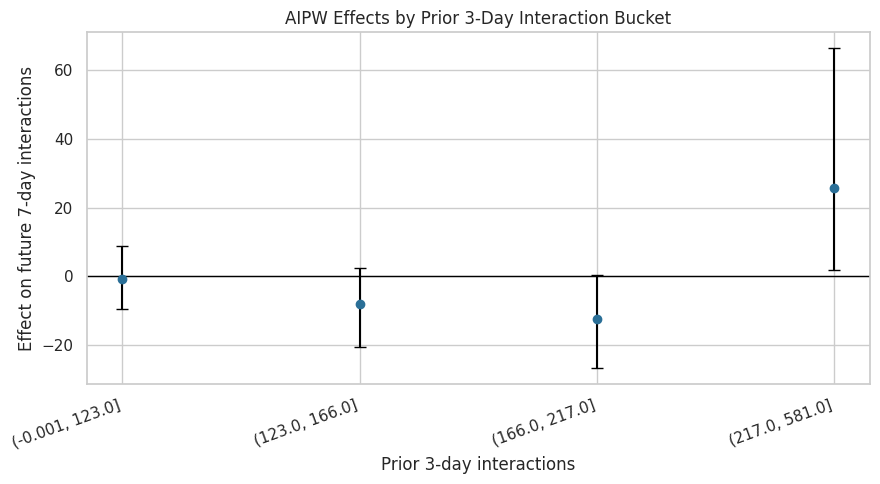
This plot checks whether the average near-zero effect is hiding differences by recent activity level. If intervals remain wide or cross zero across buckets, the heterogeneity story should stay cautious.
Plot Segment Effects by Recent Watch Quality
This plot repeats the segment view for recent high-watch share. It asks whether users with recently satisfying watch behavior respond differently to another high-watch-exposure day.
watch_segment_plot = segment_effects_with_ci.query("segment_type == 'prior_high_watch_bucket'").copy()
watch_segment_plot = watch_segment_plot.sort_values("segment")
watch_segment_plot["lower_error"] = watch_segment_plot["aipw_ate"] - watch_segment_plot["ci_95_lower"]
watch_segment_plot["upper_error"] = watch_segment_plot["ci_95_upper"] - watch_segment_plot["aipw_ate"]

fig, ax = plt.subplots(figsize=(9, 5))
ax.errorbar(
    x=np.arange(len(watch_segment_plot)),
    y=watch_segment_plot["aipw_ate"],
    yerr=[watch_segment_plot["lower_error"], watch_segment_plot["upper_error"]],
    fmt="o",
    color="#5C946E",
    ecolor="black",
    capsize=4,
)
ax.axhline(0, color="black", linewidth=1)
ax.set_xticks(np.arange(len(watch_segment_plot)))
ax.set_xticklabels(watch_segment_plot["segment"], rotation=20, ha="right")
ax.set_title("AIPW Effects by Prior High-Watch Share Bucket")
ax.set_xlabel("Prior 3-day high-watch share")
ax.set_ylabel("Effect on future 7-day interactions")
plt.tight_layout()
plt.show()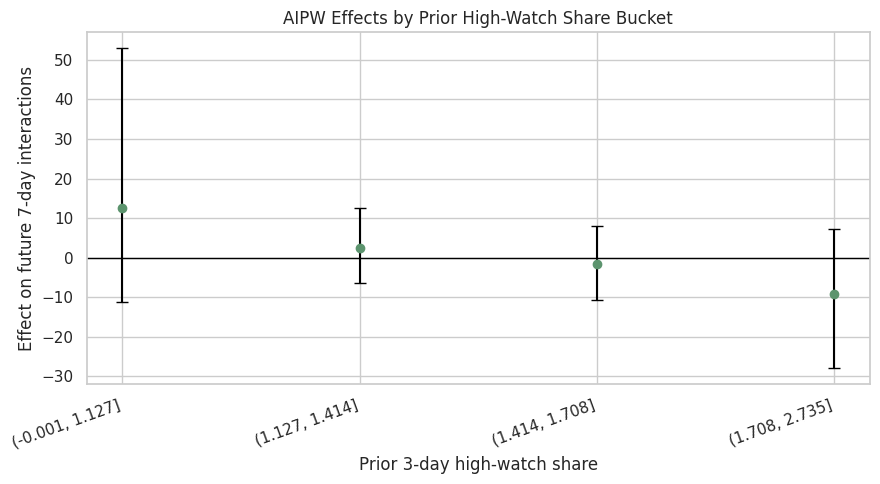
The watch-quality segment plot connects directly to the treatment definition. It helps answer whether high-watch exposure is more promising for users who were already having high-watch experiences recently.
Smooth Noisy AIPW Scores with a LightGBM Effect Model
AIPW scores are noisy row-level pseudo-outcomes. To summarize heterogeneity more smoothly, this cell fits a LightGBM regressor that predicts the primary AIPW score from pre-treatment covariates only.
This diagnostic tool identifies which user histories appear to moderate the doubly robust score.
# Smooth noisy AIPW scores with a LightGBM effect model.
effect_numeric_features = [
    "lag_1_active_day",
    "lag_1_interactions",
    "lag_1_total_play_duration_sec",
    "lag_1_avg_watch_ratio",
    "lag_1_high_watch_share",
    "prior_3day_active_day",
    "prior_3day_interactions",
    "prior_3day_total_play_duration_sec",
    "prior_3day_avg_watch_ratio",
    "prior_3day_high_watch_share",
    "calendar_day_index",
    "panel_day_index",
]
effect_categorical_features = ["day_of_week"]
effect_features = effect_numeric_features + effect_categorical_features

preprocessor = ColumnTransformer(
    transformers=[
        ("numeric", "passthrough", effect_numeric_features),
        ("categorical", OneHotEncoder(handle_unknown="ignore", sparse_output=False), effect_categorical_features),
    ],
    remainder="drop",
    verbose_feature_names_out=False,
)

effect_model = Pipeline(
    steps=[
        ("preprocessor", preprocessor),
        (
            "model",
            LGBMRegressor(
                n_estimators=120,
                learning_rate=0.04,
                num_leaves=10,
                min_child_samples=60,
                subsample=0.9,
                colsample_bytree=0.9,
                random_state=RANDOM_STATE,
                n_jobs=1,
                verbose=-1,
            ),
        ),
    ]
)

X_effect = primary_scores[effect_features].copy()
y_effect = primary_scores["aipw_score"].astype(float)
groups = primary_scores["user_id"]

group_kfold = GroupKFold(n_splits=5)
effect_pred = np.zeros(len(primary_scores), dtype=float)
effect_metric_rows = []

for fold, (train_idx, test_idx) in enumerate(group_kfold.split(X_effect, y_effect, groups=groups), start=1):
    fold_model = clone(effect_model)
    fold_model.fit(X_effect.iloc[train_idx], y_effect.iloc[train_idx])
    pred = fold_model.predict(X_effect.iloc[test_idx])
    effect_pred[test_idx] = pred
    effect_metric_rows.append(
        {
            "fold": fold,
            "rows": len(test_idx),
            "users": primary_scores.iloc[test_idx]["user_id"].nunique(),
            "rmse": np.sqrt(mean_squared_error(y_effect.iloc[test_idx], pred)),
            "mae": mean_absolute_error(y_effect.iloc[test_idx], pred),
            "r2": r2_score(y_effect.iloc[test_idx], pred),
        }
    )

primary_scores["smoothed_aipw_effect"] = effect_pred
effect_model_metrics = pd.DataFrame(effect_metric_rows)

display(effect_model_metrics)| fold | rows | users | rmse | mae | r2 | |
|---|---|---|---|---|---|---|
| 0 | 1 | 962 | 19 | 186.9065 | 106.7323 | -0.0361 |
| 1 | 2 | 934 | 18 | 236.1637 | 112.2666 | 0.0117 |
| 2 | 3 | 934 | 18 | 610.4023 | 132.5208 | -0.0014 |
| 3 | 4 | 934 | 18 | 173.2584 | 108.6869 | -0.1550 |
| 4 | 5 | 934 | 18 | 208.2852 | 99.8468 | -0.0115 |
The effect-smoothing metrics show how predictable the noisy AIPW scores are from pre-treatment history. Modest predictive performance is normal here because AIPW scores include residual noise. The model can still reveal useful moderator patterns.
Inspect the Distribution of Smoothed Effects
The smoothed effect distribution is easier to interpret than the raw AIPW score distribution. It shows where the effect model expects more positive or negative long-term impacts based on pre-treatment history.
fig, axes = plt.subplots(1, 2, figsize=(13, 4.8))

sns.histplot(primary_scores["aipw_score"], bins=60, color="#8ECAE6", ax=axes[0])
axes[0].axvline(0, color="black", linewidth=1)
axes[0].set_title("Raw AIPW Score Distribution")
axes[0].set_xlabel("AIPW score")

sns.histplot(primary_scores["smoothed_aipw_effect"], bins=40, color="#5C946E", ax=axes[1])
axes[1].axvline(0, color="black", linewidth=1)
axes[1].set_title("Smoothed Effect Prediction Distribution")
axes[1].set_xlabel("Predicted AIPW effect")

plt.tight_layout()
plt.show()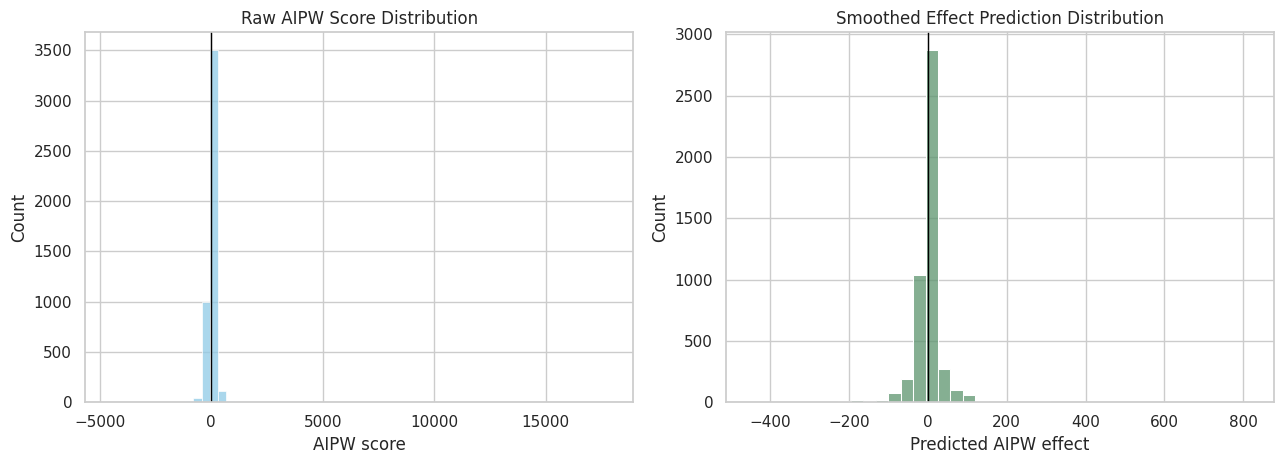
The raw AIPW scores are much noisier than the smoothed effect predictions. The smoothed distribution is better for describing heterogeneity, while the average AIPW score remains the main doubly robust estimate.
Feature Importance for Effect Moderation
The full effect model is fit on all rows so we can inspect feature importances. These importances describe which pre-treatment variables help predict variation in the AIPW pseudo-effect. They should be read as moderation diagnostics for the estimated scores.
full_effect_model = clone(effect_model).fit(X_effect, y_effect)
feature_names = full_effect_model.named_steps["preprocessor"].get_feature_names_out()
importances = full_effect_model.named_steps["model"].feature_importances_

effect_importance = (
    pd.DataFrame({"feature": feature_names, "importance": importances})
    .sort_values("importance", ascending=False)
    .reset_index(drop=True)
)

display(effect_importance.head(15))

fig, ax = plt.subplots(figsize=(9, 5))
plot_importance = effect_importance.head(12).sort_values("importance")
sns.barplot(data=plot_importance, x="importance", y="feature", ax=ax, color="#2A6F97")
ax.set_title("Top Moderators in the AIPW Effect-Smoothing Model")
ax.set_xlabel("LightGBM feature importance")
ax.set_ylabel("Pre-treatment feature")
plt.tight_layout()
plt.show()| feature | importance | |
|---|---|---|
| 0 | prior_3day_high_watch_share | 189 |
| 1 | lag_1_total_play_duration_sec | 150 |
| 2 | prior_3day_interactions | 141 |
| 3 | lag_1_interactions | 132 |
| 4 | lag_1_avg_watch_ratio | 130 |
| 5 | lag_1_high_watch_share | 103 |
| 6 | prior_3day_total_play_duration_sec | 96 |
| 7 | prior_3day_avg_watch_ratio | 78 |
| 8 | calendar_day_index | 43 |
| 9 | day_of_week_Friday | 6 |
| 10 | day_of_week_Thursday | 5 |
| 11 | day_of_week_Monday | 3 |
| 12 | day_of_week_Wednesday | 3 |
| 13 | panel_day_index | 1 |
| 14 | lag_1_active_day | 0 |
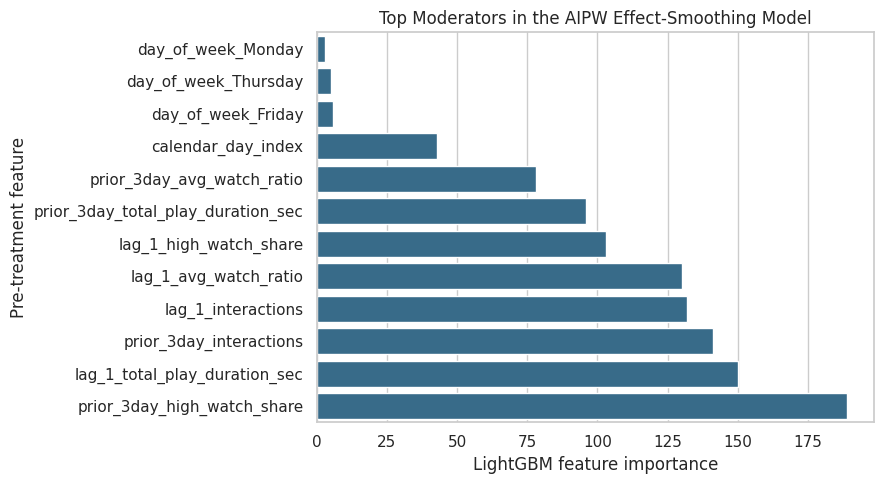
The importance table and plot identify which histories are most useful for predicting heterogeneous doubly robust scores. These variables are natural candidates for final-report discussion and future online experiment stratification.
Smoothed Effects by Predicted Effect Bucket
This cell groups rows by the smoothed effect prediction. It compares predicted effect buckets with observed AIPW scores and treatment rates. This checks whether the effect smoother is separating rows into meaningfully different pseudo-effect groups.
primary_scores["smoothed_effect_bucket"] = pd.qcut(
    primary_scores["smoothed_aipw_effect"],
    q=5,
    duplicates="drop",
).astype(str)

smoothed_bucket_summary = (
    primary_scores.groupby("smoothed_effect_bucket", observed=True)
    .agg(
        rows=("aipw_score", "size"),
        users=("user_id", "nunique"),
        treatment_rate=(PRIMARY_TREATMENT, "mean"),
        observed_outcome_mean=(PRIMARY_OUTCOME, "mean"),
        mean_raw_aipw_score=("aipw_score", "mean"),
        mean_smoothed_effect=("smoothed_aipw_effect", "mean"),
        mean_prior_interactions=("prior_3day_interactions", "mean"),
        mean_prior_high_watch_share=("prior_3day_high_watch_share", "mean"),
    )
    .reset_index()
)

display(smoothed_bucket_summary)| smoothed_effect_bucket | rows | users | treatment_rate | observed_outcome_mean | mean_raw_aipw_score | mean_smoothed_effect | mean_prior_interactions | mean_prior_high_watch_share | |
|---|---|---|---|---|---|---|---|---|---|
| 0 | (-11.184, -2.468] | 939 | 91 | 0.4696 | 374.1214 | 6.9171 | -5.7183 | 161.5474 | 1.3829 |
| 1 | (-2.468, 2.224] | 953 | 91 | 0.4711 | 352.1794 | -7.3628 | -0.1343 | 151.4974 | 1.3917 |
| 2 | (-447.053, -11.184] | 940 | 91 | 0.5681 | 393.0787 | 0.0059 | -45.8042 | 170.6777 | 1.5720 |
| 3 | (11.278, 814.396] | 940 | 91 | 0.4926 | 394.0340 | 9.0918 | 41.2670 | 201.3787 | 1.3727 |
| 4 | (2.224, 11.278] | 926 | 90 | 0.4968 | 397.6361 | -3.1214 | 5.9372 | 180.8920 | 1.4077 |
The bucket summary turns the effect model into a readable heterogeneity diagnostic. If higher predicted-effect buckets also have higher raw AIPW scores, the smoother is capturing a meaningful pattern.
The saved doubly robust outputs complete the project record. The most important file is the updated estimator comparison table, because it now contains MSM, g-computation, and AIPW estimates side by side.
Takeaways and Next Step
This notebook added a doubly robust estimator and a heterogeneity layer to the long-term causal effects project.
The AIPW estimates should be interpreted alongside the MSM and g-computation estimates. Small, uncertain estimates across all three strategies support a cautious conclusion. The current KuaiRec analysis provides weak evidence of a clear average long-term interaction-volume gain from high-watch-exposure days.
The heterogeneity results are still useful. They show how the effect may vary by recent engagement state, and they provide product hypotheses for future online testing. Together, the estimator comparison, sensitivity checks, segment findings, and limitations form the evidence record for the lab conclusion.