This lecture connects Regression Adjustment to confounding, overlap, balance diagnostics, robustness, and sensitivity.
Observational Adjustment
Observational Studies
Adjustment
Lecture Notes
This course focuses on observational causal inference when treatment assignment comes from observed behavior and measured covariates may make adjustment credible. The central discipline is to connect the adjustment strategy to the causal story, including confounders, downstream variables, weak overlap, and hidden-bias sensitivity.
The objective is to build applied fluency with the major adjustment workflows. By the end of the course, a reader should be able to fit and diagnose regression, matching, propensity score, inverse probability weighting, doubly robust, and TMLE-style estimators; evaluate balance and overlap; and communicate sensitivity to unobserved confounding.
Lecture Sequence
This lecture develops Propensity Scores with examples that make assumptions, diagnostics, and interpretation visible.
This lecture uses Matching to clarify the analyst’s question, evidence, assumptions, and decision implications.
04. Inverse Probability Weighting
This lecture studies inverse probability weighting through propensity models, weight behavior, and overlap diagnostics.
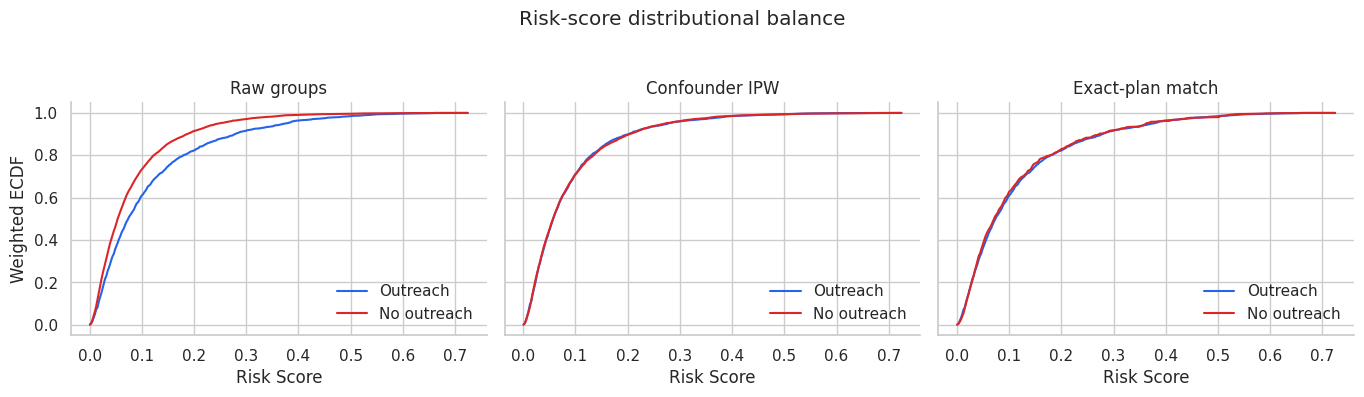
05. Covariate Balance Diagnostics
This lecture frames Covariate Balance Diagnostics as a decision problem and asks what evidence can be trusted, challenged, and communicated.
This lecture builds intuition for Overlap and Trimming and ties the result to model choice, uncertainty, and action.
This lecture applies Doubly Robust Estimation with emphasis on diagnostics, tradeoffs, and evidence limits.
08. Targeted Maximum Likelihood Estimation
This lecture develops Targeted Maximum Likelihood Estimation as a practical pattern for analysis, diagnostics, and decision support.
09. Sensitivity Analysis for Unobserved Confounding
This lecture connects Sensitivity Analysis for Unobserved Confounding to hidden-bias diagnostics and the credibility of the final causal claim.