This lecture connects From Data to Inference to evidence strength, model assumptions, uncertainty, and stakeholder-facing recommendations.
Statistical Inference for Decision Science
Statistical Inference
Uncertainty
Lecture Notes
Decision Science
This course turns statistical foundations into formal tools for inference. The emphasis is on what can be learned from data, how uncertainty should be quantified, and how inferential claims should be reported when decisions are at stake.
By the end, a reader should be able to explain sampling distributions, use likelihood-based reasoning, construct and interpret confidence intervals and tests, compare frequentist and Bayesian viewpoints, handle model uncertainty, and write inference reports that are honest about assumptions and limits.
Lecture Sequence
02. Sampling Distributions and Asymptotics
This lecture develops Sampling Distributions and Asymptotics with examples that make assumptions, diagnostics, and interpretation visible.
03. Likelihood and Maximum Likelihood
This lecture uses Likelihood and Maximum Likelihood to clarify the analyst’s question, evidence, assumptions, and decision implications.
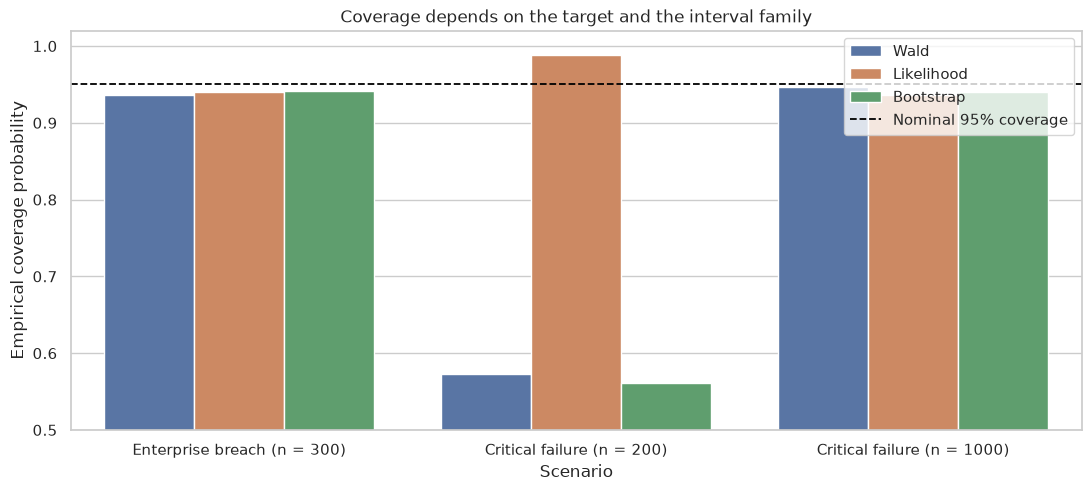
04. Confidence Intervals: Wald, Likelihood, and Bootstrap
This lecture compares Wald, likelihood, and bootstrap intervals through coverage, assumptions, and reporting tradeoffs.
05. Hypothesis Testing Beyond p-Values
This lecture frames Hypothesis Testing Beyond p-Values as a decision problem and asks what evidence can be trusted, challenged, and communicated.
06. Permutation, Randomization, and Exact Inference
This lecture builds intuition for Permutation, Randomization, and Exact Inference and ties the result to model choice, uncertainty, and action.
07. Multiple Testing, False Discovery, and Research Risk
This lecture applies Multiple Testing, False Discovery, and Research Risk with emphasis on diagnostics, tradeoffs, and evidence limits.
08. Linear Models as Inferential Engines
This lecture develops Linear Models as Inferential Engines as a practical pattern for analysis, diagnostics, and decision support.
09. Generalized Linear Models for Binary, Count, and Rate Data
This lecture connects Generalized Linear Models for Binary, Count, and Rate Data to evidence strength, model assumptions, uncertainty, and clear reporting.
10. Hierarchical Models, Partial Pooling, and Grouped Data
This lecture develops Hierarchical Models, Partial Pooling, and Grouped Data with examples that make assumptions, diagnostics, and interpretation visible.
11. Bayesian Inference for Decision Making
This lecture uses Bayesian Inference for Decision Making to clarify the analyst’s question, evidence, assumptions, and decision implications.
12. Model Checking, Calibration, and Posterior Predictive Logic
This lecture uses model checking and calibration to ask whether fitted models behave credibly on the data they claim to explain.
13. Missing Data, Measurement Error, and Robust Inference
This lecture frames Missing Data, Measurement Error, and Robust Inference as a decision problem and asks what evidence can be trusted, challenged, and communicated.
14. Statistical Decision Analysis and Value of Information
This lecture builds intuition for Statistical Decision Analysis and Value of Information and ties the result to model choice, uncertainty, and action.
15. Reporting Statistical Recommendations for Real Stakeholders
This lecture applies Reporting Statistical Recommendations for Real Stakeholders with emphasis on diagnostics, tradeoffs, and evidence limits.