# Build and label the diagnostic visualization for the Setup section.
from pathlib import Path
import os
import warnings
os.environ.setdefault("MPLCONFIGDIR", "/tmp/matplotlib-ranking-sys")
warnings.filterwarnings("default")
warnings.filterwarnings("ignore", category=DeprecationWarning)
warnings.filterwarnings("ignore", category=PendingDeprecationWarning)
warnings.filterwarnings("ignore", category=FutureWarning)
warnings.filterwarnings("ignore", message=".*IProgress not found.*")
warnings.filterwarnings("ignore", message=".*setParseAction.*deprecated.*")
warnings.filterwarnings("ignore", message=".*copy keyword is deprecated.*")
warnings.filterwarnings("ignore", message=".*disp.*iprint.*L-BFGS-B.*")
warnings.filterwarnings("ignore", message=".*variables are assumed unobserved.*")
warnings.filterwarnings("ignore", module="dowhy.causal_estimators.regression_estimator")
warnings.filterwarnings("ignore", module="sklearn.linear_model._logistic")
warnings.filterwarnings("ignore", module="seaborn.categorical")
warnings.filterwarnings("ignore", module="pydot.dot_parser")
import dowhy
import dowhy.gcm as gcm
import matplotlib.pyplot as plt
import networkx as nx
# Compatibility shim for DoWhy versions that expect the older NetworkX d_separated API.
if not hasattr(nx.algorithms, "d_separated"):
    from networkx.algorithms.d_separation import is_d_separator
    nx.algorithms.d_separated = is_d_separator
import numpy as np
import pandas as pd
pd.set_option("display.max_colwidth", None)
pd.set_option("display.max_columns", None)
pd.set_option("display.width", 0)
# Compatibility shim for DoWhy estimators written against older pandas Series integer indexing.
if not getattr(pd.Series, "_dowhy_integer_position_patch", False):
    _original_series_getitem = pd.Series.__getitem__
    def _dowhy_series_getitem_compat(self, key):
        try:
            return _original_series_getitem(self, key)
        except KeyError:
            if isinstance(key, int) and key not in self.index:
                return self.iloc[key]
            raise
    pd.Series.__getitem__ = _dowhy_series_getitem_compat
    pd.Series._dowhy_integer_position_patch = True
import seaborn as sns
from dowhy.gcm import auto
from dowhy.gcm.model_evaluation import EvaluateCausalModelConfig
import dowhy.gcm.model_evaluation as gcm_model_evaluation
from sklearn.metrics import mean_squared_error as _sklearn_mean_squared_error
def _mean_squared_error_compat(y_true, y_pred, *, squared=True, **kwargs):
    """Support DoWhy GCM's older squared= argument under newer scikit-learn."""
    mse = _sklearn_mean_squared_error(y_true, y_pred, **kwargs)
    return mse if squared else np.sqrt(mse)
gcm_model_evaluation.mean_squared_error = _mean_squared_error_compat
from IPython.display import display
from matplotlib.patches import FancyArrowPatch
# Keep generated notebooks readable and deterministic enough for tutorial output.
gcm.config.show_progress_bars = False
np.random.seed(1010)
pd.set_option("display.max_columns", 100)
pd.set_option("display.width", 150)
pd.set_option("display.float_format", "{:.4f}".format)
sns.set_theme(style="whitegrid", context="notebook")
for candidate in [Path.cwd(), *Path.cwd().parents]:
    if (candidate / "notebooks" / "tutorials" / "dowhy").exists():
        PROJECT_ROOT = candidate
        break
else:
    PROJECT_ROOT = Path.cwd()
NOTEBOOK_DIR = PROJECT_ROOT / "notebooks" / "tutorials" / "dowhy"
OUTPUT_DIR = NOTEBOOK_DIR / "outputs"
FIGURE_DIR = OUTPUT_DIR / "figures"
TABLE_DIR = OUTPUT_DIR / "tables"
FIGURE_DIR.mkdir(parents=True, exist_ok=True)
TABLE_DIR.mkdir(parents=True, exist_ok=True)
RNG = np.random.default_rng(1010)
print(f"DoWhy version: {dowhy.__version__}")
print(f"Notebook directory: {NOTEBOOK_DIR}")10: GCM Structural Causal Models
The previous lessons focused on the classic DoWhy workflow: define a graph, identify an estimand, estimate an effect, and refute the result. We introduce a different but related part of DoWhy: graphical causal models, usually called GCMs.
A GCM says more than which variables cause which other variables. It also attaches a causal mechanism to each node. For example, a root node might be modeled by an empirical distribution, while a non-root node might be modeled as an additive-noise function of its parents.
That extra structure lets us ask richer questions:
- Can the fitted mechanisms regenerate data that look like the observed data?
- Which parents are most influential for a target node’s mechanism?
- Does a graph miss important parent relationships?
- Are local causal mechanisms well fit before we use the model for simulations?
This lesson stays focused on mechanism assignment, fitting, sampling, and evaluation. The sequence next goes deeper into interventions and counterfactuals with GCMs.
Learning Goals
By the end, you should be able to:
- Explain the difference between a causal graph and a graphical causal model.
- Build a
StructuralCausalModelfrom a NetworkX graph. - Use DoWhy GCM’s automatic mechanism assignment.
- Fit node-level causal mechanisms to data.
- Draw synthetic joint samples from a fitted GCM.
- Compare observed and generated distributions.
- Evaluate local mechanism quality with DoWhy’s GCM evaluation API.
- Estimate direct parent influence for a target node.
- See how a misspecified graph degrades mechanism fit.
Dataset and Experiment Setup
We use mostly simulated or semi-synthetic observational datasets to study GCM Structural Causal Models. DoWhy is mainly about causal modeling discipline: graph, estimand, estimator, and refuter. A controlled dataset lets us show how a change in assumptions changes the estimand and the credibility of the estimate.
Read each row as an observed unit in a business or policy system. The treatment, outcome, common causes, instruments, mediators, and anomaly indicators are named to mirror applied causal workflows and keep the examples close to realistic analysis language. The experiment uses a structural causal model, so the important object is the collection of mechanisms, more than a single treatment coefficient.
The simulation is designed to make the identifying assumptions and diagnostic checks visible. It is meant to expose the assumptions that would be hidden in real data, where the true counterfactual outcome is unavailable.
Mathematical Foundation
A graphical causal model writes each variable as a structural assignment,
\[ X_j := f_j(X_{\operatorname{pa}(j)},N_j), \qquad N_j \perp\!\!\!\perp N_k \text{ for } j\neq k. \]
An intervention replaces one assignment,
\[ X_t := x. \]
Interventional and counterfactual queries modify the data-generating process and then trace how the changed mechanism propagates.
Why GCMs are Different
A standard causal graph stores structural assumptions such as X -> Y. A GCM goes one level deeper and says how each node is generated from its parents and noise.
For example, a graph might say:
\[ watch\_time \rightarrow retention\_score \]
A GCM adds a mechanism:
\[ retention\_score = f(watch\_time, user\_intent, content\_quality) + N \]
The mechanism can be linear, nonlinear, categorical, probabilistic, manually specified, or automatically selected. Once those mechanisms are fitted, the model can generate synthetic samples and support downstream what-if analysis.
Tutorial Workflow
Setup
The setup block imports the libraries, suppresses known non-actionable warnings, creates output folders, and disables DoWhy progress bars so execution stays clean. The MPLCONFIGDIR setting avoids Matplotlib cache warnings in shared or sandboxed environments.
The lesson is ready once the DoWhy version and output folders print. Every saved output from this lesson uses a 10_ prefix.
This reproducibility check keeps the run auditable before causal interpretation begins. It makes the run consistent enough for later graphs, tables, and estimates to be checked against the same environment.
GCM Workflow Map
The table below gives the workflow for this lesson. The key shift is that we are no longer only estimating one treatment effect. We are fitting a full set of local mechanisms attached to a graph.
| step | main question | why it matters |
|---|---|---|
| Specify graph | Which variables are direct parents of each node? | The graph determines which inputs each mechanism receives. |
| Assign mechanisms | What model should describe each root or non-root node? | Root nodes need distributions; non-root nodes need conditional mechanisms. |
| Fit mechanisms | Can each mechanism learn its local data-generating pattern? | A weak local mechanism can make downstream simulations unreliable. |
| Draw samples | Can the fitted model regenerate realistic joint data? | Generated samples reveal whether the model captures broad distributional structure. |
| Evaluate model | Which mechanisms fit well, and which need attention? | Mechanism-level diagnostics guide graph and model revisions. |
| Inspect parent influence | Which parents matter most for a target mechanism? | Influence summaries make fitted mechanisms easier to audit. |
The workflow is modular: each node has its own mechanism, but the graph connects those mechanisms into a joint data-generating system.
That distinction is what makes the causal model useful because interventions propagate through linked mechanisms across the system.
Simulate a Recommendation-Style Causal System
We will use a continuous example dataset with six variables. Three root variables describe upstream context: user_intent, content_quality, and content_novelty. These roots influence recommendation_exposure, which influences watch_time, which then influences retention_score.
The final outcome, retention_score, also has direct parents user_intent and content_quality. This gives the GCM a realistic mix of direct and mediated relationships.
# Define reusable helpers for the Simulate A Recommendation-Style Causal System section.
def make_gcm_teaching_data(n=2_400, seed=1010):
    """
    Idea: Construct the gcm example data used in the Simulate A Recommendation-Style Causal System section, including columns needed for later diagnostics.

    Parameters
    ----------
    n : int
        Number of observations or repetitions to generate.
    seed : int
        Random seed used to make generation or resampling reproducible.

    Returns
    -------
    tuple
        Tuple containing df, true_exposure_to_retention_total_via_watch.
    """
    local_rng = np.random.default_rng(seed)
    user_intent = local_rng.normal(loc=0.0, scale=1.0, size=n)
    content_quality = local_rng.normal(loc=0.0, scale=1.0, size=n)
    content_novelty = local_rng.normal(loc=0.0, scale=1.0, size=n)
    recommendation_exposure = (
        0.80 * user_intent
        + 0.45 * content_quality
        + 0.25 * content_novelty
        + local_rng.normal(scale=0.80, size=n)
    )
    watch_time = (
        1.10 * recommendation_exposure
        + 0.55 * user_intent
        + 0.50 * content_quality
        + local_rng.normal(scale=0.90, size=n)
    )
    retention_score = (
        1.35 * watch_time
        + 0.35 * user_intent
        + 0.25 * content_quality
        + local_rng.normal(scale=1.00, size=n)
    )
    df = pd.DataFrame(
        {
            "user_intent": user_intent,
            "content_quality": content_quality,
            "content_novelty": content_novelty,
            "recommendation_exposure": recommendation_exposure,
            "watch_time": watch_time,
            "retention_score": retention_score,
        }
    )
    true_watch_to_retention = 1.35
    true_exposure_to_watch = 1.10
    true_exposure_to_retention_total_via_watch = true_exposure_to_watch * true_watch_to_retention
    return df, true_exposure_to_retention_total_via_watch
gcm_df, true_total_exposure_effect = make_gcm_teaching_data()
print(f"Rows: {len(gcm_df):,}")
print(f"True exposure-to-retention effect through watch time: {true_total_exposure_effect:.3f}")
display(gcm_df.head())
Rows: 2,400
True exposure-to-retention effect through watch time: 1.485| user_intent | content_quality | content_novelty | recommendation_exposure | watch_time | retention_score | |
|---|---|---|---|---|---|---|
| 0 | -1.6987 | 0.1318 | -1.6164 | 0.0231 | -1.2712 | -2.0215 |
| 1 | 0.5380 | 0.8367 | -0.5806 | 1.3200 | 3.1298 | 5.6626 |
| 2 | -0.2256 | -0.8977 | -0.6099 | 0.3164 | 1.2791 | 1.6556 |
| 3 | -1.0902 | -0.5744 | -0.0702 | -0.5915 | -2.8416 | -3.4589 |
| 4 | 0.5539 | -0.0609 | -0.1177 | 0.2408 | -0.0293 | -0.8117 |
The true mediated effect is printed for context, but this lesson is not centered on one effect estimate. The main goal is to fit and evaluate the full generative causal model.
Data Field Guide
The table below documents the variable roles. GCMs make this especially important because each role implies a different type of mechanism: root distribution or conditional mechanism.
| column | role | description |
|---|---|---|
| user_intent | root node | Upstream user-level signal that affects exposure, watch time, and retention. |
| content_quality | root node | Upstream content-level signal that affects exposure, watch time, and retention. |
| content_novelty | root node | Upstream content novelty signal that affects recommendation exposure. |
| recommendation_exposure | non-root node | Exposure intensity generated from the upstream root variables. |
| watch_time | non-root mediator | Engagement variable generated from exposure, intent, and quality. |
| retention_score | non-root outcome | Final outcome generated from watch time, intent, and quality. |
The root nodes will be modeled as marginal distributions. The non-root nodes will be modeled as functions of their parents plus noise.
That distinction is what makes the causal model useful because interventions propagate through linked mechanisms across the system.
Basic Data Checks
Before building a GCM, check shape, missingness, and distribution summaries. Missing values and unexpected data types can make automatic mechanism assignment fail or choose the wrong kind of mechanism.
basic_quality = pd.DataFrame(
    {
        "rows": [len(gcm_df)],
        "columns": [gcm_df.shape[1]],
        "missing_cells": [int(gcm_df.isna().sum().sum())],
        "mean_retention_score": [gcm_df["retention_score"].mean()],
        "std_retention_score": [gcm_df["retention_score"].std()],
    }
)
numeric_summary = gcm_df.describe().T
basic_quality.to_csv(TABLE_DIR / "10_basic_quality.csv", index=False)
numeric_summary.to_csv(TABLE_DIR / "10_numeric_summary.csv")
display(basic_quality)
display(numeric_summary)| rows | columns | missing_cells | mean_retention_score | std_retention_score | |
|---|---|---|---|---|---|
| 0 | 2400 | 6 | 0 | 0.0548 | 3.3959 |
| count | mean | std | min | 25% | 50% | 75% | max | |
|---|---|---|---|---|---|---|---|---|
| user_intent | 2400.0000 | 0.0276 | 1.0014 | -3.0667 | -0.6448 | 0.0276 | 0.6951 | 3.5708 |
| content_quality | 2400.0000 | -0.0062 | 0.9832 | -3.3342 | -0.6738 | 0.0099 | 0.6452 | 3.4192 |
| content_novelty | 2400.0000 | -0.0340 | 0.9895 | -4.0167 | -0.6972 | -0.0267 | 0.5958 | 3.3365 |
| recommendation_exposure | 2400.0000 | 0.0294 | 1.2420 | -4.6289 | -0.8015 | 0.0232 | 0.8743 | 3.9199 |
| watch_time | 2400.0000 | 0.0289 | 2.1528 | -7.6553 | -1.3913 | 0.0395 | 1.5293 | 7.6264 |
| retention_score | 2400.0000 | 0.0548 | 3.3959 | -12.8045 | -2.1505 | 0.0581 | 2.3506 | 11.6465 |
The data are complete and continuous. That makes this a good setting for additive-noise mechanisms selected by DoWhy’s auto-assignment helper.
That distinction is what makes the causal model useful because interventions propagate through linked mechanisms across the system.
Define the Causal Graph
A GCM starts with a graph. Here the graph is a NetworkX directed acyclic graph. Each edge means the child node’s mechanism can use the parent node as an input.
GCM_EDGES = [
    ("user_intent", "recommendation_exposure"),
    ("content_quality", "recommendation_exposure"),
    ("content_novelty", "recommendation_exposure"),
    ("recommendation_exposure", "watch_time"),
    ("user_intent", "watch_time"),
    ("content_quality", "watch_time"),
    ("watch_time", "retention_score"),
    ("user_intent", "retention_score"),
    ("content_quality", "retention_score"),
]
causal_graph = nx.DiGraph(GCM_EDGES)
edge_table = pd.DataFrame(GCM_EDGES, columns=["parent", "child"])
edge_table.to_csv(TABLE_DIR / "10_causal_graph_edges.csv", index=False)
display(edge_table)
print(f"Is the graph acyclic? {nx.is_directed_acyclic_graph(causal_graph)}")| parent | child | |
|---|---|---|
| 0 | user_intent | recommendation_exposure |
| 1 | content_quality | recommendation_exposure |
| 2 | content_novelty | recommendation_exposure |
| 3 | recommendation_exposure | watch_time |
| 4 | user_intent | watch_time |
| 5 | content_quality | watch_time |
| 6 | watch_time | retention_score |
| 7 | user_intent | retention_score |
| 8 | content_quality | retention_score |
Is the graph acyclic? TrueThe acyclicity check should be true. GCM sampling requires a topological order so parent samples can be generated before child samples.
That distinction is what makes the causal model useful because interventions propagate through linked mechanisms across the system.
Draw the Causal Graph
This helper draws the graph with visible arrows and spaced node boxes. Clear graph visuals are useful because a GCM is only as credible as the structural assumptions it encodes.
# Define reusable helpers for the Draw The Causal Graph section.
GCM_POSITIONS = {
    "user_intent": (0.08, 0.78),
    "content_quality": (0.08, 0.50),
    "content_novelty": (0.08, 0.22),
    "recommendation_exposure": (0.42, 0.50),
    "watch_time": (0.68, 0.50),
    "retention_score": (0.92, 0.50),
}
NODE_COLORS = {
    "user_intent": "#eef2ff",
    "content_quality": "#eef2ff",
    "content_novelty": "#eef2ff",
    "recommendation_exposure": "#e0f2fe",
    "watch_time": "#ecfccb",
    "retention_score": "#fef3c7",
}
def draw_directed_graph(edges, positions, title, path, node_colors=None):
    """
    Idea: Draw a directed graph from node positions and edge definitions.

    Parameters
    ----------
    edges : object
        Collection of graph edges to draw, compare, or convert into a table.
    positions : object
        Mapping from graph nodes to plotting coordinates.
    title : str
        Title shown on the resulting plot or report.
    path : str or pathlib.Path
        Input or output path.
    node_colors : object
        Mapping from graph nodes or groups to plotting colors.

    Returns
    -------
    None
        Draws the directed graph directly on the Matplotlib axes.
    """
    node_colors = node_colors or {}
    nodes = list(dict.fromkeys([node for edge in edges for node in edge]))
    fig, ax = plt.subplots(figsize=(11, 5.8))
    ax.set_axis_off()
    for left, right in edges:
        arrow = FancyArrowPatch(
            positions[left],
            positions[right],
            arrowstyle="-|>",
            mutation_scale=16,
            linewidth=1.5,
            color="#334155",
            shrinkA=42,
            shrinkB=42,
            connectionstyle="arc3,rad=0.03",
        )
        ax.add_patch(arrow)
    for node in nodes:
        x, y = positions[node]
        ax.text(
            x,
            y,
            node.replace("_", "\n"),
            ha="center",
            va="center",
            fontsize=10,
            fontweight="bold",
            bbox=dict(
                boxstyle="round,pad=0.45",
                facecolor=node_colors.get(node, "#e0f2fe"),
                edgecolor="#334155",
                linewidth=1.1,
            ),
        )
    ax.set_xlim(0, 1)
    ax.set_ylim(0, 1)
    ax.set_title(title, pad=18)
    plt.tight_layout()
    fig.savefig(path, dpi=160, bbox_inches="tight")
    plt.show()
draw_directed_graph(
    GCM_EDGES,
    GCM_POSITIONS,
    "Structural Graph For The GCM",
    FIGURE_DIR / "10_structural_graph.png",
    node_colors=NODE_COLORS,
)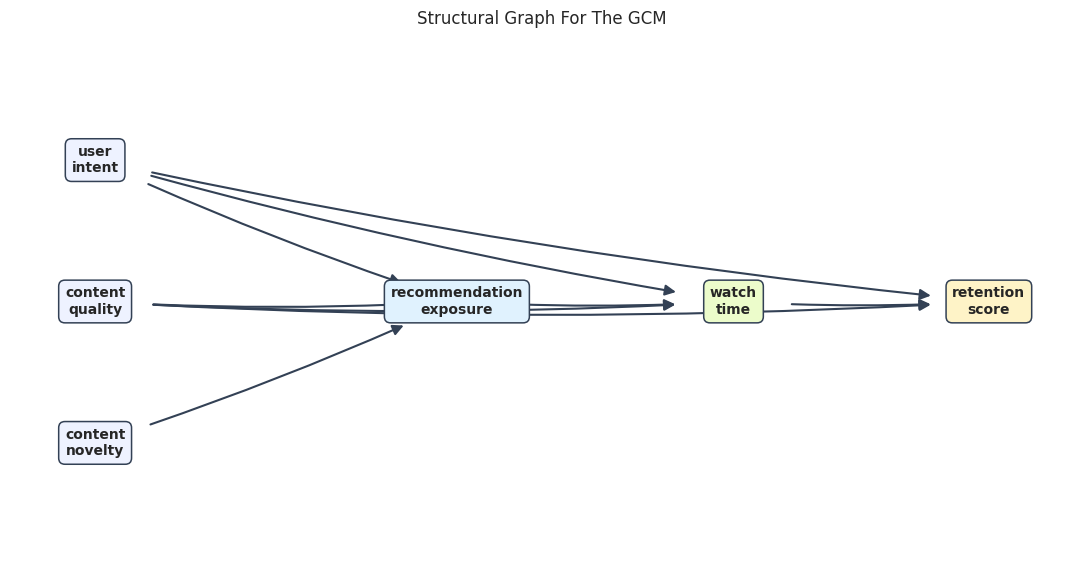
The graph separates upstream root causes, an exposure node, an engagement mediator, and a downstream outcome. Every non-root node will receive a fitted causal mechanism.
Build a Structural Causal Model Object
Now we wrap the NetworkX graph in DoWhy’s StructuralCausalModel. At this moment the graph exists, but no node has a fitted mechanism yet.
structural_model = gcm.StructuralCausalModel(causal_graph)
model_structure_table = pd.DataFrame(
    [
        {
            "node": node,
            "parents": ", ".join(causal_graph.predecessors(node)) or "none",
            "children": ", ".join(causal_graph.successors(node)) or "none",
            "is_root": causal_graph.in_degree(node) == 0,
        }
        for node in causal_graph.nodes
    ]
)
model_structure_table.to_csv(TABLE_DIR / "10_model_structure_table.csv", index=False)
display(model_structure_table)| node | parents | children | is_root | |
|---|---|---|---|---|
| 0 | user_intent | none | recommendation_exposure, watch_time, retention_score | True |
| 1 | recommendation_exposure | user_intent, content_quality, content_novelty | watch_time | False |
| 2 | content_quality | none | recommendation_exposure, watch_time, retention_score | True |
| 3 | content_novelty | none | recommendation_exposure | True |
| 4 | watch_time | recommendation_exposure, user_intent, content_quality | retention_score | False |
| 5 | retention_score | watch_time, user_intent, content_quality | none | False |
The root nodes have no parents and need marginal distributions. The other nodes need conditional mechanisms based on their listed parents.
That distinction is what makes the causal model useful because interventions propagate through linked mechanisms across the system.
Auto-Assign Causal Mechanisms
DoWhy can automatically assign mechanisms based on the graph and data. For root nodes, it typically assigns an empirical distribution. For continuous non-root nodes, it can assign additive-noise models with a selected prediction model.
We use AssignmentQuality.GOOD because it is fast enough for tutorial lessons while still evaluating a useful small set of model classes.
assignment_summary = auto.assign_causal_mechanisms(
    structural_model,
    gcm_df,
    quality=auto.AssignmentQuality.GOOD,
    override_models=True,
)
# Show the first part of the text summary without overwhelming the notebook.
print("\n".join(str(assignment_summary).splitlines()[:28]))
When using this auto assignment function, the given data is used to automatically assign a causal mechanism to each node. Note that causal mechanisms can also be customized and assigned manually.
The following types of causal mechanisms are considered for the automatic selection:
If root node:
An empirical distribution, i.e., the distribution is represented by randomly sampling from the provided data. This provides a flexible and non-parametric way to model the marginal distribution and is valid for all types of data modalities.
If non-root node and the data is continuous:
Additive Noise Models (ANM) of the form X_i = f(PA_i) + N_i, where PA_i are the parents of X_i and the unobserved noise N_i is assumed to be independent of PA_i.To select the best model for f, different regression models are evaluated and the model with the smallest mean squared error is selected.Note that minimizing the mean squared error here is equivalent to selecting the best choice of an ANM.
If non-root node and the data is discrete:
Discrete Additive Noise Models have almost the same definition as non-discrete ANMs, but come with an additional constraint for f to only return discrete values.
Note that 'discrete' here refers to numerical values with an order. If the data is categorical, consider representing them as strings to ensure proper model selection.
If non-root node and the data is categorical:
A functional causal model based on a classifier, i.e., X_i = f(PA_i, N_i).
Here, N_i follows a uniform distribution on [0, 1] and is used to randomly sample a class (category) using the conditional probability distribution produced by a classification model.Here, different model classes are evaluated using the (negative) F1 score and the best performing model class is selected.
In total, 6 nodes were analyzed:
--- Node: user_intent
Node user_intent is a root node. Therefore, assigning 'Empirical Distribution' to the node representing the marginal distribution.
--- Node: content_quality
Node content_quality is a root node. Therefore, assigning 'Empirical Distribution' to the node representing the marginal distribution.
--- Node: content_novelty
Node content_novelty is a root node. Therefore, assigning 'Empirical Distribution' to the node representing the marginal distribution.
The summary explains the mechanism families considered during assignment. The next step turns the assigned mechanisms into a compact table.
That distinction is what makes the causal model useful because interventions propagate through linked mechanisms across the system.
Inspect Assigned Mechanisms
This table shows the mechanism type assigned to each node. It is the GCM equivalent of checking your estimator configuration before fitting.
# Define reusable helpers for the Inspect Assigned Mechanisms section.
def mechanism_name(model, node):
    """
    Idea: Compute the mechanism name needed in the Inspect Assigned Mechanisms section and return it in a form the next cells can inspect.

    Parameters
    ----------
    model : object
        Fitted model or model specification used by the diagnostic.
    node : object
        Graph node whose position, label, or incident edges are being processed.

    Returns
    -------
    tuple
        Tuple containing type(mechanism).__name__, str(mechanism).
    """
    mechanism = model.causal_mechanism(node)
    return type(mechanism).__name__, str(mechanism)
mechanism_rows = []
for node in structural_model.graph.nodes:
    mechanism_type, mechanism_description = mechanism_name(structural_model, node)
    mechanism_rows.append(
        {
            "node": node,
            "parents": ", ".join(structural_model.graph.predecessors(node)) or "none",
            "mechanism_type": mechanism_type,
            "mechanism_description": mechanism_description,
        }
    )
assigned_mechanisms = pd.DataFrame(mechanism_rows)
assigned_mechanisms.to_csv(TABLE_DIR / "10_assigned_mechanisms.csv", index=False)
display(assigned_mechanisms)| node | parents | mechanism_type | mechanism_description | |
|---|---|---|---|---|
| 0 | user_intent | none | EmpiricalDistribution | Empirical Distribution |
| 1 | recommendation_exposure | user_intent, content_quality, content_novelty | AdditiveNoiseModel | AdditiveNoiseModel using LinearRegression |
| 2 | content_quality | none | EmpiricalDistribution | Empirical Distribution |
| 3 | content_novelty | none | EmpiricalDistribution | Empirical Distribution |
| 4 | watch_time | recommendation_exposure, user_intent, content_quality | AdditiveNoiseModel | AdditiveNoiseModel using LinearRegression |
| 5 | retention_score | watch_time, user_intent, content_quality | AdditiveNoiseModel | AdditiveNoiseModel using LinearRegression |
The root nodes receive empirical distributions. The non-root nodes receive conditional mechanisms that represent relationships of the form “child equals a function of parents plus noise.”
Fit the Mechanisms
After assignment, we fit each mechanism to the observed data. DoWhy fits each node locally: root mechanisms use the node column, and non-root mechanisms use parent columns plus the child column.
gcm.fit(structural_model, gcm_df)
fitted_status = pd.DataFrame(
    [
        {
            "node": node,
            "mechanism_type": type(structural_model.causal_mechanism(node)).__name__,
            "parents_used": ", ".join(structural_model.graph.predecessors(node)) or "none",
            "fitted": True,
        }
        for node in structural_model.graph.nodes
    ]
)
fitted_status.to_csv(TABLE_DIR / "10_fitted_mechanism_status.csv", index=False)
display(fitted_status)| node | mechanism_type | parents_used | fitted | |
|---|---|---|---|---|
| 0 | user_intent | EmpiricalDistribution | none | True |
| 1 | recommendation_exposure | AdditiveNoiseModel | user_intent, content_quality, content_novelty | True |
| 2 | content_quality | EmpiricalDistribution | none | True |
| 3 | content_novelty | EmpiricalDistribution | none | True |
| 4 | watch_time | AdditiveNoiseModel | recommendation_exposure, user_intent, content_quality | True |
| 5 | retention_score | AdditiveNoiseModel | watch_time, user_intent, content_quality | True |
The fitted mechanisms now define a joint generative model. We can sample roots, propagate values through the graph, and compare the generated data with the observed data.
Draw Synthetic Samples from the Fitted GCM
A fitted GCM can generate new joint samples. Sampling follows the graph order: draw root nodes first, then draw each child from its fitted mechanism conditional on already-drawn parents.
synthetic_samples = gcm.draw_samples(structural_model, num_samples=2_400)
print(f"Generated rows: {len(synthetic_samples):,}")
display(synthetic_samples.head())
Generated rows: 2,400| user_intent | content_quality | content_novelty | recommendation_exposure | watch_time | retention_score | |
|---|---|---|---|---|---|---|
| 0 | 0.0418 | 0.5652 | 0.4356 | 1.2921 | 0.7702 | 2.3595 |
| 1 | -0.1903 | 0.0882 | 0.7579 | 0.1603 | -0.4687 | -1.2741 |
| 2 | 1.5865 | 0.2247 | -0.4906 | 0.6874 | 0.6954 | 0.7259 |
| 3 | -0.8218 | -0.9321 | 0.7321 | -1.2541 | -3.0251 | -5.8734 |
| 4 | 1.3903 | -0.3183 | -0.8468 | 1.5108 | 2.8003 | 4.1785 |
The generated rows have the same columns as the observed data. They are not resampled rows; they are new samples generated by the fitted causal mechanisms.
Diagnostics and Interpretation
Compare Observed and Generated Summaries
If the GCM is reasonable, generated samples should have similar marginal means, standard deviations, and quantiles to the observed data. This falls short of proving causal correctness. It is a good first model-quality check.
# Define reusable helpers for the Compare Observed And Generated Summaries section.
def distribution_summary(data, label):
    """
    Idea: Summarize the distribution of the selected variable for diagnostics and reporting.

    Parameters
    ----------
    data : array-like or pd.DataFrame
        Data passed into the demonstrated method.
    label : str
        Short label attached to a scenario, method, or plotted result.

    Returns
    -------
    pd.DataFrame
        Distribution summary table with central tendency, spread, and tail diagnostics.
    """
    summary = data.agg(["mean", "std", "median"]).T.reset_index().rename(columns={"index": "node"})
    summary["q10"] = data.quantile(0.10).values
    summary["q90"] = data.quantile(0.90).values
    summary["sample_type"] = label
    return summary
observed_summary = distribution_summary(gcm_df, "observed")
synthetic_summary = distribution_summary(synthetic_samples[gcm_df.columns], "generated")
comparison_summary = pd.concat([observed_summary, synthetic_summary], ignore_index=True)
summary_wide = comparison_summary.pivot(index="node", columns="sample_type", values=["mean", "std", "median", "q10", "q90"])
summary_wide.to_csv(TABLE_DIR / "10_observed_vs_generated_summary.csv")
display(summary_wide)| mean | std | median | q10 | q90 | ||||||
|---|---|---|---|---|---|---|---|---|---|---|
| sample_type | generated | observed | generated | observed | generated | observed | generated | observed | generated | observed |
| node | ||||||||||
| content_novelty | -0.0899 | -0.0340 | 0.9799 | 0.9895 | -0.1005 | -0.0267 | -1.3157 | -1.3004 | 1.2380 | 1.2464 |
| content_quality | 0.0375 | -0.0062 | 0.9614 | 0.9832 | 0.0633 | 0.0099 | -1.1640 | -1.2387 | 1.3215 | 1.2451 |
| recommendation_exposure | 0.0484 | 0.0294 | 1.2124 | 1.2420 | 0.0647 | 0.0232 | -1.5176 | -1.5737 | 1.5914 | 1.6278 |
| retention_score | 0.1594 | 0.0548 | 3.3353 | 3.3959 | 0.1987 | 0.0581 | -4.1539 | -4.3322 | 4.3802 | 4.3874 |
| user_intent | 0.0373 | 0.0276 | 0.9860 | 1.0014 | 0.0212 | 0.0276 | -1.2293 | -1.2518 | 1.3005 | 1.2991 |
| watch_time | 0.0931 | 0.0289 | 2.1255 | 2.1528 | 0.1045 | 0.0395 | -2.6717 | -2.7374 | 2.8115 | 2.7795 |
The generated and observed summaries should be close. Large gaps would suggest either mechanism misspecification, graph misspecification, or both.
That distinction is what makes the causal model useful because interventions propagate through linked mechanisms across the system.
Plot Observed versus Generated Distributions
The table is precise, but distribution plots are easier to scan. Each panel overlays the observed and generated distributions for one node.
# Build and label the diagnostic visualization for the Plot Observed Versus Generated Distributions section.
plot_samples = pd.concat(
    [
        gcm_df.assign(sample_type="observed"),
        synthetic_samples[gcm_df.columns].assign(sample_type="generated"),
    ],
    ignore_index=True,
)
fig, axes = plt.subplots(2, 3, figsize=(14, 7))
for ax, node in zip(axes.flat, gcm_df.columns):
    sns.kdeplot(
        data=plot_samples,
        x=node,
        hue="sample_type",
        common_norm=False,
        fill=False,
        linewidth=1.6,
        ax=ax,
    )
    ax.set_title(node.replace("_", " ").title())
    ax.set_xlabel("")
    ax.set_ylabel("Density")
fig.suptitle("Observed Versus Generated Marginal Distributions", y=1.02)
plt.tight_layout()
fig.savefig(FIGURE_DIR / "10_observed_vs_generated_distributions.png", dpi=160, bbox_inches="tight")
plt.show()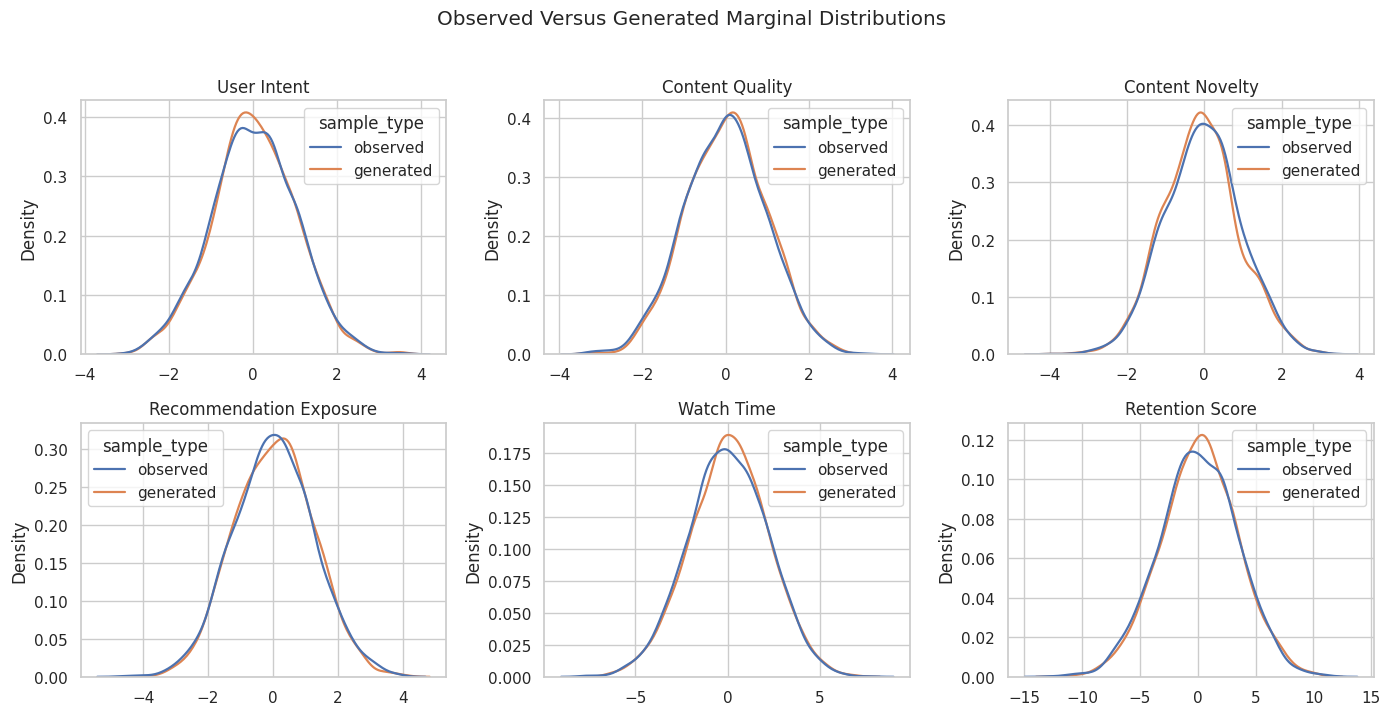
The generated distributions should broadly track the observed distributions. This is a generative-model check, not a causal identification guarantee.
For the broader lesson, the estimate should be interpreted together with the identifying assumptions and diagnostics that make it credible.
Evaluate the Fitted GCM
DoWhy’s evaluate_causal_model function can evaluate mechanism performance and overall generated-versus-observed divergence. To keep runtime modest, we evaluate on a fixed sample of the data and use three folds for mechanism evaluation.
evaluation_data = gcm_df.sample(900, random_state=1010).reset_index(drop=True)
evaluation_config = EvaluateCausalModelConfig(mechanism_evaluation_kfolds=3, n_jobs=1)
evaluation_result = gcm.evaluate_causal_model(
    structural_model,
    evaluation_data,
    evaluate_causal_mechanisms=True,
    compare_mechanism_baselines=False,
    evaluate_invertibility_assumptions=False,
    evaluate_overall_kl_divergence=True,
    evaluate_causal_structure=False,
    config=evaluation_config,
)
print(f"Overall average KL divergence: {evaluation_result.overall_kl_divergence:.4f}")
Overall average KL divergence: 0.0110The overall KL divergence is a compact generated-versus-observed distribution score. Smaller is better, but it should be read together with node-level mechanism performance.
That distinction is what makes the causal model useful because interventions propagate through linked mechanisms across the system.
Turn Mechanism Evaluation into a Table
The evaluation object stores metrics for each node. Root nodes have KL divergence for their marginal distributions. Non-root continuous nodes have metrics such as MSE, normalized MSE, R2, and CRPS.
mechanism_performance_rows = []
for node, performance in evaluation_result.mechanism_performances.items():
    mechanism_performance_rows.append(
        {
            "node": node,
            "is_root": performance.is_root,
            "kl_divergence": performance.kl_divergence,
            "mse": performance.mse,
            "nmse": performance.nmse,
            "r2": performance.r2,
            "crps": performance.crps,
        }
    )
mechanism_performance = pd.DataFrame(mechanism_performance_rows)
mechanism_performance.to_csv(TABLE_DIR / "10_mechanism_performance.csv", index=False)
display(mechanism_performance)| node | is_root | kl_divergence | mse | nmse | r2 | crps | |
|---|---|---|---|---|---|---|---|
| 0 | user_intent | True | 0.0726 | NaN | NaN | NaN | NaN |
| 1 | content_quality | True | 0.0608 | NaN | NaN | NaN | NaN |
| 2 | content_novelty | True | 0.1664 | NaN | NaN | NaN | NaN |
| 3 | recommendation_exposure | False | NaN | 0.6589 | 0.6651 | 0.5576 | 0.3836 |
| 4 | watch_time | False | NaN | 0.7345 | 0.3967 | 0.8426 | 0.2264 |
| 5 | retention_score | False | NaN | 0.9525 | 0.2872 | 0.9174 | 0.1635 |
The non-root mechanisms should have strong R2 values because the simulator uses clear parent relationships. If a child mechanism performs poorly, inspect its parent set and model family before trusting simulations from that node downstream.
Plot Non-Root Mechanism R2
The R2 plot focuses on conditional mechanisms. A root node has no parent mechanism to score with R2, so roots are excluded from this chart.
non_root_performance = mechanism_performance.loc[~mechanism_performance["is_root"]].copy()
fig, ax = plt.subplots(figsize=(9, 4.8))
sns.barplot(
    data=non_root_performance,
    x="r2",
    y="node",
    hue="node",
    dodge=False,
    legend=False,
    palette="Blues_r",
    ax=ax,
)
ax.set_xlim(0, 1)
ax.set_title("Conditional Mechanism Fit By Node")
ax.set_xlabel("Cross-validated R2")
ax.set_ylabel("")
plt.tight_layout()
fig.savefig(FIGURE_DIR / "10_mechanism_r2_by_node.png", dpi=160, bbox_inches="tight")
plt.show()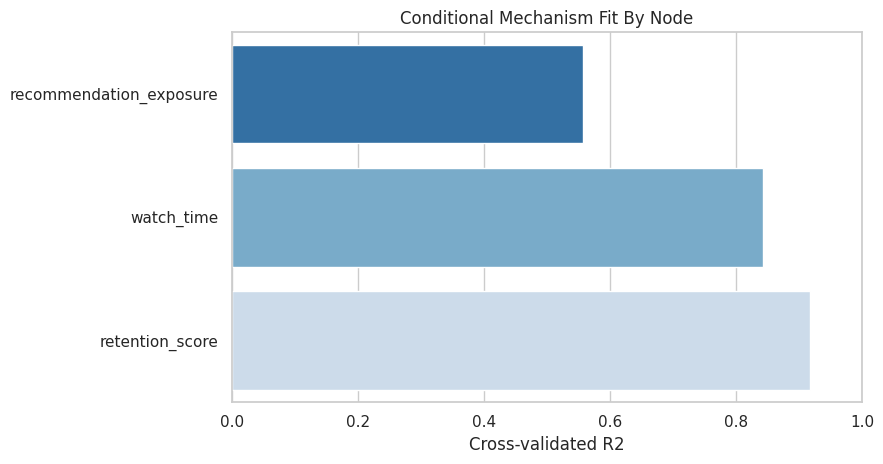
High R2 values indicate that the parents explain much of each child node’s conditional expectation. This supports the graph and mechanism choices in this controlled setting.
Inspect Direct Arrow Strength for Retention
The fitted GCM can estimate direct influence of each parent arrow into a target node. Here we inspect incoming arrows to retention_score. The largest direct influence should come from watch_time, because the simulator gives it the strongest direct coefficient.
retention_parents = list(structural_model.graph.predecessors("retention_score"))
retention_parent_samples = gcm_df[retention_parents]
np.random.seed(1011)
retention_arrow_strength = gcm.arrow_strength(
    structural_model,
    target_node="retention_score",
    parent_samples=retention_parent_samples,
    num_samples_conditional=300,
    max_num_runs=8,
    tolerance=0.05,
    n_jobs=1,
)
arrow_strength_table = pd.DataFrame(
    [
        {"parent": parent, "target": target, "arrow_strength": strength}
        for (parent, target), strength in retention_arrow_strength.items()
    ]
).sort_values("arrow_strength", ascending=False)
arrow_strength_table.to_csv(TABLE_DIR / "10_retention_arrow_strength.csv", index=False)
display(arrow_strength_table)| parent | target | arrow_strength | |
|---|---|---|---|
| 2 | watch_time | retention_score | 8.2261 |
| 1 | user_intent | retention_score | 0.1190 |
| 0 | content_quality | retention_score | 0.0267 |
The direct arrow from watch_time to retention_score should dominate. This aligns with the simulator and helps audit whether the fitted mechanism is using parents in a sensible way.
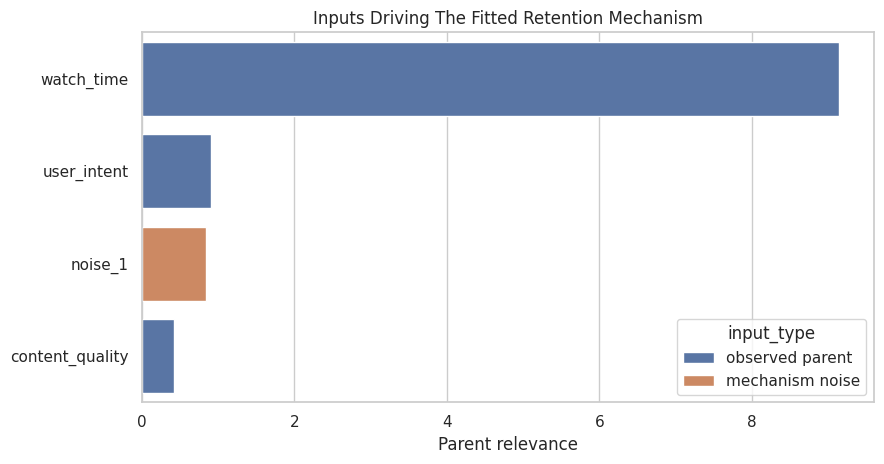
Parent Relevance for the Retention Mechanism
Parent relevance uses a Shapley-style idea to quantify how much each parent contributes to the target mechanism’s output distribution. It also reports a noise contribution, because GCM mechanisms include unobserved noise.
np.random.seed(1012)
parent_relevance_values, noise_relevance_values = gcm.parent_relevance(
    structural_model,
    target_node="retention_score",
    parent_samples=retention_parent_samples.sample(700, random_state=1012),
    num_samples_randomization=700,
    num_samples_baseline=120,
    max_batch_size=120,
)
parent_relevance_table = pd.DataFrame(
    [
        {"input": parent, "target": target, "relevance": relevance, "input_type": "observed parent"}
        for (parent, target), relevance in parent_relevance_values.items()
    ]
)
noise_relevance_table = pd.DataFrame(
    [
        {
            "input": f"noise_{idx}",
            "target": "retention_score",
            "relevance": value,
            "input_type": "mechanism noise",
        }
        for idx, value in enumerate(noise_relevance_values, start=1)
    ]
)
retention_relevance_table = pd.concat([parent_relevance_table, noise_relevance_table], ignore_index=True)
retention_relevance_table = retention_relevance_table.sort_values("relevance", ascending=False)
retention_relevance_table.to_csv(TABLE_DIR / "10_retention_parent_relevance.csv", index=False)
display(retention_relevance_table)| input | target | relevance | input_type | |
|---|---|---|---|---|
| 2 | watch_time | retention_score | 9.1453 | observed parent |
| 1 | user_intent | retention_score | 0.9053 | observed parent |
| 3 | noise_1 | retention_score | 0.8491 | mechanism noise |
| 0 | content_quality | retention_score | 0.4214 | observed parent |
The relevance table separates observed parent influence from residual noise. A large noise contribution can indicate either genuine randomness or missing parents in the graph.
Plot Retention Parent Relevance
The bar chart makes the relevance ranking easier to read. It helps explain the fitted retention mechanism.
fig, ax = plt.subplots(figsize=(9, 4.8))
sns.barplot(
    data=retention_relevance_table,
    x="relevance",
    y="input",
    hue="input_type",
    dodge=False,
    ax=ax,
)
ax.set_title("Inputs Driving The Fitted Retention Mechanism")
ax.set_xlabel("Parent relevance")
ax.set_ylabel("")
plt.tight_layout()
fig.savefig(FIGURE_DIR / "10_retention_parent_relevance.png", dpi=160, bbox_inches="tight")
plt.show()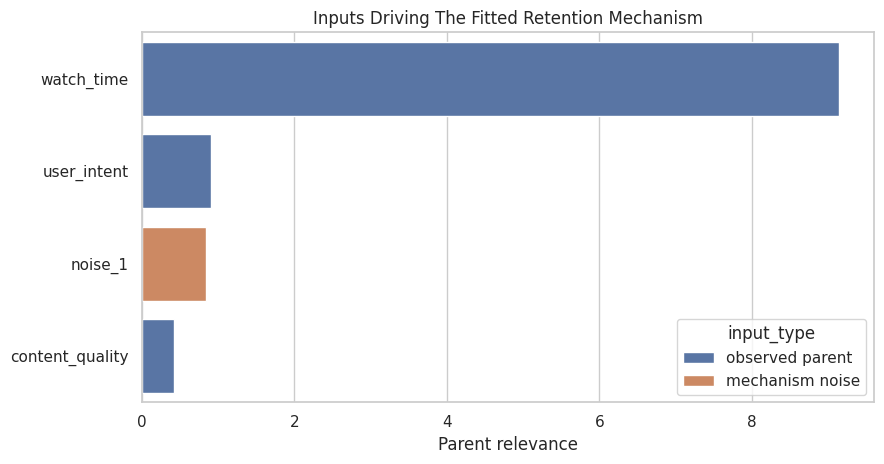
The ranking should place watch_time near the top. This matches the structural equation used to simulate retention.
The implication is design-specific: relevance can be diagnosed with data, while validity still depends on whether the instrument affects the outcome only through treatment.
Compare with a Misspecified Graph
A GCM can fit only the mechanisms implied by its graph. To show why this matters, we create a wrong graph that removes the edge watch_time -> retention_score. This forces the retention mechanism to predict retention without its most important parent.
MISSPECIFIED_EDGES = [edge for edge in GCM_EDGES if edge != ("watch_time", "retention_score")]
misspecified_graph = nx.DiGraph(MISSPECIFIED_EDGES)
misspecified_model = gcm.StructuralCausalModel(misspecified_graph)
missing_edge_table = pd.DataFrame(
    [
        {
            "removed_parent": "watch_time",
            "child": "retention_score",
            "reason_this_is_a_problem": "watch_time is the strongest direct driver of retention in the simulator",
        }
    ]
)
missing_edge_table.to_csv(TABLE_DIR / "10_misspecified_graph_removed_edge.csv", index=False)
display(missing_edge_table)| removed_parent | child | reason_this_is_a_problem | |
|---|---|---|---|
| 0 | watch_time | retention_score | watch_time is the strongest direct driver of retention in the simulator |
The wrong graph omits the most important retention parent. The next cells fit and evaluate it, then compare it with the correct graph.
Draw the Misspecified Graph
The visual makes the missing edge visible. The retention node still has parents, but it no longer receives watch_time as an input.
draw_directed_graph(
    MISSPECIFIED_EDGES,
    GCM_POSITIONS,
    "Misspecified GCM Graph: Missing Watch Time To Retention Edge",
    FIGURE_DIR / "10_misspecified_graph.png",
    node_colors=NODE_COLORS,
)
The graph is still acyclic and fit-able, but it encodes the wrong local mechanism for retention.
That distinction is what makes the causal model useful because interventions propagate through linked mechanisms across the system.
Fit and Evaluate the Misspecified GCM
We use the same auto-assignment and fitting workflow on the wrong graph. If the missing parent matters, the retention mechanism should fit much worse.
# Fit or evaluate the model objects used in the Fit And Evaluate The Misspecified GCM section.
auto.assign_causal_mechanisms(
    misspecified_model,
    gcm_df,
    quality=auto.AssignmentQuality.GOOD,
    override_models=True,
)
gcm.fit(misspecified_model, gcm_df)
misspecified_evaluation_result = gcm.evaluate_causal_model(
    misspecified_model,
    evaluation_data,
    evaluate_causal_mechanisms=True,
    compare_mechanism_baselines=False,
    evaluate_invertibility_assumptions=False,
    evaluate_overall_kl_divergence=True,
    evaluate_causal_structure=False,
    config=evaluation_config,
)
correct_retention_performance = evaluation_result.mechanism_performances["retention_score"]
wrong_retention_performance = misspecified_evaluation_result.mechanism_performances["retention_score"]
misspec_comparison = pd.DataFrame(
    [
        {
            "model": "correct graph",
            "retention_parents": ", ".join(structural_model.graph.predecessors("retention_score")),
            "retention_r2": correct_retention_performance.r2,
            "retention_nmse": correct_retention_performance.nmse,
            "retention_mse": correct_retention_performance.mse,
            "overall_kl_divergence": evaluation_result.overall_kl_divergence,
        },
        {
            "model": "misspecified graph",
            "retention_parents": ", ".join(misspecified_model.graph.predecessors("retention_score")),
            "retention_r2": wrong_retention_performance.r2,
            "retention_nmse": wrong_retention_performance.nmse,
            "retention_mse": wrong_retention_performance.mse,
            "overall_kl_divergence": misspecified_evaluation_result.overall_kl_divergence,
        },
    ]
)
misspec_comparison.to_csv(TABLE_DIR / "10_correct_vs_misspecified_gcm.csv", index=False)
display(misspec_comparison)| model | retention_parents | retention_r2 | retention_nmse | retention_mse | overall_kl_divergence | |
|---|---|---|---|---|---|---|
| 0 | correct graph | watch_time, user_intent, content_quality | 0.9174 | 0.2872 | 0.9525 | 0.0110 |
| 1 | misspecified graph | user_intent, content_quality | 0.6590 | 0.5835 | 3.9324 | 0.0243 |
The misspecified graph should have much weaker retention fit. This is the GCM version of a familiar causal lesson: if the graph omits a real parent, the downstream model quality suffers.
Plot Correct versus Misspecified Retention Fit
The plot compares retention R2 under the correct and misspecified graph. The missing watch_time parent should visibly reduce fit quality.
fig, ax = plt.subplots(figsize=(8, 4.8))
sns.barplot(
    data=misspec_comparison,
    x="retention_r2",
    y="model",
    hue="model",
    dodge=False,
    legend=False,
    palette=["#2563eb", "#ef4444"],
    ax=ax,
)
ax.set_xlim(0, 1)
ax.set_title("Retention Mechanism Fit Depends On The Parent Set")
ax.set_xlabel("Retention mechanism R2")
ax.set_ylabel("")
plt.tight_layout()
fig.savefig(FIGURE_DIR / "10_correct_vs_misspecified_retention_fit.png", dpi=160, bbox_inches="tight")
plt.show()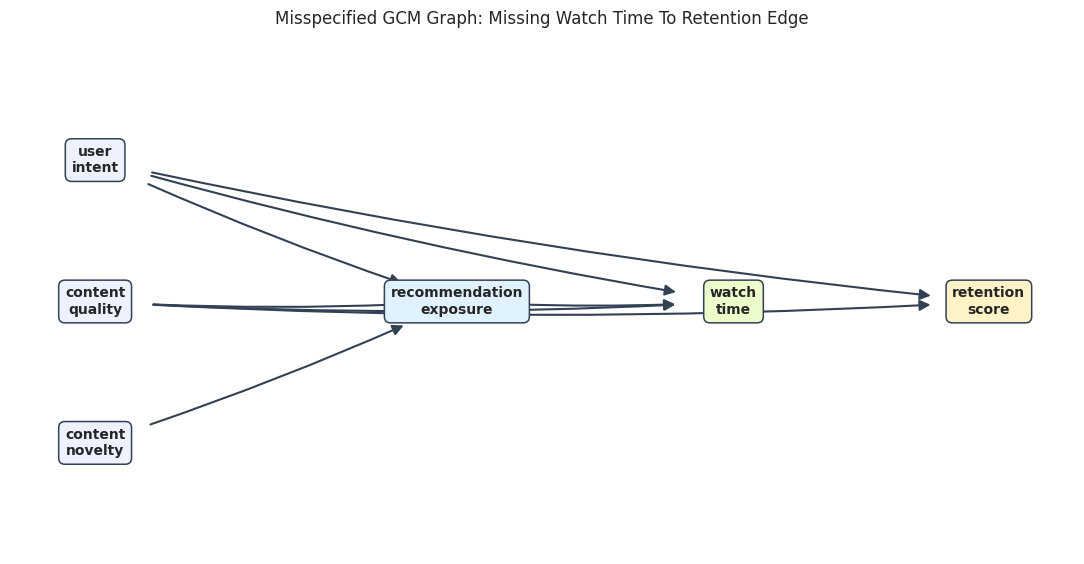
This chart connects graph structure to mechanism performance. A GCM is more than a flexible predictive model; its local predictors are constrained by the causal graph.
Reporting and Takeaways
Final GCM Summary
The final table summarizes what the lesson established: the fitted GCM can generate realistic samples, local mechanisms can be evaluated, and graph misspecification can degrade a specific mechanism.
final_gcm_summary = pd.DataFrame(
    [
        {
            "topic": "mechanism assignment",
            "result": f"{len(assigned_mechanisms)} mechanisms assigned",
            "causal reading": "each graph node has a fitted distribution or conditional mechanism",
        },
        {
            "topic": "generated samples",
            "result": f"{len(synthetic_samples):,} synthetic rows drawn",
            "causal reading": "the fitted GCM defines a joint generative process",
        },
        {
            "topic": "overall generated-data fit",
            "result": f"KL divergence {evaluation_result.overall_kl_divergence:.4f}",
            "causal reading": "generated marginals are close to observed marginals in this simulation",
        },
        {
            "topic": "retention parent influence",
            "result": f"top arrow: {arrow_strength_table.iloc[0]['parent']} -> retention_score",
            "causal reading": "the fitted mechanism identifies watch time as the dominant direct retention parent",
        },
        {
            "topic": "misspecified graph",
            "result": f"retention R2 drops from {misspec_comparison.loc[0, 'retention_r2']:.3f} to {misspec_comparison.loc[1, 'retention_r2']:.3f}",
            "causal reading": "removing a real parent damages the target mechanism",
        },
    ]
)
final_gcm_summary.to_csv(TABLE_DIR / "10_final_gcm_summary.csv", index=False)
display(final_gcm_summary)| topic | result | causal reading | |
|---|---|---|---|
| 0 | mechanism assignment | 6 mechanisms assigned | each graph node has a fitted distribution or conditional mechanism |
| 1 | generated samples | 2,400 synthetic rows drawn | the fitted GCM defines a joint generative process |
| 2 | overall generated-data fit | KL divergence 0.0110 | generated marginals are close to observed marginals in this simulation |
| 3 | retention parent influence | top arrow: watch_time -> retention_score | the fitted mechanism identifies watch time as the dominant direct retention parent |
| 4 | misspecified graph | retention R2 drops from 0.917 to 0.659 | removing a real parent damages the target mechanism |
The lesson shows the core GCM idea: a graph plus local mechanisms becomes a fitted data-generating system. The quality of that system depends on both the graph and the mechanism choices.
Practical Checklist for GCM Work
Use this checklist when moving from tutorial data to real data:
- Confirm that every node is measured before or after its parents in a plausible order.
- Decide whether each variable should be a root node or a child node.
- Inspect assigned mechanism types before fitting.
- Compare generated samples with observed data before using the model for what-if analysis.
- Evaluate local mechanisms, local mechanisms along with the final outcome node.
- Treat poor mechanism fit as a prompt to revisit the graph, the model class, or the measurement definition.
- Remember that good generated samples do not prove the graph is causal; they only support the fitted generative story.
Practice Prompts
Try these extensions after running the lesson:
- Add a direct edge from
recommendation_exposuretoretention_score. Does the retention mechanism improve or merely become more complex? - Increase the noise in
watch_time. How does the retention parent relevance change? - Change auto-assignment quality from
GOODtoBETTER. Which mechanisms change, and does evaluation improve? - Replace one root distribution with a different hand-picked mechanism. How do generated samples change?
- Write a short model card for the fitted GCM that documents graph assumptions, mechanism choices, and diagnostics.
What Comes Next
The sequence next uses fitted GCMs for interventions and counterfactuals. Once a GCM can be built, fit, sampled from, and evaluated, it becomes possible to ask what happens when a mechanism changes or a variable is set to a new value.
Summary
This lesson introduced graphical causal models as fitted data-generating systems. A graph plus local mechanisms can support sampling, mechanism evaluation, interventions, and counterfactual analysis. The quality of those tasks depends on both the graph and the local fits, so GCM work should report mechanism choices, generated-sample checks, and graph-sensitivity results together.