# Helper functions for this lecture. Docstrings state each helper's inputs, output, and causal role.
from pathlib import Path
import sys


def _find_project_root(start=Path.cwd()):
    """
    Locate the portfolio project root so shared notebook utilities can be imported.

    Idea:
        The notebooks may be executed from different working directories, so this helper walks upward until it finds the repository structure used by the lecture series.

    Args:
        start: Directory where the upward search for the project root begins.

    Returns:
        pathlib.Path: Absolute path to the portfolio project root.
    """

    for candidate in [start, *start.parents]:
        if (candidate / "notebooks" / "_shared").exists():
            return candidate
    return start


PROJECT_ROOT = _find_project_root()
if str(PROJECT_ROOT) not in sys.path:
    sys.path.insert(0, str(PROJECT_ROOT))

import warnings
warnings.filterwarnings("ignore")

import numpy as np
import pandas as pd
import matplotlib.pyplot as plt
import seaborn as sns
import statsmodels.formula.api as smf
from scipy import stats
from graphviz import Digraph
from IPython.display import display

sns.set_theme(style="whitegrid", context="notebook")
rng = np.random.default_rng(20260428)

COLORS = {
    "assignment": "#d7ecff",
    "outcome": "#ffd6db",
    "covariate": "#dff0d8",
    "warning": "#ffe0c2",
    "latent": "#e0e0e0",
    "neutral": "#f7f7f7",
}

from notebooks._shared.display import smart_display01. Randomized Experiments
Randomized experiments are the cleanest design we usually get in causal inference. They are not clean because the world becomes simple. They are clean because treatment assignment is controlled by the analyst or the system running the experiment.
That design choice changes the identification problem. In observational data, treated and untreated units may differ because of targeting, self-selection, budget rules, eligibility filters, or manager discretion. In a randomized experiment, treatment assignment is generated by a known random mechanism. If the experiment is implemented correctly, treatment is independent of the potential outcomes before treatment is assigned.
In this notebook we will study randomized experiments as a design that goes beyond a t-test. We will use simulations to see why randomization works, what difference-in-means estimates, why balance is expected but not guaranteed in any one run, how uncertainty arises, and why practical implementation details still matter.
The central idea is:
Randomization creates comparability before outcomes are observed.
That comparability is why simple estimators can have causal interpretations (Ding & Dasgupta, 2016; Athey & Imbens, 2017).
Learning Goals
By the end of this notebook, you should be able to:
- Define a randomized experiment in potential-outcomes language.
- Explain why the difference in means estimates an average treatment effect under random assignment.
- Distinguish design-based uncertainty from modeling uncertainty.
- Diagnose covariate balance without overreacting to random noise.
- Compare randomized assignment to targeted observational assignment.
- Use simulation to understand standard errors, confidence intervals, and randomization inference.
- Explain when blocking or stratified randomization improves precision.
- Build an experiment design card for an industry causal question.
# Helper functions for this lecture. Docstrings state each helper's inputs, output, and causal role.
def make_dag(edges, title=None, node_colors=None, rankdir="LR"):
    """
    Create a styled Graphviz causal or design diagram for the lecture.

    Idea:
        The diagram makes assumptions, assignment mechanisms, and diagnostic workflows visible before the code estimates an effect.

    Args:
        edges: Directed edges from source node to target node in the causal or design diagram.
        title: Title displayed on the Graphviz or Matplotlib figure.
        node_colors: Optional mapping from node labels to fill colors.
        rankdir: Graphviz layout direction, such as left-to-right or top-to-bottom.

    Returns:
        graphviz.Digraph: Renderable diagram object for display in the notebook.
    """
    node_colors = node_colors or {}
    dot = Digraph(format="svg")
    dot.attr(rankdir=rankdir, bgcolor="transparent", pad="0.15", nodesep="0.55", ranksep="0.65")
    dot.attr("node", shape="box", style="rounded,filled", color="#2b2b2b", fontname="Helvetica", fontsize="11", margin="0.12,0.08")
    dot.attr("edge", color="#404040", arrowsize="0.75", penwidth="1.6", fontname="Helvetica", fontsize="10")
    if title:
        dot.attr(label=title, labelloc="t", fontsize="14", fontname="Helvetica-Bold")
    nodes = sorted(set([node for edge in edges for node in edge[:2]]))
    for node in nodes:
        dot.node(node, fillcolor=node_colors.get(node, COLORS["neutral"]))
    for edge in edges:
        if len(edge) == 2:
            src, dst = edge
            attrs = {}
        else:
            src, dst, attrs = edge
        dot.edge(src, dst, **attrs)
    return dot


def difference_in_means(y, z):
    """Compute the treated-minus-control difference in sample means.

    Args:
        y: Outcome vector used in the comparison or adjustment.
        z: Assignment or instrument vector used to define comparison groups.

    Returns:
        float: Treated-minus-control mean difference.
    """
    y = np.asarray(y)
    z = np.asarray(z)
    return y[z == 1].mean() - y[z == 0].mean()


def two_sample_se(y, z):
    """Compute a classical two-sample standard error for a difference in means.

    Args:
        y: Outcome vector used in the comparison or adjustment.
        z: Assignment or instrument vector used to define comparison groups.

    Returns:
        float: Standard error for the two-sample mean difference.
    """
    y = np.asarray(y)
    z = np.asarray(z)
    y1 = y[z == 1]
    y0 = y[z == 0]
    return np.sqrt(y1.var(ddof=1) / len(y1) + y0.var(ddof=1) / len(y0))


def summarize_experiment(y, z, true_ate=None):
    """Summarize an experiment estimate, standard error, confidence interval, and benchmark truth.

    Args:
        y: Outcome vector used in the comparison or adjustment.
        z: Assignment or instrument vector used to define comparison groups.
        true_ate: Known average treatment effect used as the reference value.

    Returns:
        pandas.DataFrame or pandas.Series: Display-ready summary for the notebook narrative.
    """
    est = difference_in_means(y, z)
    se = two_sample_se(y, z)
    out = pd.DataFrame({
        "estimate": [est],
        "std_error": [se],
        "ci_lower": [est - 1.96 * se],
        "ci_upper": [est + 1.96 * se],
        "n_treated": [int(np.sum(z == 1))],
        "n_control": [int(np.sum(z == 0))],
    })
    if true_ate is not None:
        out["true_ate"] = true_ate
        out["estimation_error"] = est - true_ate
    return out
1. What Makes an Experiment Randomized?
A randomized experiment has a known treatment assignment mechanism. The analyst does not merely observe who received treatment; the analyst or platform assigns treatment according to a rule such as:
- 50% of eligible users receive the new feature;
- one unit in each matched pair receives the intervention;
- each store within a region is randomized to treatment or control;
- each user segment has its own fixed treatment allocation.
The key point is that assignment is unrelated to the users’ potential outcomes except through the randomization mechanism.
In potential-outcomes notation, for a binary treatment:
\[ Y_i(1) = \text{outcome unit } i \text{ would have under treatment}, \]
\[ Y_i(0) = \text{outcome unit } i \text{ would have under control}. \]
The observed outcome is:
\[ Y_i^{obs} = Z_i Y_i(1) + (1 - Z_i)Y_i(0), \]
where \(Z_i = 1\) if unit \(i\) is assigned to treatment and \(Z_i = 0\) otherwise.
In a completely randomized experiment with a fixed number treated, the assignment vector \(Z\) is randomly chosen from the possible assignments with the planned treatment count. That is the source of design-based uncertainty.
# Define the graph structure for the What Makes an Experiment Randomized? diagram.
randomized_edges = [
    ("Random number generator", "Treatment assignment"),
    ("Treatment assignment", "Observed outcome"),
    ("Pre-treatment covariates", "Potential outcomes"),
    ("Potential outcomes", "Observed outcome"),
]
randomized_colors = {
    "Random number generator": COLORS["assignment"],
    "Treatment assignment": COLORS["assignment"],
    "Observed outcome": COLORS["outcome"],
    "Pre-treatment covariates": COLORS["covariate"],
    "Potential outcomes": COLORS["neutral"],
}

smart_display(make_dag(randomized_edges, "Randomized experiment: assignment is generated by design", randomized_colors))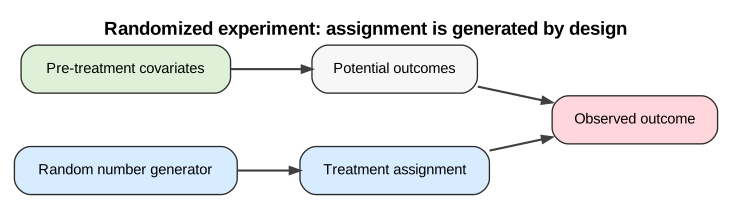
Reading the Graph
Pre-treatment covariates can still affect outcomes. High-intent users can still buy more. Experienced sellers can still perform better. Older accounts can still retain at higher rates.
Randomization does not remove outcome heterogeneity. It removes systematic treatment selection based on that heterogeneity. In expectation over the randomization, treatment and control groups are comparable before treatment is delivered.
2. A Synthetic Industry Population
We will work with a product experiment. A company is testing a new onboarding checklist. The outcome is a 30-day value score, such as retained revenue, activation value, or an internal composite metric.
The population has pre-treatment variables:
prior_usage: how active the user was before the experiment;account_age: account maturity;is_team_account: whether the account belongs to a team;segment: user segment.
The true treatment effect is heterogeneous. Newer and lower-usage accounts benefit more from the checklist. In a real experiment we would not know both potential outcomes, but in a simulation we can create them so that we know the truth.
Dataset and experiment setup. The synthetic population represents customers or accounts eligible for an experiment. Each unit has baseline covariates, a potential outcome under control, a potential outcome under treatment, and an observed outcome after random assignment. The treatment is assigned by design rather than by customer risk, sales priority, or analyst judgment. This is what makes the example a randomized experiment. The dataset still includes realistic heterogeneity, so balance is not guaranteed in every realized sample even though randomization makes treated and control groups comparable in expectation.
# Helper functions for this lecture. Docstrings state each helper's inputs, output, and causal role.
def create_experiment_population(n=20_000, seed=10):
    """Create the experiment population dataset or diagnostic object used in 01. Randomized Experiments.

    Args:
        n: Number of simulated units.
        seed: Random seed for reproducible simulation or resampling.

    Returns:
        pandas.DataFrame: Generated or modified dataset used in the next lecture section.
    """
    rng_local = np.random.default_rng(seed)
    segment = rng_local.choice(["new", "growing", "mature"], size=n, p=[0.35, 0.40, 0.25])
    prior_usage = rng_local.gamma(shape=2.0, scale=1.2, size=n)
    account_age = rng_local.exponential(scale=14, size=n)
    is_team_account = rng_local.binomial(1, 0.38, size=n)

    segment_baseline = pd.Series(segment).map({"new": -3.0, "growing": 1.5, "mature": 4.0}).to_numpy()
    y0 = (
        25
        + 4.8 * np.log1p(prior_usage)
        + 0.18 * account_age
        + 2.4 * is_team_account
        + segment_baseline
        + rng_local.normal(scale=6.0, size=n)
    )

    tau = (
        1.4
        + 2.2 * (segment == "new")
        + 0.9 * (segment == "growing")
        - 0.35 * np.log1p(prior_usage)
        + 0.5 * is_team_account
    )
    y1 = y0 + tau

    return pd.DataFrame({
        "unit_id": np.arange(n),
        "segment": segment,
        "prior_usage": prior_usage,
        "account_age": account_age,
        "is_team_account": is_team_account,
        "Y0": y0,
        "Y1": y1,
        "tau": tau,
    })

population = create_experiment_population()
true_ate = population["tau"].mean()
true_att_if_all_new = population.loc[population["segment"] == "new", "tau"].mean()

pd.DataFrame({
    "quantity": ["Finite-population ATE", "ATE among new accounts"],
    "value": [true_ate, true_att_if_all_new],
}).round(3)| quantity | value | |
|---|---|---|
| 0 | Finite-population ATE | 2.327 |
| 1 | ATE among new accounts | 3.397 |
In A Synthetic Industry Population, read the table together with assignment quality, metric definitions, uncertainty, and guardrails. Randomization helps the estimate; practical meaning still decides the launch.
# Build the A Synthetic Industry Population plot from the quantities computed above.
fig, axes = plt.subplots(1, 2, figsize=(12, 4))

sns.histplot(population["Y0"], bins=40, color="#6c757d", ax=axes[0])
axes[0].set_title("Control potential outcome distribution")
axes[0].set_xlabel("Y(0): 30-day value under control")

sns.boxplot(data=population, x="segment", y="tau", order=["new", "growing", "mature"], ax=axes[1], color="#d7ecff")
axes[1].axhline(true_ate, color="#b23a48", linestyle="--", label="Overall ATE")
axes[1].set_title("Treatment effects are heterogeneous")
axes[1].set_xlabel("Segment")
axes[1].set_ylabel("Individual treatment effect")
axes[1].legend()

plt.tight_layout()
plt.show()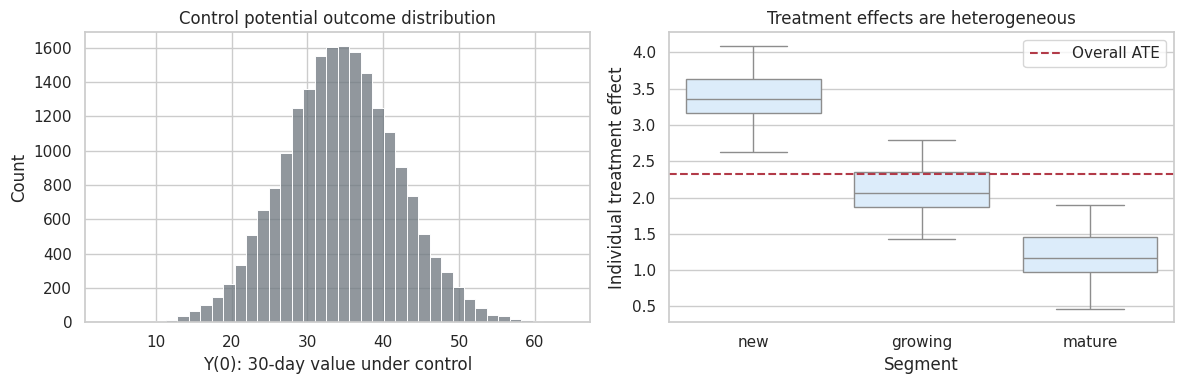
The synthetic population has heterogeneous baseline outcomes and heterogeneous treatment effects. This is realistic. Experiments do not require everyone to have the same treatment effect.
The finite-population average treatment effect is:
\[ \tau_{ATE} = \frac{1}{N}\sum_{i=1}^{N}\{Y_i(1)-Y_i(0)\}. \]
In the simulation, we can compute this because both potential outcomes are stored. In a real experiment, each unit reveals only one of them.
3. Complete Randomization and the Difference in Means
The standard estimator for a two-arm randomized experiment is the difference in observed means:
\[ \widehat{\tau} = \bar{Y}_{T}^{obs} - \bar{Y}_{C}^{obs}. \]
Under complete randomization, this estimator is unbiased for the finite-population ATE over repeated randomizations. That statement is design-based: the potential outcomes can be treated as fixed, and the randomness comes from which units are assigned to treatment.
# Helper functions for this lecture. Docstrings state each helper's inputs, output, and causal role.
def complete_random_assignment(n, treatment_fraction=0.5, seed=None):
    """Draw a complete random treatment assignment with a fixed treated share.

    Args:
        n: Number of simulated units.
        treatment_fraction: Share of units assigned to treatment.
        seed: Random seed used for reproducibility.

    Returns:
        numpy.ndarray: Binary treatment assignment vector with the requested treated share.
    """
    rng_local = np.random.default_rng(seed)
    n_treat = int(round(n * treatment_fraction))
    z = np.zeros(n, dtype=int)
    treated_idx = rng_local.choice(n, size=n_treat, replace=False)
    z[treated_idx] = 1
    return z

experiment = population.copy()
experiment["Z"] = complete_random_assignment(len(experiment), treatment_fraction=0.5, seed=101)
experiment["Y_obs"] = np.where(experiment["Z"] == 1, experiment["Y1"], experiment["Y0"])

summarize_experiment(experiment["Y_obs"], experiment["Z"], true_ate=true_ate).round(3)| estimate | std_error | ci_lower | ci_upper | n_treated | n_control | true_ate | estimation_error | |
|---|---|---|---|---|---|---|---|---|
| 0 | 2.422 | 0.104 | 2.218 | 2.627 | 10000 | 10000 | 2.327 | 0.095 |
Use this simulated result to anchor the section on Complete Randomization and the Difference in Means. It checks whether the experiment behaved like the design said it should. If assignment or baseline balance looks surprising, the problem is design credibility before it is metric interpretation.
fig, ax = plt.subplots(figsize=(8, 4))
sns.histplot(data=experiment, x="Y_obs", hue="Z", bins=40, common_norm=False, stat="density", alpha=0.45, ax=ax)
ax.set_title("Observed outcomes in one randomized experiment")
ax.set_xlabel("Observed 30-day value")
ax.legend(title="Assigned treatment", labels=["Treatment", "Control"])
plt.tight_layout()
plt.show()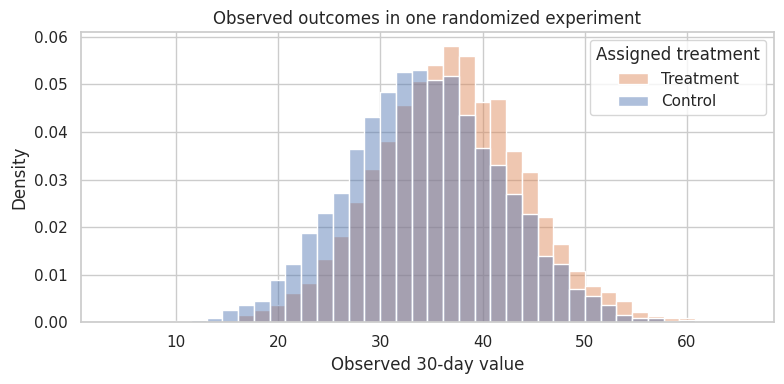
The estimate from one experiment is close to the true ATE, but not exactly equal. Randomization does not guarantee a perfect estimate in every run. It guarantees that the estimator is centered correctly over the randomization distribution.
This is the practical meaning of unbiasedness: if we could rerun the assignment many times on the same population, the average estimate would approach the finite-population ATE.
4. Repeated Randomization: Seeing Unbiasedness Directly
Because this is a simulation, we can repeatedly randomize the same fixed population and observe the distribution of estimates. In real life, we only get one assignment, but the logic of inference is built around the assignments that could have happened.
# Helper functions for this lecture. Docstrings state each helper's inputs, output, and causal role.
def repeated_randomization_estimates(population, n_sims=1_000, treatment_fraction=0.5, seed=202):
    """Repeatedly randomize treatment to show the sampling distribution of the estimator.

    Args:
        population: Population or target group named in the causal question.
        n_sims: Number of simulation repetitions.
        treatment_fraction: Share of units assigned to treatment.
        seed: Random seed used for reproducibility.

    Returns:
        pandas.DataFrame: Monte Carlo estimates from repeated random assignments.
    """
    rng_local = np.random.default_rng(seed)
    estimates = []
    n = len(population)
    for _ in range(n_sims):
        z = complete_random_assignment(n, treatment_fraction=treatment_fraction, seed=rng_local.integers(0, 2**32 - 1))
        y_obs = np.where(z == 1, population["Y1"], population["Y0"])
        estimates.append(difference_in_means(y_obs, z))
    return pd.Series(estimates, name="estimate")

rand_estimates = repeated_randomization_estimates(population, n_sims=1_000)

pd.DataFrame({
    "quantity": ["Average estimate over randomizations", "True finite-population ATE", "Monte Carlo bias", "Randomization SD"],
    "value": [rand_estimates.mean(), true_ate, rand_estimates.mean() - true_ate, rand_estimates.std()],
}).round(4)| quantity | value | |
|---|---|---|
| 0 | Average estimate over randomizations | 2.3222 |
| 1 | True finite-population ATE | 2.3273 |
| 2 | Monte Carlo bias | -0.0050 |
| 3 | Randomization SD | 0.1039 |
In Repeated Randomization: Seeing Unbiasedness Directly, the table is a design check. If assignment counts or baseline balance look surprising, pause before interpreting outcomes.
# Build the Repeated Randomization: Seeing Unbiasedness Directly plot from the quantities computed above.
fig, ax = plt.subplots(figsize=(9, 4.5))
sns.histplot(rand_estimates, bins=40, kde=True, color="#2f6f9f", ax=ax)
ax.axvline(true_ate, color="#b23a48", linestyle="--", linewidth=2, label=f"True ATE = {true_ate:.2f}")
ax.axvline(rand_estimates.mean(), color="#4f772d", linestyle=":", linewidth=2, label=f"Mean estimate = {rand_estimates.mean():.2f}")
ax.set_title("Randomization distribution of the difference-in-means estimator")
ax.set_xlabel("Estimated treatment effect")
ax.legend()
plt.tight_layout()
plt.show()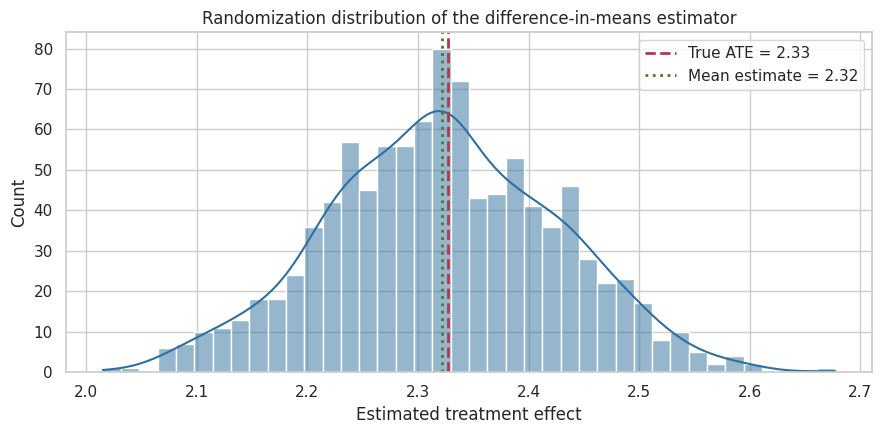
The distribution is centered near the true ATE. The spread is the uncertainty due to random assignment. A larger experiment would have a tighter distribution; a noisier outcome or more heterogeneous population would have a wider one.
This perspective is helpful in industry settings because it separates two ideas:
- The design makes the estimator target the causal effect.
- The sample size and outcome noise determine how precisely we estimate it.
5. Randomization Balance: Expected, Not Guaranteed
Randomization balances pre-treatment variables in expectation. It does not guarantee exact balance in a particular experiment.
A balance table compares treatment and control groups on variables measured before treatment. Large imbalances can happen by chance, especially in small experiments or many-segment experiments. Balance checks are diagnostics for implementation and chance imbalance; they should not become a ritual that invalidates every experiment with a noisy p-value.
# Helper functions for this lecture. Docstrings state each helper's inputs, output, and causal role.
def balance_table(df, z_col, covariates):
    """
    Summarize covariate balance between treatment groups or weighted pseudo-populations.

    Idea:
        Balance tables check whether an experiment or adjustment strategy made treated and comparison units look similar on pre-treatment variables.

    Args:
        df: DataFrame containing the treatment, outcome, cluster, or covariate columns needed by the helper.
        z_col: Column containing randomized assignment or treatment status.
        covariates: Pre-treatment covariate columns evaluated for balance or adjustment.

    Returns:
        pandas.DataFrame: Covariate means, differences, and standardized balance diagnostics.
    """
    rows = []
    z = df[z_col].to_numpy()
    for cov in covariates:
        x = df[cov].to_numpy()
        treated = x[z == 1]
        control = x[z == 0]
        pooled_sd = np.sqrt((treated.var(ddof=1) + control.var(ddof=1)) / 2)
        rows.append({
            "covariate": cov,
            "treated_mean": treated.mean(),
            "control_mean": control.mean(),
            "difference": treated.mean() - control.mean(),
            "standardized_difference": (treated.mean() - control.mean()) / pooled_sd,
        })
    return pd.DataFrame(rows)

covariates = ["prior_usage", "account_age", "is_team_account"]
bal = balance_table(experiment, "Z", covariates)
bal.round(3)| covariate | treated_mean | control_mean | difference | standardized_difference | |
|---|---|---|---|---|---|
| 0 | prior_usage | 2.400 | 2.382 | 0.019 | 0.011 |
| 1 | account_age | 14.063 | 14.289 | -0.226 | -0.016 |
| 2 | is_team_account | 0.379 | 0.387 | -0.008 | -0.017 |
In Randomization Balance: Expected, Not Guaranteed, the table is a design check. Unexpected assignment or balance patterns are design problems first and metric problems second.
# Build the Randomization Balance: Expected, Not Guaranteed plot from the quantities computed above.
fig, ax = plt.subplots(figsize=(8, 3.5))
sns.barplot(data=bal, y="covariate", x="standardized_difference", color="#2f6f9f", ax=ax)
ax.axvline(0, color="black", linewidth=1)
ax.axvline(0.1, color="#b23a48", linestyle="--", linewidth=1)
ax.axvline(-0.1, color="#b23a48", linestyle="--", linewidth=1)
ax.set_title("Standardized balance differences in one experiment")
ax.set_xlabel("Treated mean minus control mean, in pooled SD units")
ax.set_ylabel("")
plt.tight_layout()
plt.show()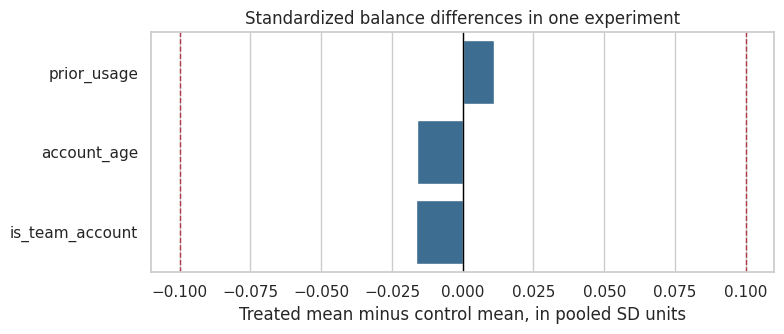
The standardized differences are small in this run. That is reassuring, but the deeper reason we trust the experiment is not the balance table. The deeper reason is the assignment mechanism.
Balance checks are still useful because they can catch implementation failures. If a supposedly 50/50 experiment has enormous pre-treatment imbalance in geography, device, or account type, the problem may be a broken randomization key, eligibility bug, logging issue, or sample-ratio mismatch.
6. Randomization Versus Targeted Assignment
To appreciate randomization, compare it to targeted assignment. Suppose the company gives the checklist only to accounts that look likely to grow. That is not a randomized experiment. It is an observational policy.
The treatment group will have better outcomes partly because the checklist helps and partly because the targeted accounts were already stronger.
# Assemble the Randomization Versus Targeted Assignment summary table used for interpretation.
targeted = population.copy()
score = 0.9 * np.log1p(targeted["prior_usage"]) + 0.05 * targeted["account_age"] + 0.6 * targeted["is_team_account"]
threshold = np.quantile(score, 0.50)
targeted["Z"] = (score >= threshold).astype(int)
targeted["Y_obs"] = np.where(targeted["Z"] == 1, targeted["Y1"], targeted["Y0"])

randomized_summary = summarize_experiment(experiment["Y_obs"], experiment["Z"], true_ate=true_ate).assign(design="Randomized")
targeted_summary = summarize_experiment(targeted["Y_obs"], targeted["Z"], true_ate=true_ate).assign(design="Targeted observational assignment")
comparison = pd.concat([randomized_summary, targeted_summary], ignore_index=True)
comparison[["design", "estimate", "std_error", "true_ate", "estimation_error"]].round(3)| design | estimate | std_error | true_ate | estimation_error | |
|---|---|---|---|---|---|
| 0 | Randomized | 2.422 | 0.104 | 2.327 | 0.095 |
| 1 | Targeted observational assignment | 7.636 | 0.097 | 2.327 | 5.309 |
In Randomization Versus Targeted Assignment, the table is a design check. Outcome interpretation comes after the assignment table looks consistent with the design.
# Build the Randomization Versus Targeted Assignment plot from the quantities computed above.
fig, axes = plt.subplots(1, 2, figsize=(12, 4))

sns.kdeplot(data=experiment, x="prior_usage", hue="Z", fill=True, common_norm=False, alpha=0.35, ax=axes[0])
axes[0].set_title("Randomized: prior usage is balanced")
axes[0].set_xlabel("Prior usage")
axes[0].legend(title="Treatment", labels=["Treatment", "Control"])

sns.kdeplot(data=targeted, x="prior_usage", hue="Z", fill=True, common_norm=False, alpha=0.35, ax=axes[1])
axes[1].set_title("Targeted: prior usage differs sharply")
axes[1].set_xlabel("Prior usage")
axes[1].legend(title="Treatment", labels=["Treatment", "Control"])

plt.tight_layout()
plt.show()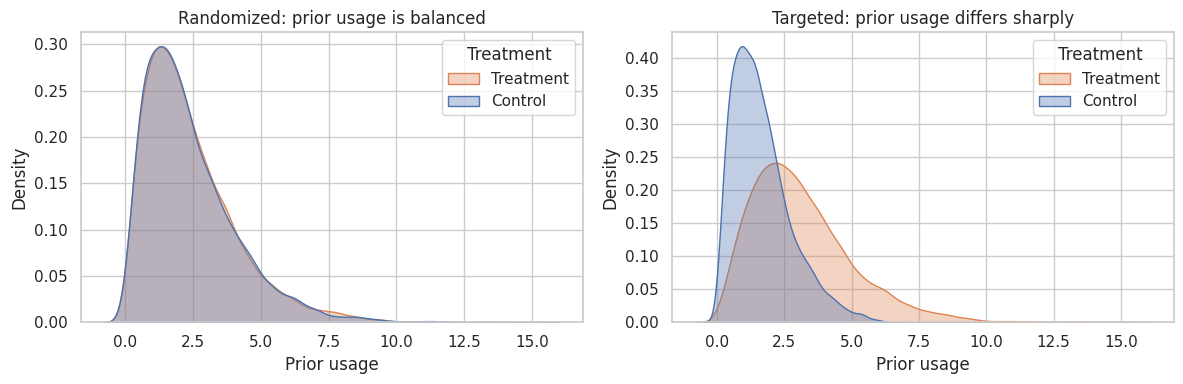
The targeted assignment estimate is not estimating the same thing as the randomized experiment. It combines the treatment effect with the fact that treated accounts were selected because they already looked different.
This is why randomized experiments are so valuable in industry. They turn a decision that would otherwise be confounded by targeting logic into a credible causal comparison.
7. Standard Errors and Confidence Intervals
For a two-arm experiment, a common large-sample standard error for the difference in means is:
\[ SE(\widehat{\tau}) = \sqrt{\frac{s_T^2}{n_T} + \frac{s_C^2}{n_C}}, \]
where \(s_T^2\) and \(s_C^2\) are the sample variances in treatment and control.
A simple approximate 95% confidence interval is:
\[ \widehat{\tau} \pm 1.96 \times SE(\widehat{\tau}). \]
This interval is not magic. It is an approximation. Later notebooks will cover power, multiple testing, clustered experiments, and guardrail metrics. For now, the point is to connect the design to the simplest readout.
readout = summarize_experiment(experiment["Y_obs"], experiment["Z"], true_ate=true_ate)
readout.round(3)| estimate | std_error | ci_lower | ci_upper | n_treated | n_control | true_ate | estimation_error | |
|---|---|---|---|---|---|---|---|---|
| 0 | 2.422 | 0.104 | 2.218 | 2.627 | 10000 | 10000 | 2.327 | 0.095 |
This result supports the section on Standard Errors and Confidence Intervals. It should be read together with assignment quality, metric definitions, uncertainty, and guardrails. Randomization gives the estimate credibility, but the decision still depends on practical meaning.
# Build the Standard Errors and Confidence Intervals plot from the quantities computed above.
fig, ax = plt.subplots(figsize=(8, 3.5))
est = readout.loc[0, "estimate"]
lo = readout.loc[0, "ci_lower"]
hi = readout.loc[0, "ci_upper"]
ax.errorbar(est, 0, xerr=[[est - lo], [hi - est]], fmt="o", color="#2f6f9f", capsize=5, markersize=7)
ax.axvline(0, color="black", linewidth=1)
ax.axvline(true_ate, color="#b23a48", linestyle="--", label="True ATE in simulation")
ax.set_yticks([0])
ax.set_yticklabels(["Experiment estimate"])
ax.set_xlabel("Treatment effect estimate")
ax.set_title("Difference in means with approximate 95% CI")
ax.legend()
plt.tight_layout()
plt.show()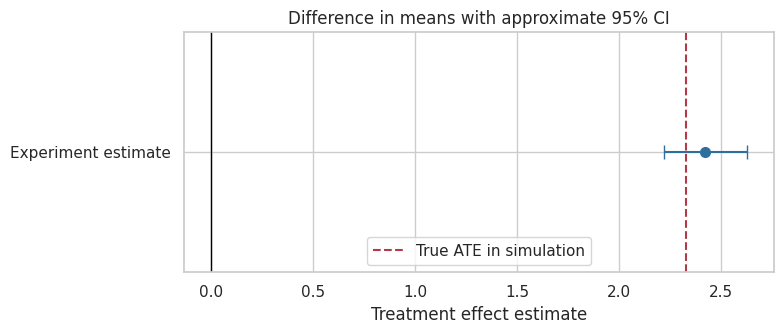
A confidence interval communicates uncertainty around the estimate. It should be read with the business context:
- Is the interval entirely above zero?
- Is it above the minimum effect needed to justify launch?
- Does it include practically trivial effects?
- Are guardrail metrics acceptable?
- Was the experiment implemented correctly?
A statistically significant effect can still be too small to matter. A practically meaningful effect can be estimated too imprecisely to support a confident launch decision.
8. Randomization Inference: Testing a Sharp Null
Randomization inference asks: if treatment assignment had no effect for any unit, how surprising is the observed difference under the randomization mechanism?
The sharp null hypothesis is:
\[ H_0: Y_i(1) = Y_i(0) \quad \text{for every unit } i. \]
Under that null, every unit’s observed outcome would be the same no matter which treatment assignment had occurred. We can repeatedly reshuffle the treatment labels according to the experimental design and compare the observed statistic to the null distribution.
This idea is closely linked to Fisherian randomization tests and is a foundational design-based approach to inference in randomized experiments (Ding & Dasgupta, 2016; Athey & Imbens, 2017).
# Helper functions for this lecture. Docstrings state each helper's inputs, output, and causal role.
def randomization_test(y_obs, z_obs, n_permutations=2_000, seed=303):
    """Run a permutation-style randomization test under a sharp null.

    Args:
        y_obs: Observed outcome vector for randomization inference.
        z_obs: Observed assignment vector for randomization inference.
        n_permutations: Number of random reassignments.
        seed: Random seed used for reproducibility.

    Returns:
        pandas.Series: Observed statistic, randomization p-value, and null distribution summary.
    """
    rng_local = np.random.default_rng(seed)
    y_obs = np.asarray(y_obs)
    z_obs = np.asarray(z_obs)
    n_treat = int(z_obs.sum())
    observed_stat = difference_in_means(y_obs, z_obs)
    null_stats = np.empty(n_permutations)
    n = len(z_obs)
    for b in range(n_permutations):
        z_perm = np.zeros(n, dtype=int)
        z_perm[rng_local.choice(n, size=n_treat, replace=False)] = 1
        null_stats[b] = difference_in_means(y_obs, z_perm)
    p_value = np.mean(np.abs(null_stats) >= abs(observed_stat))
    return observed_stat, null_stats, p_value

observed_stat, null_stats, ri_p = randomization_test(experiment["Y_obs"], experiment["Z"], n_permutations=2_000)

pd.DataFrame({
    "quantity": ["Observed difference in means", "Randomization-test p-value"],
    "value": [observed_stat, ri_p],
}).round(4)| quantity | value | |
|---|---|---|
| 0 | Observed difference in means | 2.4222 |
| 1 | Randomization-test p-value | 0.0000 |
In Randomization Inference: Testing a Sharp Null, the table is a design check. A clean outcome readout starts with a clean assignment and balance check.
# Build the Randomization Inference: Testing a Sharp Null plot from the quantities computed above.
fig, ax = plt.subplots(figsize=(9, 4.5))
sns.histplot(null_stats, bins=45, color="#6c757d", ax=ax)
ax.axvline(observed_stat, color="#b23a48", linewidth=2, label="Observed statistic")
ax.axvline(-observed_stat, color="#b23a48", linewidth=2, linestyle="--", label="Symmetric cutoff")
ax.set_title("Randomization-test null distribution under no individual effects")
ax.set_xlabel("Difference in means after reshuffling treatment labels")
ax.legend()
plt.tight_layout()
plt.show()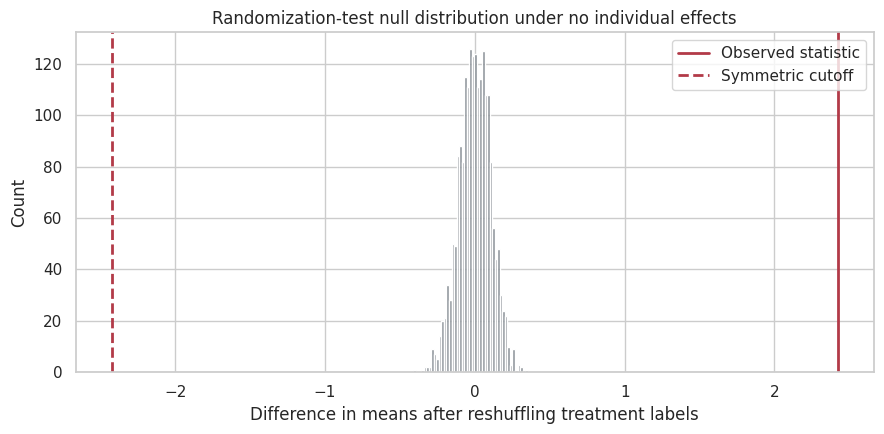
The randomization test uses the assignment mechanism directly. It does not require a model for the outcome. It asks whether the observed treatment-control difference is extreme relative to the differences we would see from random labels if treatment had no effect for anyone.
In large online experiments, normal approximations are often convenient. Randomization inference is still conceptually useful because it reminds us that inference comes from the design.
9. Regression Adjustment in Experiments
Because treatment is randomized, the unadjusted difference in means already has a causal interpretation. Regression adjustment is not needed to remove confounding created by treatment assignment.
So why adjust?
- To improve precision using strong pre-treatment outcome predictors.
- To account for chance imbalance in a transparent way.
- To estimate segment-specific effects or interactions.
But regression adjustment should use pre-treatment covariates and should not quietly change the estimand by conditioning on post-treatment variables. Athey and Imbens (2017) emphasize the distinction between analyses justified by randomization and analyses that rely more heavily on modeling choices.
# Assemble the Regression Adjustment in Experiments summary table used for interpretation.
reg_models = {
    "Difference in means / treatment only": smf.ols("Y_obs ~ Z", data=experiment).fit(cov_type="HC1"),
    "Adjusted for pre-treatment covariates": smf.ols("Y_obs ~ Z + np.log1p(prior_usage) + account_age + is_team_account + C(segment)", data=experiment).fit(cov_type="HC1"),
    "Interactions for heterogeneous effects": smf.ols("Y_obs ~ Z * C(segment) + np.log1p(prior_usage) + account_age + is_team_account", data=experiment).fit(cov_type="HC1"),
}

reg_table = pd.DataFrame({
    "model": list(reg_models.keys()),
    "coef_on_Z": [m.params.get("Z", np.nan) for m in reg_models.values()],
    "std_error": [m.bse.get("Z", np.nan) for m in reg_models.values()],
    "r_squared": [m.rsquared for m in reg_models.values()],
})
reg_table.round(3)| model | coef_on_Z | std_error | r_squared | |
|---|---|---|---|---|
| 0 | Difference in means / treatment only | 2.422 | 0.104 | 0.026 |
| 1 | Adjusted for pre-treatment covariates | 2.430 | 0.086 | 0.346 |
| 2 | Interactions for heterogeneous effects | 2.334 | 0.135 | 0.350 |
In Regression Adjustment in Experiments, the regression output is a precision check rather than a substitute for the randomized design. Read it alongside assignment quality, metric definitions, uncertainty, and guardrails.
# Prepare the diagnostic display and label the design features that matter for interpretation.
plot_df = reg_table.iloc[:2].copy()
plot_df["lower"] = plot_df["coef_on_Z"] - 1.96 * plot_df["std_error"]
plot_df["upper"] = plot_df["coef_on_Z"] + 1.96 * plot_df["std_error"]

fig, ax = plt.subplots(figsize=(9, 3.8))
ax.errorbar(
    plot_df["coef_on_Z"],
    plot_df["model"],
    xerr=[plot_df["coef_on_Z"] - plot_df["lower"], plot_df["upper"] - plot_df["coef_on_Z"]],
    fmt="o",
    color="#2f6f9f",
    capsize=4,
)
ax.axvline(true_ate, color="#b23a48", linestyle="--", label="True ATE")
ax.axvline(0, color="black", linewidth=1)
ax.set_title("Regression adjustment can improve precision")
ax.set_xlabel("Coefficient on treatment assignment")
ax.set_ylabel("")
ax.legend()
plt.tight_layout()
plt.show()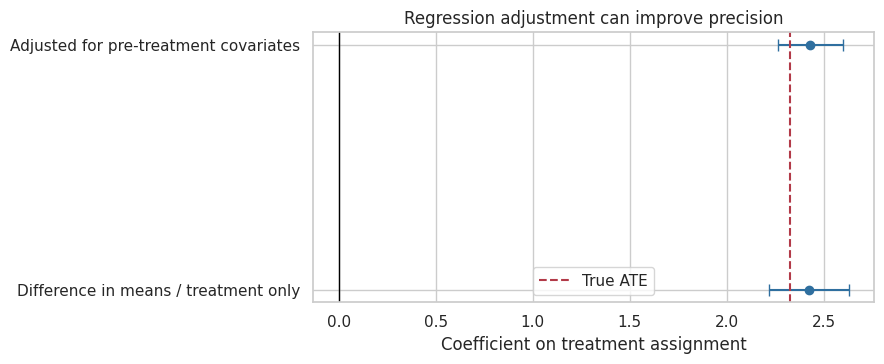
Both the unadjusted and adjusted treatment coefficients target the experiment’s average effect. The adjusted model often has a smaller standard error because baseline variables explain some outcome variation.
The important guardrail: use variables measured before treatment. If we adjust for post-treatment activation, clicks, retention, or usage, we may change the estimand from total effect to a controlled/direct-effect-style quantity.
10. Heterogeneous Effects and Segment Readouts
Randomized experiments estimate the average effect for the randomized population. But decision-makers often ask whether the effect differs across segments.
Segment analysis can be useful, but it must be handled carefully:
- Segments should ideally be pre-specified.
- Smaller segments have wider uncertainty.
- Many subgroup tests create multiple-comparison problems.
- Segment-specific estimates should be interpreted as evidence, not as automatic launch rules.
We can estimate segment effects by comparing treatment and control within each segment.
# Assemble the Heterogeneous Effects and Segment Readouts summary table used for interpretation.
segment_rows = []
for segment, g in experiment.groupby("segment"):
    est = difference_in_means(g["Y_obs"], g["Z"])
    se = two_sample_se(g["Y_obs"], g["Z"])
    true_seg_ate = g["tau"].mean()
    segment_rows.append({
        "segment": segment,
        "estimate": est,
        "std_error": se,
        "ci_lower": est - 1.96 * se,
        "ci_upper": est + 1.96 * se,
        "true_segment_ate": true_seg_ate,
        "n": len(g),
    })

segment_effects = pd.DataFrame(segment_rows).sort_values("true_segment_ate", ascending=False)
segment_effects.round(3)| segment | estimate | std_error | ci_lower | ci_upper | true_segment_ate | n | |
|---|---|---|---|---|---|---|---|
| 2 | new | 3.449 | 0.168 | 3.120 | 3.778 | 3.397 | 6961 |
| 0 | growing | 2.255 | 0.156 | 1.949 | 2.561 | 2.106 | 7958 |
| 1 | mature | 1.167 | 0.196 | 0.783 | 1.551 | 1.208 | 5081 |
In Heterogeneous Effects and Segment Readouts, read the table together with assignment quality, metric definitions, uncertainty, and guardrails. The randomized estimate is the evidence base, and the launch decision also needs magnitude and guardrails.
# Prepare the diagnostic display and label the design features that matter for interpretation.
fig, ax = plt.subplots(figsize=(8, 4))
ax.errorbar(
    segment_effects["estimate"],
    segment_effects["segment"],
    xerr=[segment_effects["estimate"] - segment_effects["ci_lower"], segment_effects["ci_upper"] - segment_effects["estimate"]],
    fmt="o",
    color="#2f6f9f",
    capsize=4,
    label="Estimated segment effect",
)
ax.scatter(segment_effects["true_segment_ate"], segment_effects["segment"], color="#b23a48", marker="x", s=80, label="True segment ATE")
ax.axvline(0, color="black", linewidth=1)
ax.set_title("Segment-level treatment effects")
ax.set_xlabel("Treatment effect")
ax.set_ylabel("Segment")
ax.legend()
plt.tight_layout()
plt.show()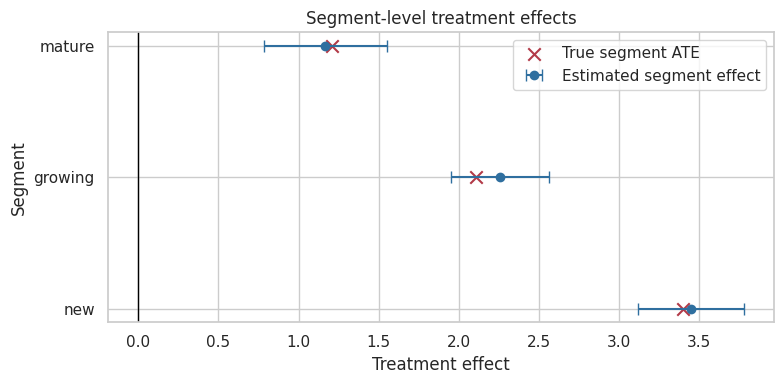
The segment estimates recover the broad pattern: new accounts benefit more than mature accounts. But segment-level uncertainty is larger than the overall estimate because each segment uses fewer observations.
This is a preview of later causal machine learning lectures. Heterogeneous treatment effects are powerful, but they need honest validation and careful decision rules.
11. Blocking and Stratified Randomization
Blocking, also called stratified randomization, randomizes within meaningful groups. For example, instead of randomizing all users at once, we randomize 50/50 within each segment.
Why do this?
- It guarantees treatment-control balance on important discrete variables.
- It can improve precision when the blocking variable is strongly related to the outcome.
- It makes readouts easier for operational stakeholders.
The estimand is still the overall effect for the randomized population, but the design reduces accidental imbalance across important strata.
# Helper functions for this lecture. Docstrings state each helper's inputs, output, and causal role.
def stratified_assignment(df, strata_col, treatment_fraction=0.5, seed=None):
    """Assign treatment separately within strata to preserve planned balance.

    Args:
        df: Analysis DataFrame used by the helper.
        strata_col: Column defining strata for blocked assignment.
        treatment_fraction: Share of units assigned to treatment.
        seed: Random seed used for reproducibility.

    Returns:
        pandas.Series: Binary treatment assignment aligned to the input rows.
    """
    rng_local = np.random.default_rng(seed)
    z = np.zeros(len(df), dtype=int)
    for _, idx in df.groupby(strata_col).groups.items():
        idx = np.array(list(idx))
        n_treat = int(round(len(idx) * treatment_fraction))
        treated = rng_local.choice(idx, size=n_treat, replace=False)
        z[treated] = 1
    return z

blocked_experiment = population.copy()
blocked_experiment["Z"] = stratified_assignment(blocked_experiment, "segment", treatment_fraction=0.5, seed=404)
blocked_experiment["Y_obs"] = np.where(blocked_experiment["Z"] == 1, blocked_experiment["Y1"], blocked_experiment["Y0"])

pd.concat([
    summarize_experiment(experiment["Y_obs"], experiment["Z"], true_ate=true_ate).assign(design="Complete randomization"),
    summarize_experiment(blocked_experiment["Y_obs"], blocked_experiment["Z"], true_ate=true_ate).assign(design="Blocked by segment"),
], ignore_index=True)[["design", "estimate", "std_error", "true_ate", "estimation_error"]].round(3)| design | estimate | std_error | true_ate | estimation_error | |
|---|---|---|---|---|---|
| 0 | Complete randomization | 2.422 | 0.104 | 2.327 | 0.095 |
| 1 | Blocked by segment | 2.463 | 0.104 | 2.327 | 0.135 |
In Blocking and Stratified Randomization, the table is a design check. If assignment counts or baseline balance look surprising, pause before interpreting outcomes.
# Helper functions for this lecture. Docstrings state each helper's inputs, output, and causal role.
def compare_design_precision(population, n_sims=600, seed=505):
    """Compare estimator precision under simple and stratified randomization.

    Args:
        population: Population or target group named in the causal question.
        n_sims: Number of simulation repetitions.
        seed: Random seed used for reproducibility.

    Returns:
        pandas.DataFrame: Precision summaries for simple and stratified assignment.
    """
    rng_local = np.random.default_rng(seed)
    rows = []
    for b in range(n_sims):
        seed_b = int(rng_local.integers(0, 2**32 - 1))
        z_complete = complete_random_assignment(len(population), 0.5, seed=seed_b)
        y_complete = np.where(z_complete == 1, population["Y1"], population["Y0"])
        rows.append({"design": "Complete", "estimate": difference_in_means(y_complete, z_complete)})

        z_block = stratified_assignment(population, "segment", 0.5, seed=seed_b)
        y_block = np.where(z_block == 1, population["Y1"], population["Y0"])
        rows.append({"design": "Blocked by segment", "estimate": difference_in_means(y_block, z_block)})
    return pd.DataFrame(rows)

design_precision = compare_design_precision(population)

design_precision_summary = design_precision.groupby("design").agg(
    mean_estimate=("estimate", "mean"),
    sd_estimate=("estimate", "std"),
).reset_index()
design_precision_summary["true_ate"] = true_ate
design_precision_summary.round(4)| design | mean_estimate | sd_estimate | true_ate | |
|---|---|---|---|---|
| 0 | Blocked by segment | 2.3290 | 0.0964 | 2.3273 |
| 1 | Complete | 2.3152 | 0.1069 | 2.3273 |
In Blocking and Stratified Randomization, the table is a design check. Unexpected assignment or balance patterns are design problems first and metric problems second.
# Build the Blocking and Stratified Randomization plot from the quantities computed above.
fig, ax = plt.subplots(figsize=(9, 4.5))
sns.kdeplot(data=design_precision, x="estimate", hue="design", fill=True, common_norm=False, alpha=0.25, ax=ax)
ax.axvline(true_ate, color="#b23a48", linestyle="--", linewidth=2, label="True ATE")
ax.set_title("Blocking can tighten the randomization distribution")
ax.set_xlabel("Estimated treatment effect across simulated assignments")
ax.legend(title="Design")
plt.tight_layout()
plt.show()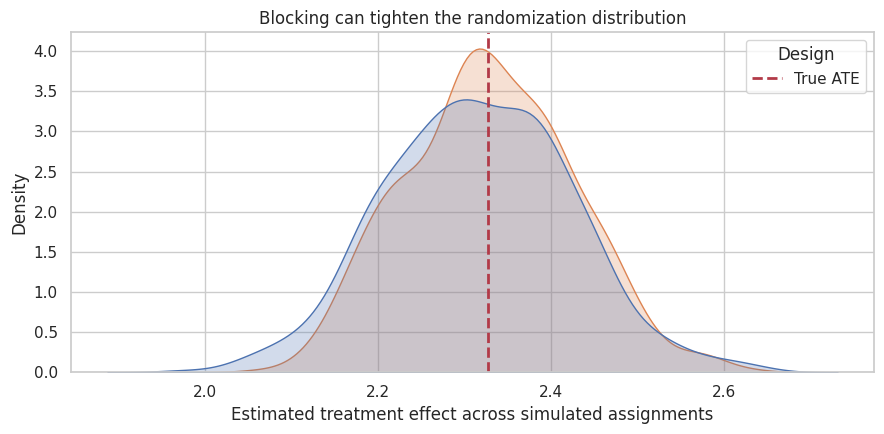
Both designs are centered near the true ATE. Blocking can reduce variance when the blocking variable explains outcome differences. It is a design-stage way to improve precision without relying on a model after the fact.
In industry experiments, common blocking variables include country, platform, market, account type, risk tier, seller size, store region, or pre-experiment activity band.
12. What Can Still Go Wrong?
Randomization is powerful, but it is not a spell. The design can be undermined by implementation and measurement problems.
Common issues:
- Sample-ratio mismatch: assigned treatment counts differ from planned counts.
- Noncompliance: users do not receive or use the treatment assigned to them.
- Attrition: outcomes are missing in ways affected by treatment.
- Interference: one user’s treatment affects another user’s outcome.
- Logging bugs: treatment exposure, assignment, or outcome is recorded incorrectly.
- Peeking and stopping: the experiment is stopped based on interim noisy results without a valid sequential design.
- Multiple testing: many metrics or segments are searched until something looks significant.
These do not make experiments useless. They tell us what to monitor.
| risk | symptom | diagnostic_or_response |
|---|---|---|
| Sample-ratio mismatch | Treatment/control counts do not match planned allocation | SRM test; inspect randomization and eligibility logic |
| Noncompliance | Assignment differs from actual exposure or usage | Report ITT; consider TOT/LATE in later notebook |
| Attrition / missing outcomes | Outcome availability differs by treatment | Compare missingness rates; sensitivity analysis |
| Interference | Control units are affected by treated units | Cluster or network design; measure spillovers |
| Logging bug | Assignment, exposure, or outcome fields disagree | A/A tests; event audits; invariant metrics |
| Peeking / early stopping | Decision is made after repeatedly checking noisy results | Use pre-specified sequential design or fixed horizon |
| Multiple testing | Many metrics or subgroups searched without correction | Pre-register primary metric; adjust or label exploratory |
13. Experiment Design Card
Before running an experiment, write a one-page design card. This is not bureaucracy; it protects the causal interpretation.
A useful design card includes:
| Field | Question |
|---|---|
| Business decision | What decision will this experiment inform? |
| Unit of randomization | User, account, session, store, market, seller, or cluster? |
| Treatment | What exactly changes for treated units? |
| Control | What exactly happens for control units? |
| Eligibility | Who can enter the experiment? |
| Primary outcome | What metric answers the decision question? |
| Guardrails | What metrics must not degrade? |
| Assignment probability | What fraction is treated? Is it equal across strata? |
| Duration | When does the experiment start and stop? |
| Estimand | ITT effect of assignment, effect of treatment received, or another contrast? |
| Analysis plan | Difference in means, regression adjustment, stratified estimator, cluster-robust SE? |
| Known threats | Interference, noncompliance, attrition, novelty effects, logging risk? |
This card also makes your portfolio stronger: it shows industry readers that you think like someone who can run credible experiments, not merely analyze CSV files after the fact.
| field | example_for_onboarding_checklist |
|---|---|
| Business decision | Launch checklist to all eligible new accounts? |
| Unit of randomization | Account |
| Treatment | New onboarding checklist shown after signup |
| Control | Current onboarding experience |
| Eligibility | New accounts created during experiment window |
| Primary outcome | 30-day retained value per account |
| Guardrails | Support tickets, refund rate, page latency |
| Assignment probability | 50% treatment, blocked by segment and platform |
| Duration | Run until fixed sample size or pre-specified date |
| Estimand | Intent-to-treat effect of assignment to checklist |
| Analysis plan | Difference in means plus pre-specified covariate-adjusted readout |
| Known threats | Cross-account spillovers, logging, missing 30-day outcomes |
14. Key Takeaways
- Randomization makes treatment assignment independent of potential outcomes by design.
- The difference in means is a causal estimator in a correctly implemented randomized experiment.
- Balance is expected over repeated randomizations, not guaranteed in every single run.
- The standard error describes uncertainty from finite sample size and outcome variation.
- Randomization inference uses the assignment mechanism directly.
- Regression adjustment can improve precision, but the causal identification comes from the design.
- Blocking can improve precision and operational trust when important strata are known before assignment.
- Experiments can still fail through implementation problems: noncompliance, attrition, interference, logging bugs, peeking, and multiple testing.
The next notebooks will build on this foundation: A/B testing in product systems, power and minimum detectable effects, guardrail metrics, clustered experiments, noncompliance, and interference.
References
Athey, S., & Imbens, G. W. (2017). The econometrics of randomized experiments. Handbook of Economic Field Experiments, 73-140. https://doi.org/10.1016/bs.hefe.2016.10.003
Ding, P., & Dasgupta, T. (2016). A potential tale of two-by-two tables from completely randomized experiments. Journal of the American Statistical Association, 111(513), 157-168. https://doi.org/10.1080/01621459.2014.995796
Kohavi, R., Henne, R. M., & Sommerfield, D. (2007). Practical guide to controlled experiments on the web. Proceedings of the 13th ACM SIGKDD International Conference on Knowledge Discovery and Data Mining, 959-967. https://doi.org/10.1145/1281192.1281295
Kohavi, R., Longbotham, R., Sommerfield, D., & Henne, R. M. (2009). Controlled experiments on the web: Survey and practical guide. Data Mining and Knowledge Discovery, 18(1), 140-181. https://doi.org/10.1007/s10618-008-0114-1
Rubin, D. B. (1974). Estimating causal effects of treatments in randomized and nonrandomized studies. Journal of Educational Psychology, 66(5), 688-701. https://doi.org/10.1037/h0037350
West, S. G. (2009). Alternatives to randomized experiments. Current Directions in Psychological Science, 18(5), 299-304. https://doi.org/10.1111/j.1467-8721.2009.01656.x